
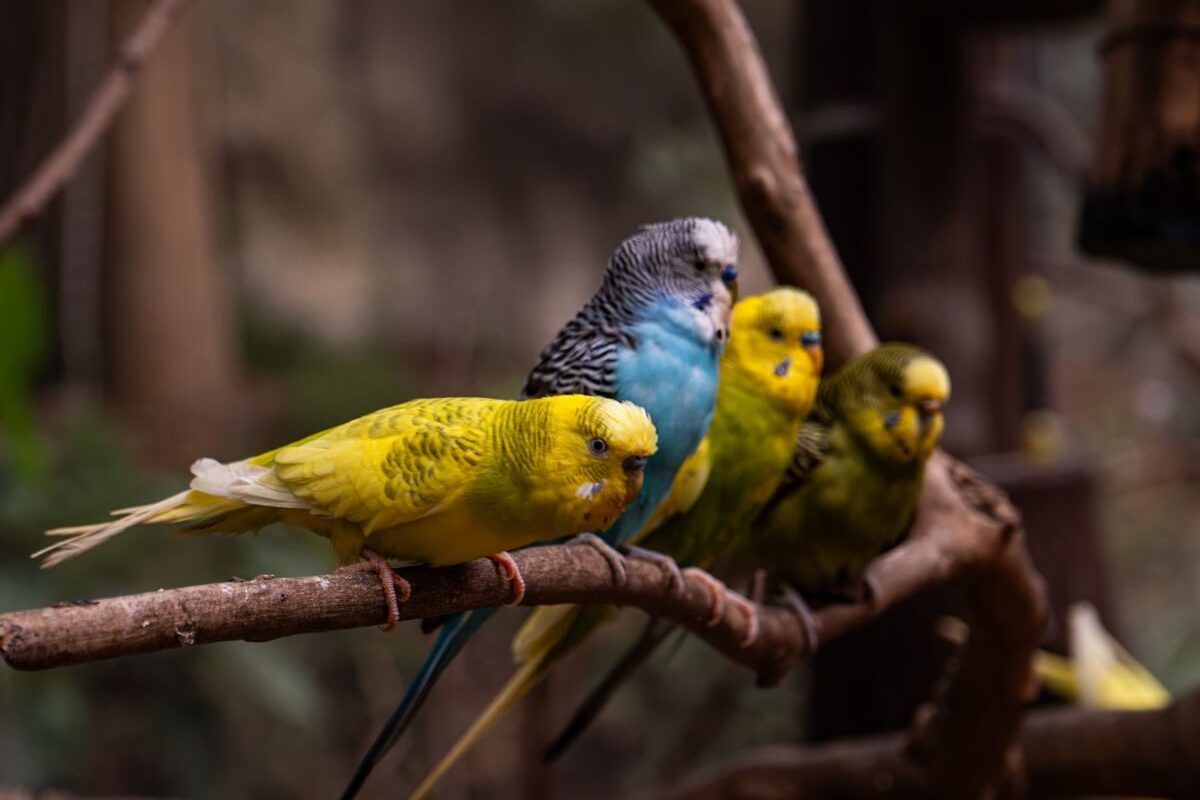
In the early days, biting is most likely fear: a new, untrusting bird and a too-fast approach are at the top of the list. Budgies usually warn first — eye pinning, beak opening or clicking, lunging, hissing, flattened or fluffed feathers and leaning away.
Most budgies bite because something has pushed them past what they can cope with: fear in a new or untamed bird, a hand invading cage territory, hormonal protectiveness, overstimulation during handling, or pain. A bite is communication, not bad character, and it almost always comes after warning signs that are easy to miss if no one has shown you what to look for.
You offered a finger and got a sharp nip. What helps is working out which kind of bite you got, changing the set-up that produced it, and rebuilding contact so the bird can choose it.
If you are new to budgies entirely, start alongside this guide with our overview of keeping pet birds day to day. A budgie that bites is still a budgie that can become tame. It is telling you the current pace is wrong, not that the relationship is over.
At a Glance
- In the early days, biting is most likely fear. Omlet’s budgie guide and Lafeber’s biting guidance both put a new, untrusting bird and a too-fast approach at the top of the list.
- Budgies usually warn first: eye pinning, beak opening or clicking, lunging, hissing, flattened or fluffed feathers and leaning away. Lafeber’s first rule is to learn to read the bird and not get bitten in the first place.
- Cage territory, hormones, jealousy and overstimulation are separate causes with separate fixes. Treating them all as disobedience makes every one worse.
- Never punish a bite. No shouting, spraying, flicking or cage-shaking. Behaviour sources agree punishment and dramatic reactions create fear or reward the bite with attention.
- A sudden change — a tame bird that starts biting hard, with fluffed posture, poor eating or quietness — needs an avian vet to rule out pain or illness.
Contents
- Why does my budgie bite when I try to handle it?
- The warning signs that come before a bite
- Cause and fix: why does my budgie bite in this situation?
- How to stop biting, step by step
- What not to do when your budgie bites
- When biting means see a vet
- Frequently Asked Questions
- Sources and Further Reading
Why does my budgie bite when I try to handle it?

Start with the bird’s view. A budgie is a prey animal, and a hand coming fast from above looks like a predator. If the bird is new, untamed, or has been grabbed before, biting is its last tool after freezing, fleeing and warning have failed.
Lafeber’s behaviour page makes the wider parrot point clearly: birds bite more in captivity because their boundaries are being pushed too far, every bird has a threshold before it lashes out, and fear biting is a named, expected category. Its rule number one is prevention: learn to read your bird so you can step back before the bite happens, because a bird that bites usually gets what it wanted — you go away — and a big fuss from you can be rewarding in itself.
Omlet’s budgie-specific guide says the same in budgie terms. In the early days a bite is most likely due to fear, you are probably moving too fast, and the budgie still sees your hand as a potential threat. That covers most new-owner bites. The other causes below explain bites that appear later, in a bird that was tame, or in specific places such as at the cage door.
Not every beak on skin is a bite. Budgies explore with their beaks and steady themselves when stepping up. A true bite is fast, hard, often repeated, and paired with tense body language.
If your bird is still settling in, the taming sequence in our starter guide to budgie care and taming basics is the pace to follow: presence, treats through the bars, hand still in the doorway, step-up only when the bird chooses it. Skipping stages is how fear bites are made.
The warning signs that come before a bite

Budgies rarely bite without advertising it first. The advertisement is just fast and small. Lafeber lists the parrot signals to learn: eye pinning, where the pupil dilates in and out in a heightened state, beak clicking as a warning to stay away, and hissing or growling when a bird feels cornered. Budgie-specific guides add the rest:
- Open beak, lunging or beak snapping toward the hand, sometimes with a hiss or screech. The clearest back-off signal. Stop.
- Feathers held tight and flat, body leaning away, or fluffed up with a tense, crouched posture. Flat and leaning away is trying to escape; fluffed and forward is defensive.
- Tail fanning or sharp tail flicks, wings held slightly out, and rapid head movements. A bird working itself up, not inviting contact.
- Freezing completely still. Easy to misread as calm. In a prey animal, freezing is fear, and a hand that keeps coming is likely to be bitten.
- Repeated beak opening and closing without eating, paired with fixed staring at your hand.
When you see these, withdraw slowly and let the moment end. You have taught the bird its warnings work, so it needs the bite less. Owners who push through train the bird to skip warnings and bite hard first.
Reading the relaxed end matters too. Our guide to the signs a budgie is happy and settled covers beak grinding, relaxed fluffing, singing and playful bobbing, so you can time handling for moments your bird is actually in the mood for it.
Cause and fix: why does my budgie bite in this situation?

| Cause | What it looks like | Gentle fix to try first |
|---|---|---|
| Fear / untamed, new home | Bites when a hand approaches or grabs; bird flees, freezes or panics first | Stop handling. Sit nearby, talk calmly, treats through the bars; advance only when the last step is relaxed |
| Too fast, too much handling | Nip after a long session, or when hands keep coming back after warnings | Shorten sessions, watch for warnings, end on a calm moment with a treat |
| Cage territorial | Fine out of the cage, bites hands that reach inside, guards door, toys or food dish | Let the bird come out to a perch or hand at the door on its own; clean and change food when it is out |
| Hormonal / breeding condition | Seasonal nippy, possessive bird; guards a corner, toy or person | Keep light under 12 hours, remove nest-like boxes, do not stroke down the back, increase sleep, keep handling brief |
| Overstimulation / excitement | Bites during noisy, fast play; eye pinning, tail fanning, hyper chatter first | Pause the game, lower energy and noise, return the bird to a perch to settle |
| Jealousy / bonded-bird bite | Bites when someone else gets attention, or a favoured person arrives or leaves | Socialise calmly with other household members using treats; do not let a jealous bird sit on a shoulder |
| Beak exploration mistaken for biting | Gentle nibbling, mouthing a finger while stepping up, no tense posture | Do not react as if bitten. Offer a toy or treat to mouth instead, reward calm stepping up |
| Pain or illness | Sudden biting in a previously gentle bird, with fluffing, poor eating, changed droppings or quietness | Stop training and book an avian vet promptly |
Territorial biting has a classic pattern. Omlet notes birds often defend cage space after finger-training, linked to coming and going entirely on their own terms, and suggests bringing the bird out on your finger and returning it the same way. The choice-based version works best for most pets: offer a hand or perch at the open door and let the bird step out because it wants to.
Hormonal biting follows the light. Lafeber notes longer spring days can prompt breeding mode and territorial behaviour, and reducing light to less than 12 hours can help — the same fix it gives for egg-laying triggers, alongside removing nest sites. A budgie guarding a corner or dish as a nest needs those triggers removed, not more handling.
Adding a second bird does not fix fear or territory, and can add jealousy. If you are still at the choosing stage, our comparison of the best first pet bird for different levels of handling helps match expectations, and our complete cockatiel starter guide shows how the same trust lessons apply to a larger cousin.
How to stop biting, step by step

Step 1: Keep a three-day note. Time, place, who handled the bird, what happened just before, and what the bird did first. Fear at the cage door, hormones in spring and overstimulation at noisy play look identical in memory and completely different on paper.
Step 2: Reset to the last relaxed step. If stepping up produced the bite, go back to treats through the bars. Progress is measured in the bird’s behaviour, not your calendar. Lafeber’s advice for an adopted biting bird applies: give it weeks or months to settle if needed, sit by the cage with hands out of sight, talk to it, and move slowly.
Step 3: Make hands predict good things. Millet or a favourite seed, in small amounts, delivered by hand and nowhere else for a while. Let the bird come to the treat. Never chase it around the cage, and never grab to start a session. Birds do not like being grabbed, Lafeber notes, because that is what a predator does.
Step 4: Practise step-up as a game. Practise short perch-to-hand step-ups in a calm room, rewarded each time, with fun stops so pick-ups do not always mean being put away. Lafeber calls that counteractive biting: biting when returned because the bird does not want to be locked in.
Step 5: Fix the background. Keep 10 to 12 hours of quiet sleep, light under 12 hours if hormones are driving the biting, rotate toys, and offer foraging. Many nippy birds improve on sleep and enrichment alone.
Step 6: If a bite still lands, do almost nothing. Stay calm, do not shout or jerk away, set the bird down on a perch if safe, and end the session quietly. Then change the set-up so that exact moment does not repeat tomorrow. The learning is in prevention, not in a reaction after the beak has landed.
What not to do when your budgie bites

Never punish a budgie for biting. That rule holds across every reputable behaviour source checked, and the reasons are practical. Shouting, spraying with water, flicking the beak, tapping the cage or shutting the bird away in anger either frightens a prey animal, giving it more to bite about next time, or gives a dramatic response which Lafeber warns can be attractive to a bird and reinforce the behaviour.
Do not push a hand at a warning bird to teach it who is in charge — there is no dominance lesson here, only a trust lesson, and it runs the other way. Do not let children keep trying to hold a biting bird, or hand it to a visitor to socialise it. And do not stop all contact: a budgie left alone becomes more fearful and territorial. The answer is slower contact the bird can choose.
When biting means see a vet

Most biting is behavioural. Some is medical, and the marker is sudden change. Book an avian vet promptly if a previously gentle budgie starts biting hard, or biting comes with eating less, fluffed quietness, changed droppings, discharge, breathing effort, a drooping wing, or loss of grip. Lafeber includes molting, illness and injury among reasons a bird may bite, and a bird in pain has a low threshold for touch. Do not train through a suspected medical change.
This article is educational information only and is not a substitute for advice from an avian veterinarian. If your budgie’s biting is sudden, it is biting with signs of illness, or it has injured itself or you badly, contact an avian vet promptly.
Frequently Asked Questions
Why does my budgie bite me but not other people?
It usually means the bird has a different history with you: you do the cleaning, the catching for vet trips, or the handling it likes least — or it has bonded to you and bites from jealousy when attention shifts. Lafeber describes jealousy biting in bonded parrots, and Omlet gives the budgie fix: have other household members socialise calmly with the bird too, with treats.
Why does my budgie lunge at me through the bars?
Usually territorial or frustrated behaviour at its boundary. Do not poke fingers through the bars. Work on chosen door-threshold step-ups and give out-of-cage time.
How long does it take to stop a budgie biting?
A bird biting from a rushed first week may settle in days once handling slows down. A bird with months of fear or territorial habit behind it may need weeks to months, and Lafeber is explicit that some older, untamed birds may never fully trust hands. Measure a bird that warns less, approaches more, and steps up by choice.
Should I wear gloves to handle a biting budgie?
Not for routine taming: gloves look unfamiliar and teach trust in gloves, not you. A towel is for vet-supervised restraint or medicine, as PetMD notes.
My budgie nibbles gently. Is that biting?
Probably not. Gentle mouthing with a relaxed body is normal beak use. Offer a toy to mouth if it gets firm.
What should I do in the moment when my budgie bites?
Stay calm and do not pull away sharply, shout, or punish — all of those teach the bird that biting works or that hands are scary. Hold still, wait for the bird to release, then calmly put it down and end the session. Afterwards, think about what came before the bite: the warning signs and the trigger are the lesson, not the bite itself.
Can hormones make a budgie bite more?
Yes. Hormonal budgies — often in spring, or with long daylight hours, nest boxes or dark hiding spots — become territorial and nippy, especially around the cage. Shorten daylight to 10 to 12 hours, remove nest-like spots, and avoid stroking the back and belly, which stimulates hormones. If biting is sudden and severe, a vet check rules out pain first.
How do I rebuild trust after a biting phase?
Go back to basics: sit near the cage talking softly, offer millet through the bars, then from an open hand, and let the bird step up on its own terms. Keep sessions short and end on a calm note. Trust rebuilds in days to weeks with patience, and every bite-free session makes the next one easier — consistency matters more than speed.
Sources and Further Reading
- Lafeber Pet Birds — Pet Bird and Parrot Behavior: birds bite more in captivity when boundaries are pushed; Rule #1 is not to get bitten, learn to read the bird; fear, hormonal and jealousy biting, light under 12 hours, molting/illness irritability, counteractive put-away biting; eye pinning, beak clicking and hissing as warnings. https://lafeber.com/pet-birds/bird-behavior/
- Lafeber Pet Birds — Biting Q&A (adopted cockatiel): new bird needs weeks or months to settle, do not handle yet, sit by cage with hands out of sight, move slowly, prey animals do not like being grabbed. https://lafeber.com/pet-birds/questions/biting-8/
- Omlet — Budgie Behaviour Problems, Biting: early days most likely fear and moving too fast; territorial cage defence; bonded bird may bite from jealousy, fix is wider socialising. https://www.omlet.co.uk/guide/budgies/budgie_behaviour/problems/
- PetMD — Budgie Care Sheet: approach parent-raised birds cautiously to reduce stress, towel can protect handler and bird for medication handling. https://www.petmd.com/bird/budgie-care-sheet
About the author
Furrology Team — pet owner and researcher behind Furrology. We read the veterinary research and draw on real owner experience, then turn it into plain-English guides about dogs, cats, birds and small pets. We are not vets — Furrology is researched information, not veterinary advice, and a poorly pet always needs a real vet. More about how we work: About Us · Editorial Policy