
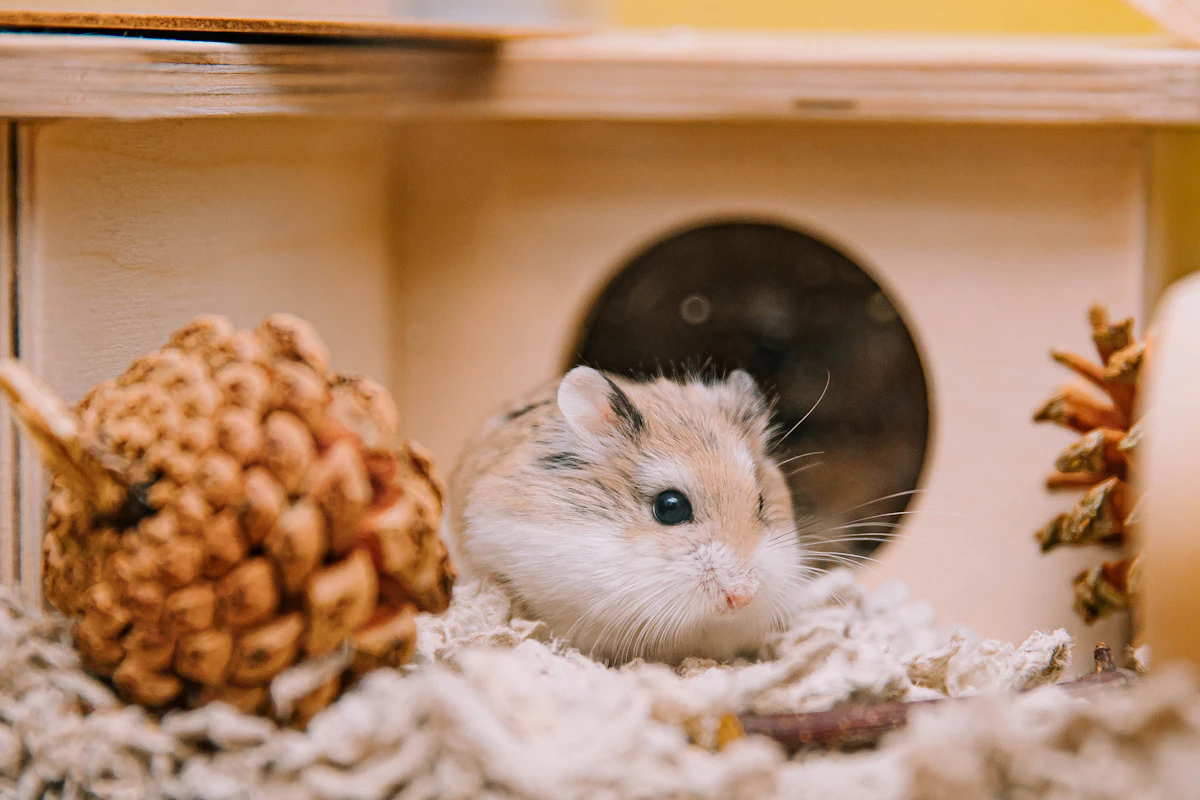
The true dwarfs kept as pets are Roborovski, Campbell’s and Winter White hamsters — the Syrian hamster is a separate, larger species, not a dwarf. Lifespan is short: roughly 1.5 to 2 years for Campbell’s and Winter Whites, with Roborovskis often living up to about 3 years.
Good dwarf hamster care comes down to space, quiet and patience: a large floor-level enclosure with deep bedding, a solid wheel of at least 8 inches (20 cm), a species-appropriate seed-based diet, a sand bath, and gentle evening handling – for a pet who will usually live about 1.5 to 2 years, with Roborovskis often reaching 3.
Can a pet who fits in the palm of your hand really need a home almost a metre long? Yes – and that single surprise explains most of dwarf hamster care. The tiny cages sold in bright boxes are the biggest reason new owners struggle. Get the home right first, and feeding, handling and health all become easier.
Dwarf hamsters are fast, mostly nocturnal, and built to run, burrow and forage. They are wonderful to watch, and some learn to enjoy handling, but they are not miniature cuddly toys. This guide covers what they actually need, species by species.
You will find dwarfs alongside rabbits, ferrets and other pets in our small pets hub, but their care is very much their own: solitary or carefully paired housing, deep bedding, and a room that stays steady and calm.
At a Glance
- The true dwarfs kept as pets are Roborovski, Campbell’s and Winter White hamsters. The Syrian hamster is a separate, larger species – it is not a dwarf.
- Lifespan is short: roughly 1.5–2 years for Campbell’s and Winter Whites, with Roborovskis often living up to about 3 years.
- Cage guidance disagrees between countries and sources – UK charities now point to 100 × 50 cm, while some US guidance lists much smaller minimums. Go as large as you can; exceeding the minimum is the point.
- Wheel: solid surface, at least 8 inches (20 cm) across for dwarfs, so the back stays flat.
- Keep the room around 18–24°C, offer unscented sand (not dust) for bathing, and handle only when your hamster is awake in the evening.
Contents
- Which hamsters count as dwarfs?
- Dwarf hamster care at a glance: housing
- Food and water
- Handling a very small, very fast pet
- Temperature, sleep and sand baths
- Health checks and lifespan
- Frequently Asked Questions
- Sources and Further Reading
Which hamsters count as dwarfs?

Three species make up most pet dwarf hamsters, and knowing which one you have changes your expectations for handling and lifespan.
Roborovski hamsters are the smallest and fastest, at roughly 4–5 cm as adults. They are fascinating to watch and often the least keen on being held. Many Roborovskis live in carefully monitored same-sex pairs or groups from the same litter, but fights can still happen, so a spare enclosure is a sensible backup.
Campbell’s hamsters are rounder and a little larger. They and Winter White hamsters (also called Djungarian) look similar, and many pet-shop “Russian dwarfs” are hybrids of the two. Winter Whites may lighten in coat colour in winter in response to shorter days. Both species are known to be more prone to diabetes than Roborovskis, which is why sugary treats are a particular problem for them – more on food below.
The Syrian hamster is not a dwarf. Syrians are a separate, much larger species, grow to around 15 cm or more, and must live alone. PetMD makes the same distinction when it lists dwarf species separately and gives Syrians a different adult size. If a shop tries to sell you a Syrian as a big dwarf, you are looking at completely different housing and social needs.
Before any handling, learn to read the animal in front of you. That habit transfers: the same watch-first approach in our rabbit body language guide – posture and movement before you touch – will stop you startling a just-woken hamster.
Dwarf hamster care at a glance: housing

Floor space matters more than height, levels or tubes. A hamster runs on the ground, burrows in bedding, and builds a nest, a food store and a toilet area in different corners. Tubes and extra levels do not make up for a small footprint.
Here is where honesty matters: sources disagree on the minimum. UK welfare charities including PDSA and Blue Cross are now summarised by HamsterWelfare.com as recommending at least 100 cm × 50 cm of floor space for all hamster species, a figure rooted in German veterinary (TVT) guidance. A local RSPCA branch checklist uses the same 100 × 50 × 50 cm figure. By contrast, PetMD’s US care sheet lists a minimum habitat of 24″ × 12″ × 12″ – far smaller – while still adding “always provide the largest habitat possible.”
Treat the larger figure as your target and the smaller as a floor you should aim well above. A large glass tank or a secure bin-style enclosure with a mesh lid gives you the depth for bedding and stops escapes. If you use bars, spacing needs to be very narrow – PetMD suggests around ¼ inch or less – because dwarfs can squeeze through gaps that look impossible.
| Need | What to provide | Notes |
|---|---|---|
| Cage floor space | Aim for 100 × 50 cm or larger; unbroken floor space | UK charity guidance; some US sheets list smaller minimums – bigger is better |
| Wheel | Solid surface, at least 8 in / 20 cm diameter | PetMD / Chewy care sheet: 8″+ for dwarfs; some UK rescues suggest 21–25 cm – choose larger if your hamster’s back still arches |
| Food | Species-appropriate seed mix or quality hamster food, plus tiny amounts of fresh veg | Keep fruit and sugary treats rare, especially for Campbell’s and Winter Whites |
| Lifespan – Roborovski | Often up to about 3 years | Generally the longest-lived of the three dwarfs |
| Lifespan – Campbell’s | About 1.5–2 years | Prone to diabetes; watch weight and thirst |
| Lifespan – Winter White | About 1.5–2 years | Hybrids are common in pet trade |
| Bedding depth | Deep enough to burrow – at least 15–20 cm in part of the cage where possible | Paper-based or aspen; avoid cedar and strongly scented products |
| Sand bath | Shallow dish of plain bathing sand | Sand, not fine dust; remove soiled sand regularly |
Food and water

Feed a good-quality hamster mix designed for dwarfs, following the packet as a starting point, and scatter-feed it. A varied seed mix is closer to what these hamsters would forage for in the wild than a bowl of identical pellets alone, though a quality lab block can be part of the diet – PetMD recommends high-quality hamster food or lab blocks as the base, with grains, vegetables and fruit kept to a small share.
Fresh food is a supplement, not the main event. Offer a fingernail-sized piece of safe vegetable – broccoli, cucumber, carrot, squash or spinach are listed as safe options by PetMD – and remove anything uneaten before it spoils. Keep fruit small and occasional because of its sugar, and be stricter with Campbell’s, Winter Whites and hybrids because of their diabetes risk.
Never feed chocolate, caffeine, alcohol, citrus, rhubarb, onion, garlic, raw beans or raw potato – PetMD lists several of these as toxic or unsafe. Fresh water must always be available, in a bottle, a shallow heavy bowl, or both, checked and refreshed daily.
Handling a very small, very fast pet

Start by not handling at all. Give a new hamster several days to settle, learn the layout, and build a nest. Sit by the enclosure, talk quietly, and let them get used to your scent.
Timing matters. Dwarfs are nocturnal or crepuscular, so handle in the evening when they have woken on their own. Waking a sleeping hamster is the fastest way to get nipped – a startled prey animal bites first and investigates later.
Not every dwarf will become hand-tame, and Roborovskis in particular may always rather be watched than held. That is not failure. A hamster who runs, forages, bathes and explores while you watch is still giving you most of what keeping one is about.
Escape-proofing the play area uses the same gap-checking mindset as larger pets: if you would block a gap for a ferret in our ferret-proofing checklist, scale the thinking down – a dwarf can use the space under a door or behind a bookcase just as effectively.
Temperature, sleep and sand baths

Keep the enclosure in a quiet, draft-free room out of direct sunlight. PetMD advises average household temperatures and keeping habitats no hotter than 80°F (about 27°C). Other guidance commonly puts the comfortable band at about 18–24°C (65–75°F). Use that as your working range, and put a small thermometer near the cage if the room is a spare bedroom, conservatory or anywhere temperatures swing.
Cold is a specific risk. When temperatures drop too low, hamsters can slip into torpor – a hibernation-like state where breathing slows and the body feels cold. Torpor in a pet hamster is an emergency signal that the environment is wrong, not a cute winter nap. Warm the room gradually, never blast the hamster with direct heat, and contact a vet if your hamster does not rouse promptly as things warm up.
Health checks and lifespan

Signs that need an exotic or small-animal vet include weight loss, diarrhoea or a wet, stained tail area, wheezing or sneezing, discharge, drooling or overgrown teeth, lumps, hair loss, and a hamster who stops eating. PetMD lists these among its “call your vet” signs, and time matters because small animals decline fast.
Plan for the lifespan honestly before you buy. About 1.5–2 years is typical for Campbell’s and Winter Whites, with Roborovskis often reaching around 3 years, though individual care sheets give wider 2–3 year ranges for dwarfs overall. That short life can be hard, especially for children experiencing a first pet loss. It also means senior care arrives quickly – by the second year, watch for slower movement, coat changes and weight loss, and make the enclosure easier to navigate.
Find a vet who treats small exotic pets before you need one urgently at midnight. Not every practice has that experience, and searching during an emergency wastes the one resource a sick hamster cannot spare: time.
Frequently Asked Questions
Is a Syrian hamster a dwarf hamster?
No. Syrians are a separate, larger species and must live alone. The dwarfs in this guide are Roborovski, Campbell’s and Winter White hamsters. They differ in adult size, social needs and lifespan, so the label matters when you are buying a cage and wheel.
What is the minimum cage size for a dwarf hamster?
Sources disagree. UK charities including PDSA and Blue Cross are summarised as recommending at least 100 × 50 cm of floor space, while PetMD’s US sheet lists 24″ × 12″ as a minimum but says to always provide the largest habitat possible. Aim for the larger guidance and exceed it if you can – floor space is the single biggest welfare upgrade.
How big should a dwarf hamster wheel be?
At least 8 inches (20 cm) in diameter, with a solid running surface, so your hamster runs with a flat back. Some UK rescues recommend 21–25 cm for dwarfs. If the back arches on an 8-inch wheel, size up. Never use a wire or mesh wheel that can trap feet.
Do dwarf hamsters need a sand bath?
Yes, offer one. A shallow dish of plain, unscented bathing sand lets a dwarf keep its coat clean and is a natural behaviour. Use sand, not fine scented dust, and never wash a hamster in water. Some hamsters use the dish daily, others a few times a week – leave the choice to them.
Can dwarf hamsters live together?
Sometimes, with care. Same-sex pairs or groups raised together, especially Roborovskis, can live together, but PetMD notes dwarfs not raised together are best housed separately, and any pair must be watched for fighting. If fighting happens, separate them permanently and house them singly.
Why is my dwarf hamster sleeping all day?
That is usually normal. Dwarfs are nocturnal and most active at night and around dawn and dusk. Worry instead if a hamster who is normally active in the evening stops waking, eating or running, feels cold to the touch, or the room has become very cold – those can point to illness or torpor and need prompt attention.
What size wheel does a dwarf hamster need?
Bigger than most pet-shop wheels: a solid, upright wheel around 20 cm or more across, so the hamsterruns with a straight back rather than an arched one. A wheel that is too small causes back problems over time. Avoid wire or mesh wheels, which can trap tiny feet and injure toes.
Do dwarf hamsters need company?
It depends on the species. Roborovskis often live well in same-sex pairs or groups if introduced young and given plenty of space, while Campbell’s and Winter Whites are more territorial and often do better alone. Never mix species, and always have a spare cage ready: even bonded dwarfs can fall out, and fights need an immediate split.
Why is my dwarf hamster awake during the day?
Dwarfs are crepuscular or nocturnal, so daytime waking is usually brief: a drink, a snack, a toilet trip, then back to sleep. A hamster who is suddenly active all day, or who is lethargic at its usual active times, is showing a change worth watching — and a vet check if it comes with appetite loss, weight loss or laboured breathing.
Sources and Further Reading
- PetMD – Dwarf Hamster Care Sheet – https://www.petmd.com/exotic/dwarf-hamster-care-sheet
- RSPCA Worcester and Mid-Worcestershire Branch – Hamster Care (dwarf species, 100 × 50 × 50 cm checklist, sand bath, wheel sizes) – https://www.rspca-worcester.org/small-animal-care-information/hamster-care
- HamsterWelfare.com – PDSA Recommend 100 cm × 50 cm Hamster Cage Size – https://www.hamsterwelfare.com/blog/pdsa-recommend-100cm-x-50cm-hamster-cage-size/
- HamsterWelfare.com – Woodgreen Recommend 100 cm × 50 cm Hamster Cage Size (Blue Cross, PDSA and Wood Green alignment, wheel sizes) – https://www.hamsterwelfare.com/blog/woodgreen-recommend-100cm-x-50cm-hamster-cage-size/
This guide is educational information only and is not a substitute for advice from your own vet – if your hamster stops eating, feels cold and unresponsive, or shows any sudden change, contact a vet with small-pet experience promptly.
About the author
Furrology Team — pet owner and researcher behind Furrology. We read the veterinary research and draw on real owner experience, then turn it into plain-English guides about dogs, cats, birds and small pets. We are not vets — Furrology is researched information, not veterinary advice, and a poorly pet always needs a real vet. More about how we work: About Us · Editorial Policy