
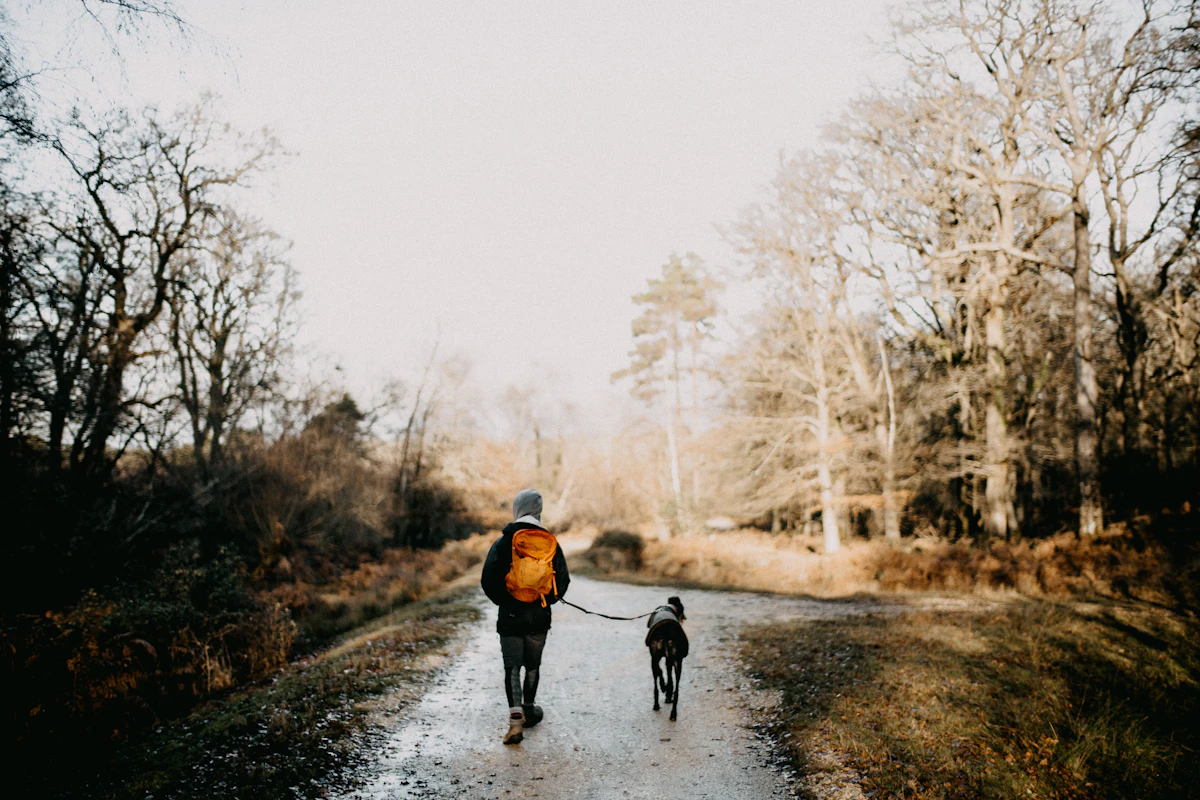
Most healthy adult dogs need 30 minutes to 2 hours of exercise a day, usually split into two or more sessions. Puppies need about five minutes of structured exercise per month of age, once or twice a day, as a common guideline rather than a strict law.
How much exercise does a dog need each day? For most healthy adult dogs, the working answer is between 30 minutes and 2 hours, split across the day, with high-energy sporting, herding, and working breeds at the top of that range and toy, flat-faced, and senior dogs toward the bottom. Puppies need far less in one go: short, frequent sessions, guided by the common rule of about five minutes per month of age, once or twice a day.
How long should today’s walk be: twenty minutes, an hour, or until somebody’s shoes give up?
It is a fair question, and breed charts only get you halfway. The dog in front of you – his age, his joints, his breathing, his fitness today – settles the rest.
For a broader view of daily care, training, and health topics, start with our dog care hub for owners.
At a Glance
- Most healthy adult dogs need 30 minutes to 2 hours of exercise a day, usually split into two or more sessions.
- Puppies: about five minutes of structured exercise per month of age, once or twice a day, is a common guideline, not a strict law.
- High-energy herding, sporting, and working breeds often need 90 minutes to 2 hours or more, plus mental work.
- Seniors still need daily movement. Shorter, gentler, more frequent sessions work better than one long outing.
- Mental exercise counts. Sniffing, training, and puzzle games tire many dogs as effectively as extra distance.
Contents
- How much exercise does a dog need by age?
- The exercise table: age, size, and breed type
- How much exercise does a dog need by breed type?
- Size matters, but not the way most people think
- Mental exercise: the half of the job walks miss
- Signs you have the amount wrong
- Fuelling exercise without feeding the wrong things
- Frequently Asked Questions
- Sources and Further Reading
How much exercise does a dog need by age?

Age changes the answer more than almost anything else. A four-month-old puppy and a four-year-old adult of the same breed should not be doing the same walk.
Puppies: short, often, and self-paced
The American Kennel Club, citing veterinary researchers, recommends walks of about five minutes multiplied by every month of age, once or twice a day. A three-month-old gets roughly 15 minutes. A five-month-old gets roughly 25 minutes, up to twice a day.
The PDSA, the UK pet charity, gives the same figure as a rough starting guide, and adds a caution: there is very little evidence behind the exact number, and the type of exercise matters more than clock-watching. Treat it as a guardrail for structured, on-lead exercise, not a total limit on a puppy’s day.
Free play is different. In a safe garden or on a long line, a puppy speeds up, slows down, sniffs, and flops when he is tired. The AKC calls safely free running the best exercise for puppies, precisely because the puppy, not the lead, sets the pace.
Protect growing joints while you do it. Growth plates, the soft areas at the ends of growing bones, take time to harden. The AKC advises holding off on jogging with a puppy on lead until he is mature: roughly 6 to 8 months for smaller breeds, 12 months for medium breeds, 12 to 18 months for large breeds, and 18 to 24 months for giant breeds.
Adolescents: adult energy, unfinished body
Between about six and 18 months, many dogs have adult levels of energy on a still-maturing frame. Build up gradually instead of jumping to marathon sessions. Longer walks, sniff-heavy outings, training games, and controlled play suit this stage better than sustained running or repetitive jumping. Giant breeds mature latest, so their build-up should be the slowest.
Adults: the prime years
For a healthy adult, use the 30-minutes-to-2-hours range as your frame, then place your dog inside it by breed type and temperament, using the table below. Most dogs do best with the total split into at least two sessions.
Seniors: keep moving, change the shape
Older dogs still need daily exercise to hold muscle, manage weight, and keep their minds engaged. What changes is the shape: shorter, slower, more frequent walks, softer ground where you can, and more sniffing time built in.
The RSPCA’s senior pet guidance makes the same point: shorter, more frequent walks, at the dog’s pace, with rest stops, and familiar routes. Swimming is often suggested as a low-impact option for stiff joints. If a senior dog becomes reluctant, stiff, or lame, that is a vet conversation, not a training problem.
The exercise table: age, size, and breed type

These are starting ranges for healthy dogs, drawn from the guidance cited in this article. Health, fitness, weather, and temperament can move a dog outside a range.
| Dog | Typical daily total | Best shape of exercise |
|---|---|---|
| Puppy, 3 months | About 15 minutes structured, once or twice a day, plus free play | Short walks on soft ground, play, sniffing, brief training |
| Puppy, 6 months | About 30 minutes structured, once or twice a day, plus free play | Walks, play sessions, socialisation outings |
| Adult toy / small breed | About 30 to 60 minutes | Two short walks, indoor or garden play |
| Adult medium breed, moderate energy | About 60 to 90 minutes | Walks plus play or training |
| Adult sporting breed (e.g. retrievers, spaniels) | About 90 minutes to 2 hours | Long walks, retrieving, swimming where safe |
| Adult herding breed (e.g. Border Collie, Australian Shepherd) | About 90 minutes to 2 hours or more, plus mental work | Walks plus training, scent games, structured tasks |
| Adult working breed (e.g. Husky, Boxer) | About 90 minutes to 2 hours | Steady, purposeful activity, hiking, play |
| Adult flat-faced breed (e.g. Pug, Bulldog) | About 30 to 60 minutes, in short gentle sessions | Short walks in cool parts of the day, gentle play |
| Adult giant breed (e.g. Great Dane) | About 30 to 60 minutes, low-impact | Steady walks, avoid sustained running and jumping |
| Senior dog | About 30 to 60 minutes, adjusted to comfort | Shorter frequent walks, swimming, sniffing games |
Read the table as a first draft, not a prescription. Try a range for two weeks, watch weight, sleep, and behaviour, then adjust by 10 or 15 minutes at a time.
How much exercise does a dog need by breed type?

Breed is a clue about the job a dog was developed for, and that job predicts energy better than size alone.
Sporting breeds were bred to work in the field all day, finding and retrieving. Herding breeds were bred to run, think, and problem-solve for hours. Working breeds were bred for endurance tasks like pulling, guarding, and rescue work. Those histories are why these groups sit at the top of the range, and why a 30-minute stroll often leaves them restless.
Terriers are intense and game-driven in bursts. Hounds follow their noses, so a scent-rich moderate walk can satisfy a hound in a way a faster, blander walk does not. Toy and companion breeds have lower totals, but lower does not mean optional: a small dog who is never walked still gains weight, loses confidence, and gets bored.
If your dog is a mix, go by the traits you actually see: prey drive, stamina, love of retrieving, obsession with scent. The mix in front of you outranks the label on paper.
Size matters, but not the way most people think

Big dog, big exercise is only half true. Giant breeds are heavy and many have moderate stamina, so forcing a young giant into long runs risks his joints. Small dogs have the opposite problem: their walks get skipped because they can be carried, yet they still need daily outdoor movement. Their totals are shorter because their legs and heat tolerance are smaller, not because their need is trivial.
Flat-faced breeds need special care at any size. Their breathing makes cooling harder, so keep sessions shorter and gentler, in the coolest parts of the day.
Mental exercise: the half of the job walks miss

A dog can come home physically tired and mentally wired. Add brain work and the picture changes.
The AKC recommends a mix for puppies that transfers well to adults: tug, hide-and-seek, and a sniffari, where pieces of kibble are scattered in grass for the dog to find. Add short training sessions, food puzzles, and scavenger boxes, and you have exercise that works the nose and the brain together.
Sniffing deserves its own mention. Letting a dog sniff properly on a walk is not wasted time. Many dogs come home calmer after 30 minutes of sniff-rich walking than after 45 minutes of marching past everything interesting.
This is also where you will see your dog thinking hardest. If you have ever watched a dog tilt his head while he works out a word or a sound, you have seen concentration in action. Short training games produce that focus, and they tire dogs in a satisfying way.
A practical split for many adult dogs is two walks, one of them sniff-heavy, plus 10 to 15 minutes of training or puzzle play at home.
Signs you have the amount wrong

Too little exercise tends to show up as restlessness, destructive chewing, digging, excessive barking, attention-seeking, and weight gain. Puppies and adolescents show it fastest, often in the early evening.
Too much has signs too: lagging behind, sitting or lying down on walks, heavy panting that is slow to settle, stiffness the next day, limping, or a puppy who gets wild and bitey when overtired. Overtired puppies often look more hyper, not less.
In heat, watch for excessive panting and reluctance to continue, and move exercise to cooler hours. When in doubt, change one variable at a time: add or remove 10 minutes, keep everything else steady for a week, and watch the dog.
Fuelling exercise without feeding the wrong things

Exercise and food are a pair, and two habits keep dogs safer. First, timing: the AKC suggests walking at least an hour after a meal, giving food time to digest. Second, rewards: training treats should be small, counted into the day’s food, and safe.
That last point matters more than people expect. A pocketful of the wrong people food can turn a good training walk into an emergency, so check any human food against the complete list of foods dogs should never eat, and the safer alternatives to use instead before it goes in your treat pouch.
Offer water before and after exercise, and on longer outings, bring it with you.
Frequently Asked Questions
Can I exercise my dog too much?
Yes. Puppies can injure growing joints with sustained, high-impact exercise, and any dog can be pushed into exhaustion, overheating, or injury. Watch for lagging, sitting down, slow-to-settle panting, stiffness, or limping, and end the session rather than completing the route.
Is one long walk as good as two shorter ones?
For most dogs, two sessions work better. They spread toilet breaks, training, and stimulation across the day, and they suit puppies and seniors especially well.
How much exercise does a senior dog really need?
Most seniors still benefit from daily movement, often around 30 to 60 minutes in total, broken into shorter, gentler sessions. Let stiffness, pain, or reluctance set the ceiling, and ask your vet to check any new reluctance.
What if my dog still seems hyper after a long walk?
Add mental work before you add distance. Training, scent games, and puzzle feeders tire the brain, and some herding and sporting breeds will simply out-walk you.
What are the signs my dog is getting too little exercise?
Restlessness, destructive chewing, barking, weight gain, and bursting energy on walks are the usual signs. A dog who destroys furniture or paces the house often needs more physical and mental work, not more scolding. Increase exercise gradually, and add training and sniffing games alongside walks.
Does mental exercise really count as exercise?
Yes. Training sessions, scent games, puzzle feeders and new routes all tire a dog’s brain, and a mentally tired dog settles better than one who only ran. For puppies, seniors and dogs on restricted exercise, mental work is often the safest way to burn energy without straining growing or ageing bodies.
How should I exercise a dog in hot weather?
Walk early or late, avoid midday heat, carry water, and watch for heavy panting, drooling, wobbling or refusal to walk — all signs to stop and cool down at once. Pavement burns paws in summer, so test it with your hand. Swimming and indoor games are safer than a long run on a hot day, and brachycephalic breeds need extra caution.
Sources and Further Reading
- American Kennel Club – How Much Exercise Does a Puppy Need? Mental and Physical Exercises – https://www.akc.org/expert-advice/health/puppies-mental-physical-exercise/
- PDSA – New Puppy Checklist (exercising your puppy, five minutes per month of age as a general rule) – http://www.pdsa.org.uk/pet-help-and-advice/looking-after-your-pet/puppies-dogs/new-puppy-checklist
- PDSA – Weigh Up puppy leaflet (five minutes per month widely reported, little evidence, type of exercise matters more) – https://www.pdsa.org.uk/media/12615/pdsa_weighup_puppy_leaflet.pdf
- PetSafe – How Much Exercise Does My Dog Need? (adult range, breed groups, life stages) – https://www.petsafe.com/blog/how-much-exercise-does-my-dog-need/
- Dogster – How Much Exercise Does a Dog Need Every Day? (UK Kennel Club five-minute rule; adult 30 minutes to 2 hours) – https://www.dogster.com/dog-health-care/how-much-exercise-does-a-dog-need/
- RSPCA Queensland – Senior Pet Care (shorter, more frequent walks for senior dogs) – https://www.rspcaqld.org.au/resources/pet-care/senior-pet-care-MCPWKJSCZMNEO3J4JRFOYLEK7KQ
This article is educational and is not a substitute for veterinary advice. If your dog has a health condition, an injury, or a sudden change in how much exercise he can manage, talk to your vet before changing his routine.
About the author
Furrology Team — pet owner and researcher behind Furrology. We read the veterinary research and draw on real owner experience, then turn it into plain-English guides about dogs, cats, birds and small pets. We are not vets — Furrology is researched information, not veterinary advice, and a poorly pet always needs a real vet. More about how we work: About Us · Editorial Policy