
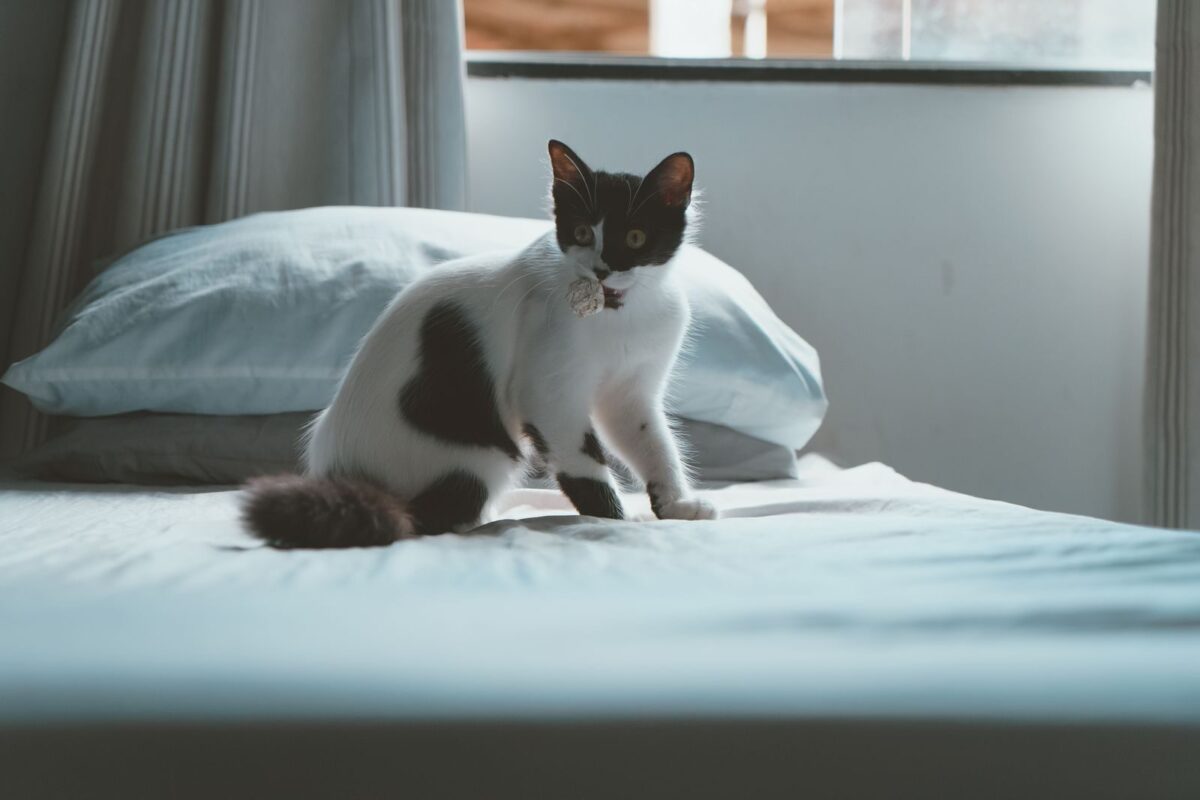
It’s 3 a.m. Something lands on your feet. Then it walks up your body, sits on your chest, and starts purring directly into your face. You open one eye. Your cat is staring at you. It’s the middle of the night, and your cat is wide awake — and she has decided that you should be too.
If this sounds familiar, you’re not alone. Cats waking their owners at night is one of the most common complaints cat owners have, and it’s also one of the most misunderstood. Your cat isn’t being spiteful. She isn’t punishing you. She isn’t even really trying to wake you up, most of the time. She’s just being a cat — and her idea of a good time happens to be 3 a.m.
This guide explains why cats wake their owners, what your cat is actually trying to tell you, and the routine changes that genuinely fix it. The answer isn’t to shut the cat out of the bedroom (though we’ll talk about that too). The answer is to understand what she needs and give it to her at the right time — during the day, not at 3 a.m.
The short answer: your cat is crepuscular, and your schedule is wrong for her

Cats are crepuscular — they’re most active at dawn and dusk. In the wild, that’s when their prey is most active, and it’s when a cat’s body is wired to hunt. Your cat’s internal clock tells her to be alert and active in the early hours of the morning and again in the evening. Your internal clock tells you to sleep through both of those.
So at 3 a.m., while you’re in the deepest part of your sleep, your cat is hitting her natural peak of energy. She’s been asleep for hours. She’s rested, she’s alert, and she’s ready to do something. And the most interesting thing in the house is you — warm, moving occasionally, and capable of opening doors and producing food.
This doesn’t mean the problem is unsolvable. It means the solution is about shifting your cat’s energy to the right time of day, not about fighting her nature. A cat who has had enough play, enough stimulation, and enough food during the evening is a cat who is much more likely to sleep through the night — or at least to leave you alone until morning.
Why she wakes you: the five real reasons

She’s hungry. This is the most common reason, and the most common fix. Cats who are fed once a day, early in the evening, will be genuinely hungry by 3 a.m. — and a hungry cat will wake you up to tell you about it. A cat who is fed a small meal late in the evening, or who has access to a small amount of food overnight, is much less likely to wake you for breakfast. An automatic feeder set to dispense a small meal at 4 or 5 a.m. can solve this problem completely — your cat gets fed, and you get to sleep.
She’s bored. A cat who has nothing to do all day will save her energy for the night. If your cat sleeps all day while you’re at work, and then you come home and sit on the sofa, she’s had a whole day of rest and no stimulation — and by 3 a.m., she’s ready to play. The fix is to give her something to do during the day: play sessions, puzzle feeders, a window to watch birds from, a scratching post, a cardboard box. A cat who has been busy during the day is a cat who sleeps at night.
She wants attention. Cats are social animals, and many cats genuinely enjoy their owner’s company. If the only time your cat gets your full, undivided attention is at 3 a.m. — because you wake up, talk to her, pick her up, or get out of bed — then she has learned that 3 a.m. is attention time. The fix is to give her plenty of attention during the day and evening, so she doesn’t need to seek it at night. And at night, when she wakes you, don’t give her the attention she’s looking for. That’s hard, and we’ll come back to it.
She wants to play. This is closely related to boredom, but it’s worth naming separately, because the fix is specific: a proper play session in the evening, before bed, that tires her out. Not five minutes with a toy mouse. A real session — fifteen or twenty minutes of active play with a wand toy, chasing, pouncing, and jumping — followed by a small meal. Play, then food, then sleep. That’s the natural sequence for a cat: hunt, eat, groom, sleep. If you give her that sequence in the evening, she’s much more likely to sleep through the night.
She’s learned that it works. This is the big one, and it’s the one most owners miss. Every time your cat wakes you and you respond — by feeding her, by talking to her, by getting up, by playing with her, even by pushing her off the bed — you have taught her that waking you up works. She wanted something, she woke you, and she got it. From her point of view, that’s a successful strategy, and she’ll use it again. Breaking this pattern takes consistency, and it takes time — but it works.
The mistake that makes it worse: responding

Here’s the hard truth: the thing that keeps your cat waking you up is you. Every time you respond to a 3 a.m. wake-up — with food, with attention, with play, even with anger — you are rewarding the behaviour. Your cat doesn’t know the difference between a reward and a punishment. She knows that when she wakes you, something happens. And something happening is more interesting than nothing happening.
This means the fix requires you to do nothing. When your cat wakes you at 3 a.m., don’t get up. Don’t feed her. Don’t talk to her. Don’t push her off the bed in a way that turns into a game. Just lie still, ignore her, and wait. She’ll try harder for a few nights — this is called an extinction burst, and it’s normal — and then she’ll stop, because the behaviour no longer gets a result.
This is genuinely hard. It means lying awake, listening to your cat meow, and doing nothing about it. It means resisting the urge to just get up and feed her so you can go back to sleep. But if you give in on night four, after three nights of ignoring her, you’ve taught her something worse: that persistence pays off. She’ll wake you for longer next time, because she knows that if she keeps at it, you’ll eventually give in.
Be consistent. Every night, the same response: nothing. And during the day, give her everything she needs — food, play, attention — so that the night-time ignoring doesn’t feel like neglect. It’s not. It’s teaching her when the good stuff happens.
The evening routine that actually works

The single most effective change you can make is to build an evening routine that tires your cat out and fills her up, so that by the time you go to bed, she’s ready to sleep too. Here’s what that looks like.
Play session, 30–60 minutes before bed. Fifteen to twenty minutes of active play with a wand toy. Let her chase, pounce, jump, and stalk. This is the hunt — and it should feel like one. Vary the speed, hide the toy behind furniture, let her catch it sometimes. A cat who has had a good hunt is a cat who is ready for the next step.
Small meal, right after play. A small portion of wet food, or a few treats, immediately after the play session. This is the “eat” part of the sequence. In the wild, a cat hunts, then eats. You’re recreating that. The meal should be small — you’re not feeding her a full dinner, just a snack that completes the sequence.
Then quiet. After the meal, your cat will usually groom herself and settle down. That’s the “groom, then sleep” part of the sequence. If she settles, you’re done. If she’s still restless, give her a puzzle feeder or a small toy to keep her occupied while you wind down for bed.
Automatic feeder for the early hours. If your cat wakes you because she’s hungry, an automatic feeder set for 4 or 5 a.m. can be a complete fix. She gets a small meal, delivered by a machine, not by you — so she doesn’t learn to associate waking you with food. Set it for a time just before she usually wakes you, and she’ll learn to wait for the feeder instead of waking you.
This routine works because it works with your cat’s nature, not against it. You’re not trying to make her sleep through the night by force. You’re giving her the hunt, the meal, and the rest she needs — at the right time, so that the night is for sleeping.
What about shutting her out of the bedroom?

Some owners shut the cat out of the bedroom and close the door. This works for some cats, and not for others. A cat who is shut out will often meow at the door, scratch at it, or rattle the handle — which is just as disruptive as being woken up by a cat on your chest, except now it’s happening from the hallway.
If you do shut the door, be consistent — every night, no exceptions — and make sure your cat has everything she needs outside the bedroom: food, water, a litter tray, a comfortable place to sleep, and a toy or two. And be prepared for a few nights of meowing while she adjusts. If she’s still meowing at the door after a week, the closed door isn’t working, and you’re better off going back to the evening routine and the ignore-at-night approach.
Some cats are fine with a closed door. Some aren’t. It depends on the cat, and on how attached she is to sleeping with you. If your cat has always slept on your bed, shutting her out is a big change, and it may cause more stress than it solves. The evening routine is usually the better first step.
When it’s not just a habit: medical reasons

Most night-waking is behavioural — it’s about hunger, boredom, or a learned habit. But sometimes it’s medical, and it’s worth knowing when to check.
An older cat who suddenly starts waking you. If your cat has always slept through the night and suddenly starts waking you at 3 a.m., especially if she’s older, that’s worth a vet visit. Older cats can develop conditions that affect their sleep — thyroid problems, cognitive decline, pain, or high blood pressure — and a change in night-time behaviour is often the first sign. Our guide to warning signs in cats covers what to look out for and when to call the vet.
A cat who is eating much more, or much less, than usual. A sudden change in appetite, combined with night-waking, can be a sign of a thyroid problem or diabetes. If your cat is suddenly ravenous at night, or if she’s waking you because she’s uncomfortable, get her checked.
A cat who is crying, not just meowing. A cat who yowls at night — a long, loud, distressed cry, rather than a normal meow — may be in pain, confused, or disoriented. This is especially common in older cats, and it should always be checked by a vet.
If your cat’s night-waking is new, sudden, or accompanied by any other change — in appetite, in weight, in litter tray habits, in behaviour — don’t assume it’s just a habit. Get her checked. The vet visit is quick, and it’s worth it for the peace of mind.
What about kittens?
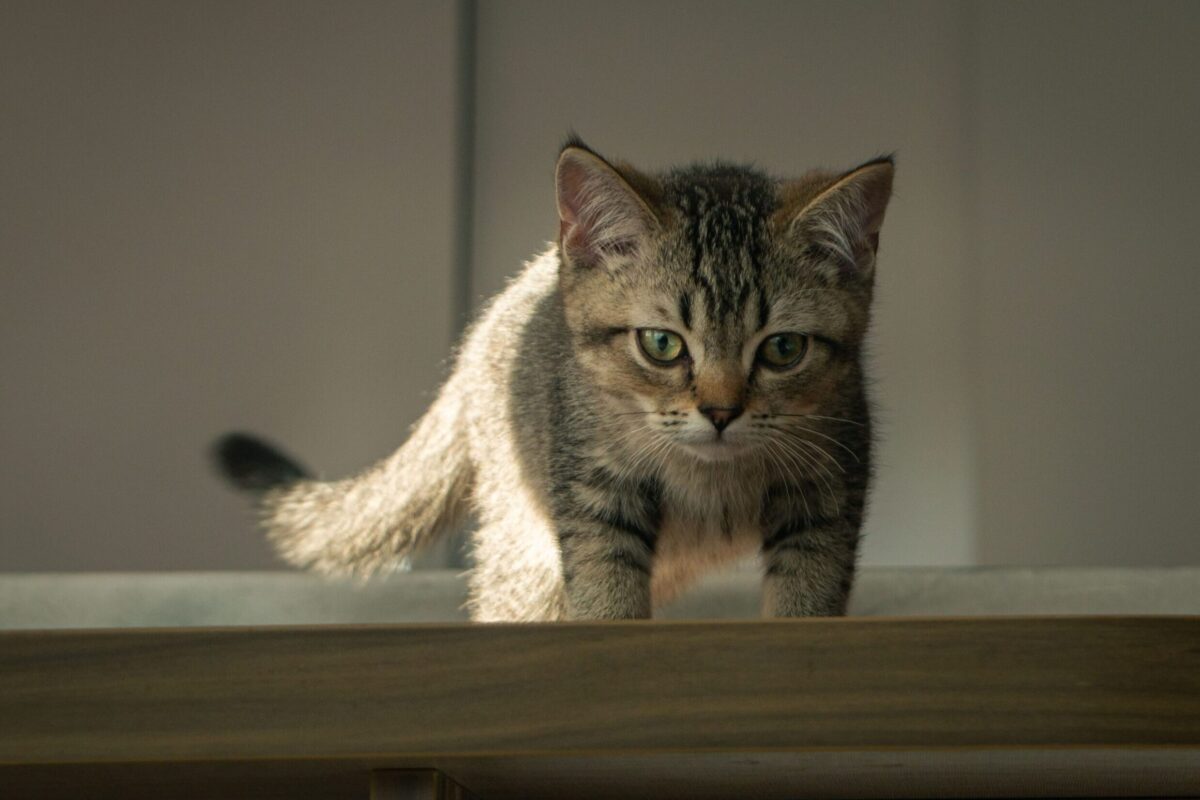
Kittens are a special case, because kittens are naturally more active at night and they haven’t yet learned your schedule. A kitten who wakes you at 3 a.m. is a normal kitten — she’s young, she’s energetic, and she hasn’t yet learned that night is for sleeping.
The same principles apply, but with more patience. A kitten needs more play during the day — several short sessions, not just one evening session — and she needs more food, more often. The evening routine works for kittens too, but it may take longer to see results, because a kitten’s energy is almost limitless and her attention span is short.
Socialisation matters too. A kitten who is well socialised — used to people, sounds, and handling — is a kitten who is more likely to settle into a routine. Our guide to socialising a kitten covers the early months and how to help a kitten grow into a confident, well-adjusted cat. And if your kitten is waking you because she’s hungry, check your feeding schedule — kittens need to eat more often than adult cats, and our guide to how often to feed a cat covers the right frequency by age.
How long does it take to fix?

If the cause is hunger, an automatic feeder or a late-evening meal can fix it in a night or two. If the cause is boredom, the evening play routine can make a difference within a week. If the cause is a learned habit — your cat has been waking you for months and getting a reward for it — it can take two to four weeks of consistent ignoring before she stops. The extinction burst (her trying harder for a few nights) usually lasts three to five nights, and then the behaviour fades.
Be patient, and be consistent. The worst thing you can do is to be consistent for a week, give in once, and then start over — because now your cat knows that if she keeps at it for long enough, you’ll eventually give in. Every night, the same response: nothing. Every evening, the same routine: play, food, quiet. It works, but it works on a cat’s timescale, not yours.
Frequently Asked Questions
Why does my cat wake me up at the same time every night?
Because cats are creatures of habit, and because your cat’s internal clock is very precise. If she’s been waking you at 3 a.m. for weeks, it’s because 3 a.m. is when she’s most active and when she’s learned that waking you works. The time will shift if you change the routine — a late-evening meal and an automatic feeder can move her wake-up time later, and a consistent ignore-at-night approach can stop it altogether.
Should I feed my cat when she wakes me up?
No. Feeding her when she wakes you teaches her that waking you is how she gets food. Feed her in the evening, before bed, and use an automatic feeder for the early hours if she’s genuinely hungry overnight. The food should come from you (or the feeder) on a schedule, not from her waking you up.
Is it cruel to ignore my cat at night?
No. Ignoring her at night is not the same as neglecting her. She has food, water, a litter tray, and a comfortable place to sleep. You’re not ignoring her all the time — you’re giving her plenty of attention, play, and food during the day and evening. You’re just teaching her that the night is for sleeping, not for demanding things. That’s a kindness, not a cruelty — to both of you.
My cat sleeps on my bed. Should I stop her?
You don’t have to. Many cats sleep on their owner’s bed and sleep through the night perfectly well. The problem isn’t that she’s on the bed — it’s that she’s waking you up. If she’s sleeping peacefully on the bed, leave her there. If she’s waking you, the evening routine and the ignore-at-night approach will help, whether she’s on the bed or not.
Can I train my cat to sleep through the night?
You can shift her schedule, and you can teach her that waking you doesn’t get a result — but you can’t make her sleep through the night in the same way you do. Cats sleep in short bursts, and they wake up several times during the night. The goal isn’t to make her sleep for eight hours straight. The goal is to make her wake up quietly, entertain herself, and go back to sleep — instead of waking you up. A cat who wakes at 3 a.m., has a snack from the automatic feeder, plays with a toy for ten minutes, and goes back to sleep is a cat who has learned to sleep through the night on her own terms.
My cat only wakes me up on weekends. Why?
Because your schedule changes on weekends. If you get up later on Saturday, your cat’s feeding time shifts, and she wakes you at the time she expects to be fed — which is earlier than when you’re planning to get up. Keep the feeding schedule consistent, even on weekends, and use an automatic feeder to cover the early morning. Your cat doesn’t know it’s Saturday. She just knows she’s hungry.