

Cat sleeping positions give clues about warmth, safety and comfort, not one fixed message. A curled cat is usually keeping warm and protecting its belly, a cat on its back or side usually feels safe enough to expose its belly, and a cat sleeping on you is usually choosing warmth, your familiar scent and a safe place to rest.
You find your cat folded into a tight crescent on the arm of the sofa, tail wrapped round like a scarf, and you wonder what that shape is saying. If you are searching for cat sleeping positions meaning, the honest answer is that positions give clues, not certainties: a curled cat is usually conserving heat and protecting its belly, a belly-up or side-sleeping cat usually feels safe enough to expose vulnerable organs, and a loafing cat is resting while staying ready to move. Read the posture alongside temperature, place and the rest of the cat, and the clues get much clearer.
You will learn your cat’s favourites within weeks: one spot for morning sun, one high place for the afternoon, one specific cushion no one else may sit on. Legs tucked on a cold day, body stretched on a warm floor, a paw over the eyes when the room is bright.
This guide works through the common positions and what each suggests. For broader background, see our hub for cats, behaviour and daily care.
At a Glance
- Adult cats typically sleep 12 to 16 hours a day, in many short naps rather than one long block. Kittens and senior cats often sleep more, sometimes up to 20 hours.
- Curled and loaf positions usually help a cat conserve heat and protect vulnerable organs while resting.
- Sleeping on the back or side usually indicates a cat feels safe and relaxed, because the belly and vital organs are more exposed.
- Cats are both predators and prey animals, so even in sleep, instinct favours warmth, safety and an easy escape route.
- Sleeping-position meanings are interpretations based on comfort, temperature and trust. A sudden change in where or how your cat sleeps matters more than any single pose.
Contents
- How much sleep is normal, and why cats sleep this way
- Cat sleeping positions meaning: the main postures decoded
- Curled up, loaf, and the tucked-away sleepers
- Belly up, side sleeping, and the stretched-out cat
- Sleeping on you, in boxes, and in odd places
- What does it mean when your cat sleeps with you?
- When a sleeping position or habit needs a vet
- A quick visual checklist
- Frequently Asked Questions
- Sources and Further Reading
How much sleep is normal, and why cats sleep this way

PetMD states cats typically sleep 12 to 16 hours a day. Kittens may sleep up to 20 hours while growing, and senior cats aged at least 10 years often sleep more than younger adults.
That sleep does not arrive in one stretch. PetMD describes frequent catnaps of roughly 15 to 30 minutes, which let a cat rest while still reacting quickly to sounds nearby.
Cats are crepuscular, most active at dawn and dusk, so daytime sleep conserves energy for those bursts. PetMD notes breed, diet, lifestyle and health shift the exact total, and a bored indoor cat may sleep more simply to fill time.
Cat sleeping positions meaning: the main postures decoded

No position has a single proven emotional translation. PetMD says positions reveal clues about comfort, trust, temperature and state of mind. Clues is the right word: feelings such as trust are inferences from what a posture does — conserving heat, protecting the abdomen, staying ready to move — not measurements. Check the table against your cat, your room and the weather.
| Position | What it most likely suggests | What else to check |
|---|---|---|
| Curled into a ball | Conserving heat, protecting vital organs | Room temperature, draughts |
| Loaf (paws tucked under) | Relaxed but ready to react and move | Whether the head stays up and alert |
| On the back, belly exposed | Feels safe, comfortable and secure | Do not assume it invites a belly touch |
| On the side, legs stretched | Relaxed, comfortable, secure | Depth of sleep, twitching during dreams |
| Superman (belly down, legs stretched) | Relaxed, protecting the abdomen, ready to move | Warm or cool surface choice |
| In a box or enclosed space | Seeking security, warmth and protection | Whether hiding is new or increased |
| On you or next to you | Trust, warmth, companionship | Whether your cat keeps a small gap |
| Paws over eyes | Blocking light, conserving warmth | Bright room, wish to be left alone |
| In the litter tray | Possible health or stress problem | Treat a new habit here as a vet prompt |
Curled up, loaf, and the tucked-away sleepers

Curled into a ball
This is the classic crescent: nose near tail, tail wrapped round the body, head tucked towards the chest.
A cat curled into a ball is usually trying to conserve body heat and protect vulnerable areas, PetMD says. Curling also surrounds the vital organs in the abdomen with stronger muscle and bone, which makes the posture protective as well as warm.
You will see it more in winter and draughty rooms. A cat who curls in a cold hallway and stretches out in a sunny room is regulating temperature first, mood second. PetMD suggests such cats often enjoy donut-shaped or bolster beds, which support the curl.
The loaf
In a loaf, the front paws are tucked underneath the body, the body sits in a neat rectangle, and the head stays upright, at least at first.
Loafing cats are usually relaxed while still remaining alert and ready to react, in PetMD’s description. The position helps conserve heat and protect vital organs, and keeping the paws tucked underneath allows a cat to react faster and use its claws if needed.
Think of the loaf as a parked car with the engine idling: resting, but upright in half a second if the food cupboard opens. Many cats loaf after paw pressing on the same spot; our guide to the biscuit-making habit and what drives it explains why kneading comes before the settle.
Paws over eyes, face tucked away
PetMD gives this practical jobs: conserving warmth around paws and face, blocking bright light like a sleep mask, and protection from dust. Read it as a do-not-disturb sign.
Belly up, side sleeping, and the stretched-out cat

On the back, belly exposed
A cat sleeping on its back with the belly exposed usually feels safe, comfortable and secure, PetMD says. Because cats instinctively protect their vital organs, exposing the abdomen during sleep is often read as a sign of trust and confidence.
Hold one boundary: a sleeping belly is not an invitation. PetMD warns many cats will scratch, swat or bite if the stomach is touched, even in this relaxed pose. Temperature matters too — a cat may roll onto its back in a sun patch, or onto a cool floor in summer. Temperature first, trust second.
Side sleeping
Side sleeping is the long, loose sprawl: body on one side, legs stretched out, much of the body exposed.
This position is linked to a cat feeling relaxed, comfortable and secure, in PetMD’s account. Like back sleeping, it leaves vital organs more exposed, which is often a sign of trust. Unlike back sleeping, it still allows a cat to get up and move quickly, which suits an animal that is both predator and prey.
This is often deeper sleep. Whisker twitching and faint paw paddling fit REM sleep, the stage linked to dreaming in humans and likely in cats, as PetMD notes. A 2025 Current Biology study also reported about two-thirds of cats sampled preferred a leftward position, which authors linked to a clearer left visual field on waking.
The Superman pose
Belly down, front legs forwards, back legs behind. These sleepers are usually relaxed but ready to move quickly, protecting the abdomen while resting, PetMD says. On tile in warm weather, contact with a cool floor helps regulate temperature.
Sleeping on you, in boxes, and in odd places

Place matters as much as posture, because a cat chooses both.
Sleeping on your chest, PetMD says, usually reflects trust, affection and comfort: your chest is warm, moves as you breathe, and your cat can hear your heartbeat. Sleeping next to you, even without touching, is also a sign of trust, with a little space kept by choice. Sleeping on your feet adds a quick escape route.
Boxes are the solo version of the same logic. PetMD describes box sleeping as seeking security, warmth and protection. A box holds heat, walls the vulnerable sides, and still offers a way out. Perched sleeping, on a sofa back or cupboard, is about vantage and safety, PetMD notes. Offer a proper cat tree if your cat chooses precarious high spots.
That fixed gaze when your cat wakes and watches you has its own reasons, covered in our guide to reading that steady look from your cat. For more puzzling habits, see odd feline habits and the science behind them.
What does it mean when your cat sleeps with you?
It usually means your cat feels safe with you. Your bed is warm, it smells familiar, and your cat can switch off there — the same three reasons behind most sleeping positions in this guide: warmth, safety and comfort. A cat that sleeps on you is choosing your company over a colder, lonelier spot, and a cat that sleeps beside you, even without touching, is showing the same trust with a little space kept by choice. What it does not mean is a ranking of who your cat loves most. Cats pick the warmest, quietest, most predictable sleeper, and that choice can change with the seasons, a new routine, or simply which side of the bed is free.
When a sleeping position or habit needs a vet
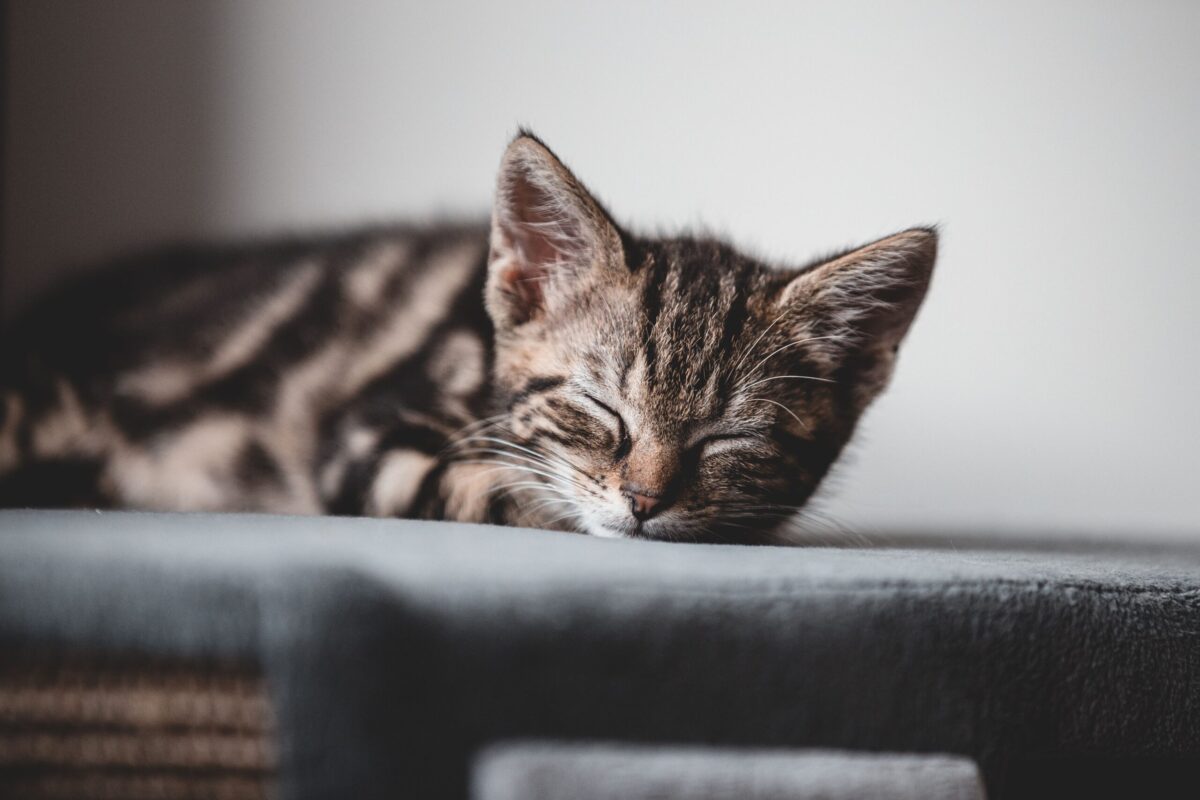
One position deserves its own warning, because PetMD is direct about it: sleeping in the litter tray.
A cat that suddenly starts sleeping or spending unusual time in its litter tray may be experiencing urinary, digestive or other health issues, and PetMD advises contacting your veterinarian if the behaviour develops unexpectedly. In shelters or very stressful homes it can also reflect a lack of safe hiding places, but medical causes should be ruled out first.
The broader rule is change. PetMD lists sudden changes in habits or locations as a possible health signal, and increased sleep can signal boredom, stress, illness or injury. A cat sleeping much more, especially with appetite loss, weight loss, hiding or reduced play, should be seen promptly.
Sleeping with eyes partly open is usually normal, and a translucent third eyelid may show. Vet prompts are eye swelling, discharge, squinting, pawing at the eye, or the third eyelid staying visible while awake. A senior cat sleeping longer in familiar spots, eating and moving well, is showing age; a sudden move to a hidden spot is showing a change.
A quick visual checklist

Work through these five checks:
- Temperature: Warm or cold room and surface? Curled usually means conserving heat, stretched means releasing it.
- Exposure: Belly protected or exposed? Exposed postures usually indicate the cat feels secure.
- Readiness: Paws tucked for a quick start (loaf), or stretched out in deep relaxation (side sleeping)?
- Place: Height, enclosure, company or solitude? Place reveals whether safety, warmth or companionship mattered most.
- Pattern: Usual shape in its usual spot, or something new with other changes? Pattern matters more than any single pose.
How sleeping habits change across a cat’s life
A kitten sleeps differently from an adult, and an adult sleeps differently from a senior, and most of the difference is about warmth, safety, and how much the world still surprises them.
Kittens look for bodies. A young kitten will pile into littermates, press against its mother, or climb onto the nearest warm person, and it will drop off to sleep in short bursts between bursts of play. That need for contact fades gradually, not overnight. As a kitten grows more confident, it starts to pick its own spots — a sunny cushion, a quiet corner — and to sleep alone for longer stretches. A kitten that always wants to be touching someone is not being clingy. It is being young.
Adult cats are creatures of fixed habit. An adult usually has a small set of favourite places and a clear daily rhythm: a morning sun patch, a high perch for the afternoon, a particular chair in the evening. The spots may shift with the seasons — a warm radiator bed in winter, a cool floor in summer — but the pattern stays steady. When an adult cat’s sleeping pattern is steady, it is usually a sign the cat feels settled.
Senior cats rest more and move less between rests. An older cat often chooses warmer, softer, lower places: a padded bed on the floor rather than a high shelf, a blanket in a sun patch rather than a draughty windowsill. It may stay close to familiar people for longer and be slower to get up when disturbed. That is age, not attitude, and it is worth making those favourite places easy to reach: a soft bed where the cat already likes to sleep, a step up to a beloved chair, a warm spot that does not require a jump.
What matters at every age is change against the cat’s own normal. A senior that abandons a perch it used for years, a kitten that suddenly sleeps alone all day, or an adult that moves from the middle of the family to a hidden corner is telling you something has shifted. If the change lasts more than a day or two, or comes with eating, drinking, or litter changes, talk to your vet. The position itself is rarely the message. The change is.
Sharing a bed without losing sleep
Many owners love having their cat in bed and still want a decent night. The two are not in conflict, but they do need a routine, because cats are most active around dawn and dusk and will happily treat four in the morning as a social call.
Start with the wind-down. A short play session in the evening, followed by a small meal as part of the normal feeding routine, gives a cat the same settle-down shape it would have after hunting and eating. Keep the bedroom routine steady: same door position, same lights-out time, same sleeping places. Cats read consistency as safety, and a cat that knows the shape of the night is less likely to patrol it.
Give the cat a proper place of its own in the bedroom. A bed or blanket beside yours, ideally one that smells faintly of you, gives a cat the warmth and scent it wants without it needing to be on your pillow. If your cat does climb onto your pillow, move it gently to its own spot every time, without a fuss. Chasing a cat out of the bedroom at three in the morning teaches it that night-time brings excitement, which is the opposite of what you want.
Early-morning waking is usually a routine problem, not a mystery. If a cat learns that meowing at dawn produces breakfast, dawn meowing becomes the routine. Hold feeding to its set time, even when the meowing starts early, and the habit usually fades over a week or two. It is slow work, and it only works if everyone in the house holds the same line.
For allergy-prone sleepers, small habits help: wash bedding more often, keep the bedroom aired, and brush the cat outside the bedroom so loose fur does not end up on the pillow. If sneezing or broken sleep persists, talk to your doctor about options rather than guessing. And if a light sleeper, a tiny kitten, or a restless senior makes bed-sharing impractical, a bed of the cat’s own right beside yours keeps the closeness without the broken nights. The bond is in the nearness, not in sharing the pillow.
Two cats, one bed: sleeping spots in multi-cat homes
In a home with more than one cat, sleeping spots are also territory, and the map changes when a new cat arrives.
Cats that are genuinely bonded often sleep touching: curled against each other, sharing a chair, or piled together in a sun patch. Cats that merely tolerate each other usually time-share instead: one cat sleeps on the bed during the day while the other uses it at night, or each cat keeps a different chair. Both arrangements are normal. Touching is not the only proof of friendship, and separate spots are not proof of dislike.
Problems start when there are fewer good spots than cats. A newcomer may take over the resident cat’s favourite chair, and the resident cat may retreat to a high shelf, a hidden corner, or another room entirely. The fix is simple and generous: provide more good resting places than you have cats. One extra bed, one extra perch, one extra quiet corner means no cat has to compete for rest. Height helps too, because a cat that can sleep up high does not need to argue about the ground floor.
Watch what happens after a new cat moves in. The resident cat’s sleeping spots may shift for a week or two while the two cats work out the new map, and then settle again. That temporary shuffling is ordinary. What deserves attention is a lasting change: a cat that stops sleeping in the open entirely, that hides all day, or that starts sleeping in odd, exposed places it never used before. If that pattern holds, or comes with eating or litter changes, talk to your vet. Sleeping spots show how safe a cat feels in its own home, and in a multi-cat house they show it twice over: once for the home, and once for the company.
Frequently Asked Questions
What does it mean when a cat sleeps curled up in a ball?
Most often, conserving body heat and protecting its vital organs, as PetMD explains. It is a common, normal posture, especially in cooler rooms. The pose alone is not a worry.
Does a cat sleeping on its back really trust me?
It usually indicates your cat feels safe and secure, because the belly is exposed. That is a good sign about the home and, when done near you, about you. It does not mean your cat wants its belly touched while asleep.
How many hours a day should a cat sleep?
PetMD gives 12 to 16 hours as typical for adults. Kittens may sleep up to 20 hours, and seniors often sleep more. A sudden, lasting change, especially with appetite or behaviour changes, is the reason to call your vet.
Why does my cat sleep in a loaf with its paws tucked?
To conserve heat and protect its organs while staying ready to react. PetMD describes loafing cats as relaxed but alert, with tucked paws allowing a faster response.
Why has my cat started sleeping in strange new places?
It can reflect temperature, a new sun patch or a wish for quiet. It deserves attention when sudden and paired with hiding, appetite change, or sleeping in the litter tray itself, which PetMD flags as a vet prompt.
Is it normal for my cat to twitch or sleep with its eyes open?
Usually, yes. Twitching fits deeper sleep and likely dreaming, and PetMD notes cats can sleep with eyes partly open, third eyelid visible. Contact your vet for eye swelling, discharge, squinting, or a third eyelid visible while awake.
Why does my cat sleep with me?
Usually warmth, familiar scent, safety and routine together. Your bed is warm, it smells like you, and your cat can switch off there. It is a sign your cat feels safe with you, not a test of who it loves most.
Why does my cat only sleep with me, and not my partner?
Usually because you are calmer at bedtime, move less in your sleep, or your side of the bed is warmer and more familiar by bedtime. Cats pick the quietest, most predictable sleeper, not necessarily the person who feeds them.
Should I let my cat sleep with me?
For most healthy adults, yes if you sleep well with them there. If allergies, broken sleep, or a tiny kitten or stiff senior make it hard, a bed of their own beside yours, with a blanket that smells like you, is a good middle step.
Why has my cat suddenly started sleeping with me?
Cold weather, a new pet, a visitor, building work, a move, or a changed routine are the common reasons. A cat looks for the warmest, quietest, most familiar place when its world feels unsettled. If the change lasts days and comes with eating, hiding or litter-tray changes, call your vet.
Sources and Further Reading
- PetMD — 20 Cat Sleeping Positions and What They Mean — https://www.petmd.com/cat/general-health/cat-sleeping-positions-and-what-they-mean
- PetMD — Why Do Cats Sleep So Much? (12–16 hours a day, kittens up to 20 hours, catnaps, crepuscular activity, illness and stress signs) — https://www.petmd.com/cat/behavior/why-do-cats-sleep-so-much
- Current Biology via Cell Press — Lateralized sleeping positions in domestic cats (2025 study reporting a leftward sleeping preference in about two-thirds of cats sampled) — https://www.cell.com/current-biology/fulltext/S0960-9822(25)00507-X
This article is educational and is not a substitute for veterinary advice. If your cat’s sleep amount, positions or sleeping places change suddenly, or your cat starts sleeping in the litter tray, contact your vet.
About the author
Furrology Team — pet owner and researcher behind Furrology. We read the veterinary research and draw on real owner experience, then turn it into plain-English guides about dogs, cats, birds and small pets. We are not vets — Furrology is researched information, not veterinary advice, and a poorly pet always needs a real vet. More about how we work: About Us · Editorial Policy