Your cat has been sleeping in the same position for years, and you probably thought it was random. It’s not. Not even close.
Every single position your cat chooses when they sleep is a direct message — about how safe they feel, how deeply they trust you, and in some cases, about their health. Cats sleep between 12 and 16 hours a day. That’s two-thirds of their entire life spent sleeping. But here’s what most owners never find out: your cat’s wild ancestors had to protect their vital organs even while unconscious, and every position they chose had a survival reason behind it. Your domestic cat still carries every one of those same instincts. So when you watch your cat sleep, you’re watching thousands of years of evolution playing out on your couch. Here’s what each position actually means.
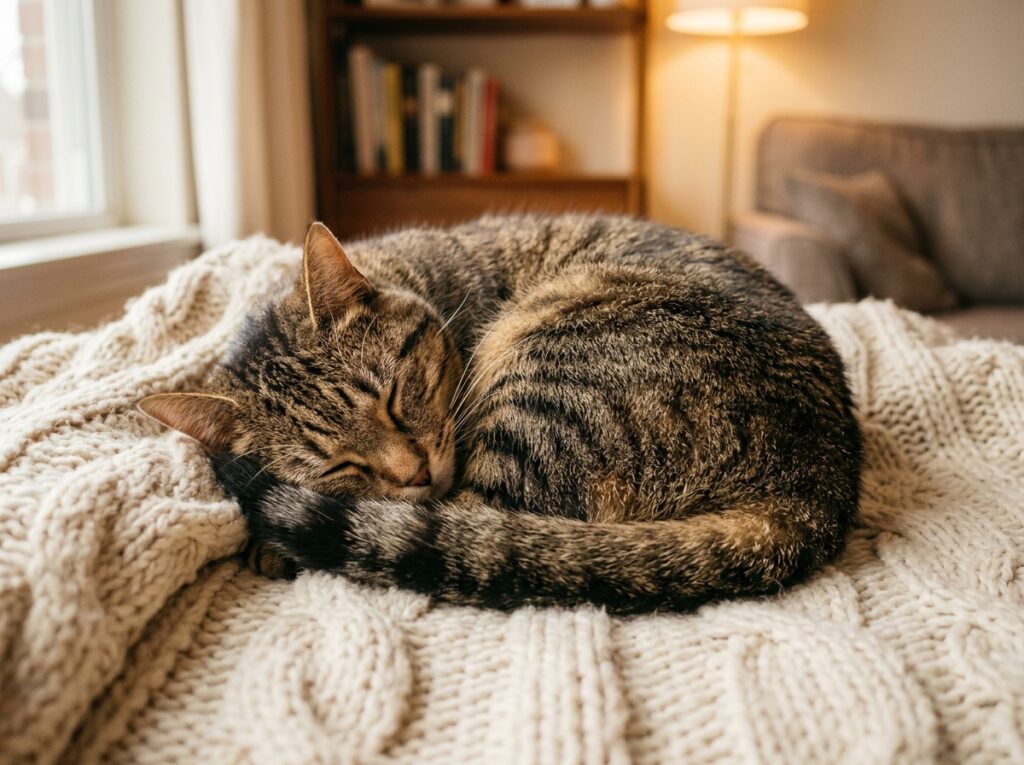
The Curled Ball — Comfortable, But Not in Full Trust Mode Yet
This is the most common sleeping position and the most ancient one in a cat’s behavioral repertoire. When your cat curls into a tight, compact ball, they are protecting their stomach — the most vulnerable part of their body. In the wild, exposing the belly while sleeping meant exposure to danger. The curled ball kept vital organs shielded and the cat ready to react quickly if needed.
What does it mean for your relationship? Your cat feels comfortable and relaxed in their environment — but they’re not yet in their deepest trust mode. They’re at ease, but a small part of their survival brain is still quietly on alert. Think of it as a content, peaceful middle ground. It’s a good sign, just not the deepest signal of trust on this list.
The Loaf — Resting, But Ready to Move in a Heartbeat
Paws tucked neatly under the chest, eyes half-closed, expression unreadable. This is called the loaf position, for obvious reasons — your cat looks exactly like a small, fluffy bread loaf sitting on your kitchen counter. But here’s what’s actually happening beneath that deceptively calm exterior.
Your cat is resting, but they could spring into action in under a second if they needed to. Those front paws aren’t tucked under for comfort alone — they’re quietly positioned for a fast launch. The loaf tells you your cat is relaxed and content with their environment, but still engaged with what’s going on around them. They’re not in deep sleep. They’re in what you might call watchful rest — calm, aware, and perfectly at ease.
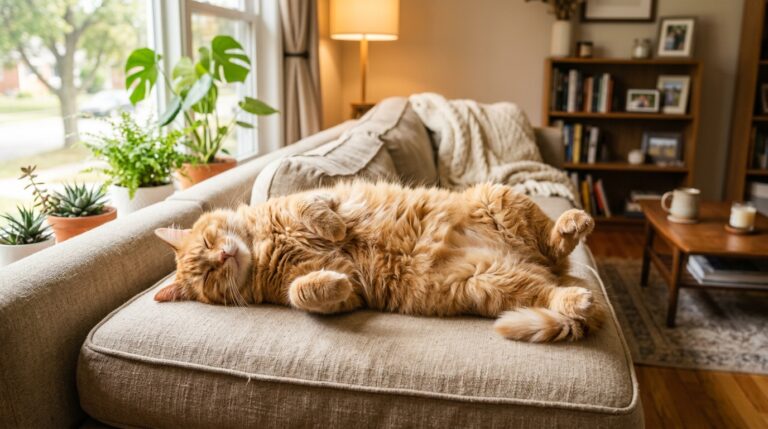
Belly Up — One of the Highest Trust Signals a Cat Can Give You
This one matters more than most owners realize. A cat exposing their belly is exposing the single most vulnerable part of their entire body — the place where, in the wild, one wrong move could mean death. There is no position more defenseless than flat on the back, belly to the sky.
If your cat sleeps belly up around you, they are sending you one of the most powerful trust signals in their entire behavioral vocabulary. They are telling you, as clearly as they possibly can without words: I feel completely safe here. You are not a threat. I trust this place and I trust you.
One critical thing to keep in mind: belly up does not mean belly rub. Many cats will wake from this position and scratch or bite if you reach for their stomach. The exposed belly is a declaration of trust, not an open invitation for touch. Respect what they’re communicating, and the trust only grows deeper.
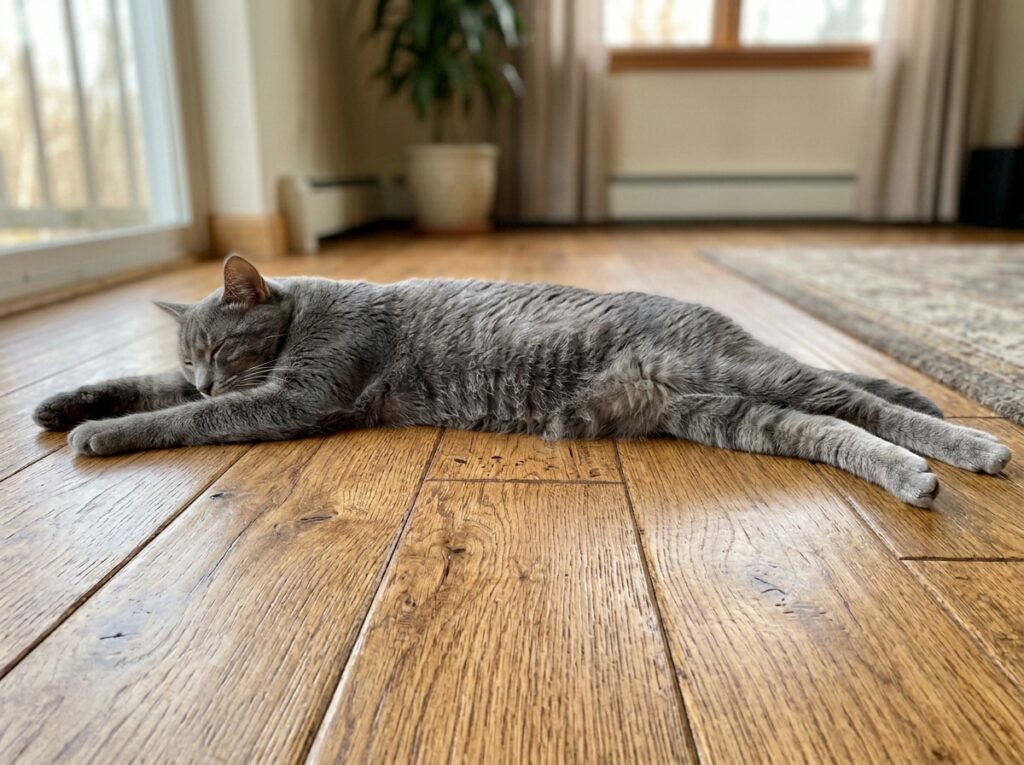
The Superman Stretch — Deep Sleep, Zero Threat Detected
Completely flat on their belly, all four legs extended outward, utterly sprawled. This is what veterinary behaviorists call the Superman stretch, and it carries a very specific meaning. Cats only stretch out to this degree when they feel absolutely zero threat in their environment. There is no defensive instinct active at all. Every muscle is relaxed. Every guard is completely down.
This position also tells you something about your cat’s physical comfort — a cat sleeping in a full Superman stretch is at a healthy, comfortable temperature. Not too hot, not too cold. Everything in their world is exactly as it should be, and their body is showing you that openly.
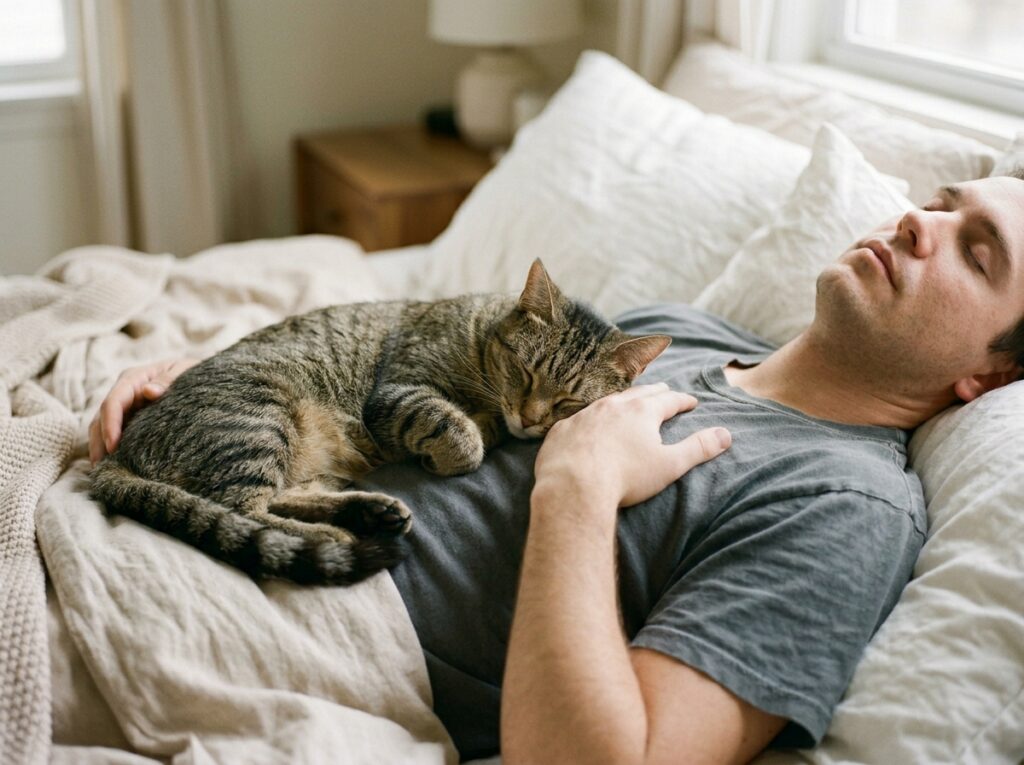
Sleeping on Your Chest — You Are Their Person, Their Home
This is the position that means the most. When your cat chooses to sleep directly on your chest, they are placing themselves over your heartbeat and the steady rhythm of your breathing. That choice is not accidental, and it is not simply about warmth.
Researchers have found that cats who sleep on their owner’s chest show lower stress markers and more relaxed body language during interactions overall. Your steady heartbeat and rhythmic breathing physically mimic the comfort a kitten experiences sleeping pressed against their mother. Your cat isn’t just warm. In the deepest instinctual sense, they are home.
There’s another layer to this that makes it even more meaningful. When your cat presses against your chest while they sleep, they are leaving their scent on you. In the cat world, scent-marking someone is one of the most intimate gestures that exists. It means: you are mine, and I am yours. If your cat sleeps on your chest regularly, that is not a small thing. That is one of the most honest declarations of love they are capable of making.
At Your Feet — Protective, Devoted, and Closer Than You Think
This position confuses a lot of owners. If my cat sleeps at my feet instead of on my chest, does that mean they don’t want to be that close? No. It means almost exactly the opposite.
Your feet move the least while you sleep, making them the most stable, least disruptive part of your body to rest near. Your cat wants to be close to you — genuinely and deeply — but they also want quality, uninterrupted sleep. Sleeping at your feet gives them both at the same time.
There’s also a protective element worth noting. A cat sleeping at your feet can see the room, monitor any movement in the space, and stay close to you simultaneously. In multi-cat households, lower-ranking cats often sleep at the periphery while keeping watch. When your cat does this with you, they’re treating you as someone worth protecting. That’s not distance. That’s devotion with a practical edge.
Near Your Head or Pillow — The Deepest Emotional Attachment
Your head actually moves less during sleep than any other part of your body — even less than your feet. Cats who choose to sleep beside your head or on your pillow are seeking the quietest, warmest, most stable spot available. But the reasoning goes much further than physical comfort.
Your head is where your scent is the most concentrated — your hair, your breath, your warmth, all gathered in one place. Cats who sleep near your head have built a very specific and deeply rooted emotional attachment. Behavioral researchers note that this mirrors the sleeping behavior of strongly bonded cats in multi-cat households, where they press as close as physically possible to the ones they love most.
If your cat chooses your pillow, they are not just sleeping near you. They are sleeping as close to the heart of you as they can possibly get.
One more thing worth knowing: A 2025 study published in Current Biology discovered that domestic cats overwhelmingly prefer to sleep on their left side. The reason comes down to brain lateralization — the same mechanism behind human handedness. Sleeping on the left side activates the right hemisphere of the brain, which in cats is associated with processing emotional and social information. In other words, when your cat curls up on their left side, their brain is literally in social bonding mode. Watch tonight and see which side they choose.
Final Thoughts: Pay Attention to Changes in How Your Cat Sleeps
One last thing that every cat owner needs to know. If your cat suddenly stops sleeping near you, begins hiding to sleep, or shifts from open and relaxed positions to tight, closed ones — that is a signal worth taking seriously.
It could mean stress in the environment. It could mean they’re not feeling well. A cat’s sleeping position is not only a window into their trust and emotions — it is also one of the earliest behavioral indicators of a health issue. A sudden, unexplained change in sleeping habits is always worth a conversation with your vet.
But on the other side of that — when your cat sleeps curled near you, or stretches out fully in your presence, or places themselves over your heart while you rest — remember what you’re seeing. Your cat cannot say I love you in any language you speak. But they say it every single time they close their eyes beside you.
Watch where your cat sleeps tonight. You’ll understand them in a way you didn’t this morning. Want to keep learning what your cat is trying to tell you? Explore more science-backed guides at Furrology.net.