
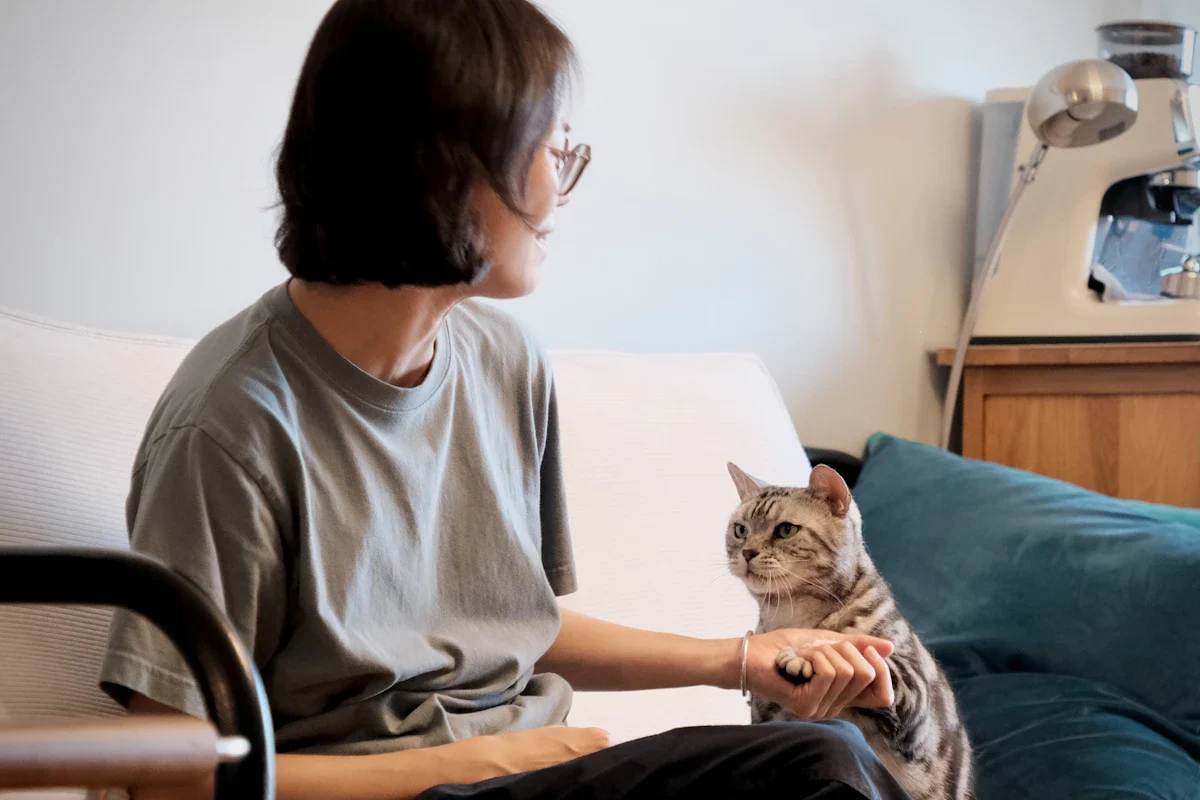
Wondering how to make your cat love you when she walks past your open arms and sits, pointedly, in a cardboard box? Cats bond on different terms from dogs: let your cat choose when contact happens, answer a slow blink with one of your own, play in short hunt-like sessions, feed on a predictable routine, and stop stroking before she has had enough – that pattern, repeated daily, is what builds real trust.
At a Glance
- Choice is the whole game. A cat who can walk away freely is a cat who will come back.
- Slow-blinking works. In a 2020 study, cats were more likely to approach a person who slow-blinked first.
- Play is bonding. Short, daily hunt-style play followed by food mirrors the pattern cats are built for.
- Most cats prefer cheeks, chin and ear-base strokes – and short sessions with pauses.
- Routine calms cats. Same feeding, play and quiet times each day lower stress for everyone.
Contents
- Start with choice: the rule behind how to make your cat love you
- Speak cat: slow blinks, greetings and your voice
- Play, food and routine: how to make your cat love you daily
- Touch, space and trust repairs
- A simple 7-day bonding plan
- Frequently Asked Questions
- Sources and Further Reading
Does your cat ignore the person who adores her and reserve her affection for a visitor who barely looks at her? That confusing pattern also contains the answer.
Cats are drawn to calm, predictable people who do not grab, chase or loom. The visitor scores well by accident: sitting still, not staring, not reaching. You can do the same on purpose. Our complete guide to cats and their care covers health and daily needs; this article covers the relationship itself. “Love” in a cat looks quiet: choosing your room, sleeping nearby, slow-blinking, rubbing cheeks. Aim for more of those chosen moments.
Start with choice: the rule behind how to make your cat love you

1. Let your cat start – and end – every interaction
RSPCA guidance on consent-based touch makes the point plainly: allow the cat to approach and rub against you while you stay still, and give the cat complete control over contact. Touch that the cat can stop is touch the cat learns to trust.
In practice, sit at cat level, offer a loosely held fist at nose height, and wait. If she rubs it, stroke for two or three seconds, then take your hand away and offer it again. Rubbing again means “more, please.” Walking away means “thank you, done” – honouring that answer is the fastest trust-builder there is. With cats, restraint is the affection: the cat who is never grabbed starts volunteering.
2. Get down, get quiet, get boring – at first
Looming over a cat, reaching over her head, and following her from room to room all read as pressure. Sitting on the floor with a book, letting her investigate you at her own pace, reads as safety.
Keep early sessions short. Five calm minutes where nothing is demanded beats thirty minutes of determined cuddling. Leave before she does, if you can – time with you should end while it is still good.
Speak cat: slow blinks, greetings and your voice

3. Slow-blink back
This one has the clearest experiment behind it. Researchers at the University of Sussex and the University of Portsmouth reported in Scientific Reports in 2020 that cats produced more eye-narrowing and half-blinks after their owners slow-blinked at them, compared with no interaction.
In the second experiment, cats were more likely to approach an unfamiliar person after a slow blink than after a neutral expression. In plain terms: slow-blinking is a polite, positive signal cats recognise, even from strangers. Imagine what it does from you, daily.
Soften your eyes first – a hard stare is a threat in cat language – blink slowly, and look slightly aside. It costs three seconds and it is a conversation, not a trick.
4. Greet the way cats greet each other
Friendly cats greet with a raised tail, a brief nose touch, cheek rubbing and scent exchange. You can borrow the shape of that greeting: say her name softly as you enter, offer the back of a finger for a nose bump or cheek rub, and let her press her scent onto you.
That head and cheek rubbing – bunting – is how cats mark social partners with pheromones, as Cornell experts describe it. When your cat bunts you, she is not asking for a full-body hug. She is filing you under “mine, and safe.” Answer with a short cheek or chin scratch and let her move on.
Noticing these signals gets easier with practice. If a behaviour puzzles you – the kneading, the chattering, the 3 a.m. sprint – our explainer on strange cat habits and what each one really means translates the common ones.
5. Use your voice like a routine, not a performance
Cats learn individual words slowly but learn tone and timing fast. Use the same soft call for meals, the same greeting when you come home, and quiet talking while you sit nearby. You are building a sound map of “this person, this calm.”
Avoid calling her name only for things she dislikes, like the carrier or medicine. If her name predicts good, ordinary things, she will come to it – and to you – more often.
Play, food and routine: how to make your cat love you daily

6. Play like a hunt, not like a wrestling match
Interactive play is one of the strongest bonding tools you have, and RSPCA enrichment guidance highlights it as especially rewarding because the cat gets to stalk, chase, pounce and catch with you as the partner. Keep sessions short – five to fifteen minutes is plenty – and move the toy like prey: away from the cat, hiding behind a corner, pausing, then darting.
Let her catch it. A game she never wins is frustrating, not fun. End with a catch, then offer a small meal or part of her dinner. Hunt, catch, eat, groom, sleep: that sequence settles cats deeply, and you become the person who provides it.
Never use hands or feet as toys. It teaches biting, it hurts, and it muddles exactly the trust you are building.
7. Feed predictably – and make some food fun
Routine is a love language for a control-loving animal. Feed at roughly the same times, in the same quiet place, and keep fresh water in a wide bowl away from the food. Predictability lowers background stress, and lower stress means a cat with more capacity to be social.
Then make a portion of food interesting: a puzzle feeder, kibble hidden in a box, or treats tossed to chase. Keep treats small and count them in the day’s food – affection should not quietly become overfeeding.
8. Build a home that says “you are safe here”
Bonding is also the scratching post in the room she actually uses, the high perch where she can watch without being cornered, the box she can retreat to, and a clean litter tray in a quiet spot.
Provide choices and watch which she picks. A cat whose environment works stops spending energy on vigilance – and spends it, often, on being near you. Rotate toys weekly and protect her rest. Waking a cat for affection spends trust you have not earned yet.
Touch, space and trust repairs

9. Stroke where cats actually like it – briefly
Most friendly cats prefer the cheeks, under the chin and around the base of the ears. The belly, tail base, legs and back are common “no, thank you” zones, even in cats who adore their owners. A cat rolling over is often showing trust, not issuing a belly-rub invitation.
Use the pause test from step one throughout: stroke, pause, wait. Leaning in, rubbing again or purring with a loose body means continue. Stillness, tail flicks, ears rotating back, skin rippling or a sudden head turn means stop – kindly, and without a fuss. Stopping early is not rejection. It is fluency.
And watch the purr carefully. PetMD notes cats purr when content, but also when anxious or in pain, as self-soothing. A tense cat purring through a long cuddle is not a happy cat. She is coping. Shorter, chosen sessions fix that.
10. Repair trust after a scare – and avoid the quiet trust-breakers
Every long relationship includes a stepped-on tail or a vet trip. Repair is simple and slow: floor-sitting, treats placed nearby, play at a distance, no reaching. Most cats re-warm in days if the scary thing does not repeat.
The slower damage comes from everyday habits owners do not realise hurt – picking a cat up without support, punishing scratching, forcing cuddles, or using products around the home that are unsafe for cats. We list those plainly in our guide to common things that can hurt your cat without you realising. Reading it once will protect the bond you are building here.
| Bonding habit | Do this | Avoid this |
|---|---|---|
| Greetings | Sit low, offer a fist, wait | Reaching over the head, grabbing |
| Eye contact | Soft gaze, slow blink | Hard, unbroken staring |
| Stroking | Cheeks and chin, 2–3 seconds, pause | Long sessions, belly and tail base |
| Play | Wand toy like prey, let her catch | Hands as toys, games she never wins |
| Daily life | Same feed and play times | Chaotic routine, waking her to cuddle |
A simple 7-day bonding plan

Build the ten habits in a week of small, repeatable wins.
- ☐ Day 1-2: Floor time twice a day. No reaching. Treats placed, not handed. One slow-blink exchange.
- ☐ Day 3-4: Add a five-minute wand-toy hunt before dinner. Use the stroke-pause-offer pattern twice.
- ☐ Day 5: Add a puzzle feeder or hidden-kibble game. Note her favourite stroke spot and favourite toy.
- ☐ Day 6: Keep every routine time identical to the day before. Let her choose the room you relax in together.
- ☐ Day 7: Repeat the full pattern – greet, play, feed, brief chosen strokes, quiet company. Note what she volunteered this week that she did not last week.
Bonding in cats is cumulative: dozens of small proofs that you are safe, interesting and easy to leave. A cat who is free to go, and stays, has answered your question.
Bonding at different life stages: kittens, shy rescues, and seniors
The same bonding rules apply to every cat, but the pace and the details change with the cat in front of you.
With a kitten, everything is short and frequent. Keep handling gentle and brief, let the kitten climb onto you rather than lifting it up, and use play as the main bridge: a wand toy moved like prey, a few minutes at a time, several times a day. Kittens learn people through play and food, so pair the two — a game, then a meal — and keep the routine steady from the first week. A kitten that is handled kindly, never grabbed, and never chased grows into a cat that seeks people out.
With a shy or rescue adult, slow everything down. Start with one safe room where the cat has food, water, a litter tray, a hiding place, and a bed, and spend quiet time in that room doing nothing: reading, sitting on the floor, letting the cat watch you. Put food a little closer to where you sit each day, and let the cat close the gap. Do not corner the cat, do not pull it out of hiding, and do not insist on holding it. Progress with a shy cat is measured in weeks, and the first signs are small: eating while you are in the room, coming out of hiding while you are nearby, sitting in the open instead of behind furniture. Those small signs are the bond forming. Rushing them breaks it.
With a senior cat, gentleness is the whole method. Play shorter and slower, keep strokes to the spots the cat clearly enjoys, and avoid sudden lifting or carrying, which can startle a stiff older body. Keep routines rock-steady, because an older cat leans on predictability more than a young one does. Quiet company counts as bonding for a senior: sitting together in the evening, a warm lap, a familiar voice. A senior cat that chooses to spend its rest time near you is showing the same trust a kitten shows by playing with you. It just looks quieter.
How to tell it is working: the small signs, week by week
Bonding rarely arrives as one big moment. It arrives as a series of small choices, and learning to spot them keeps you patient while they add up.
In the first week or two, look for tolerance turning into choice. The cat stays in the room instead of leaving when you enter. It eats with you nearby. It sits in the open with a loose body rather than crouched under furniture. It may blink slowly back at you. None of these look dramatic, and all of them matter, because each one is the cat deciding that your presence is safe.
Over the following weeks, the signs get warmer. The cat greets you at the door, or comes to find you when you sit down. It rubs its head or cheek against you. It chooses your lap, or your chair, or the cushion next to you, when it could have chosen anywhere else. It follows you from room to room, not anxiously but companionably. It sleeps near you, relaxed, sometimes stretched out. A cat that shows its belly while resting nearby is deeply relaxed, though that is still not an invitation to touch the belly — enjoy the trust and leave the belly alone.
Setbacks are part of the pattern. A vet trip, a loud visitor, a new piece of furniture, or a sudden noise can send a cat back to hiding for a day or two, even a cat that was doing well. That is not failure. Go back to the basics — floor time, quiet company, food placed nearby — and the cat usually returns to where it was within days. Do not chase the setback by demanding affection. The fastest way to rebuild trust is to offer it and wait.
If you keep a simple note of what the cat volunteered each week — stayed in the room, rubbed my hand, sat on the sofa with me — you will see the line moving even on weeks when it feels flat. Bonding in cats is cumulative, and the record proves it when memory does not.
Bonding through change: moves, visitors, and new family members
A bond that survives a quiet week at home still has to survive the disruptions of real life. Planning for them protects it.
For a move, keep one thing constant: scent. Leave one blanket or bed unwashed so it smells like home, and set up one safe room first, with food, water, a litter tray, and that familiar blanket, before opening up the rest of the house. Keep feeding times exactly as they were. Expect the cat to hide for a day or two and to explore at night first. That is normal settling, not rejection, and it passes faster when the routine does not change with the address.
For visitors, brief your guests before they arrive. The rules are simple: ignore the cat, let it approach, do not reach for it, and do not follow it if it walks away. Most cats warm up to a calm visitor within an hour if the visitor does not try to force it. A cat that hides from visitors is not being rude. It is choosing safety, and it will come out when the house is quiet again.
For a new baby or a new pet, go slowly and protect the cat’s routine. Let the cat meet the new scent first — a blanket from the baby’s room, or a cloth the new pet has slept on — before any face-to-face meeting. Keep the cat’s feeding times, favourite spots, and daily play with you unchanged, because what upsets cats about a new arrival is usually the routine breaking, not the newcomer itself. Give the cat a high, quiet retreat it can reach whenever it wants, and let it decide when to investigate.
For your own holidays, expect a cool reception when you return. A cat that ignores you for a day after a trip is not punishing you. It is readjusting to a routine that changed and then changed back. Resume the normal pattern — same greeting, same feeding time, same quiet company — and the cat usually comes back to you within a day or two. The bond was never gone. It was just waiting for the routine to return.
Frequently Asked Questions
How long does it take for a cat to bond with you?
It varies widely. A confident kitten may bond in days; a shy adult or rescue cat may need weeks or months of predictable, low-pressure contact. Progress usually shows as small choices first – staying in the room, sleeping nearby, volunteering a rub – before lap time arrives.
Why does my cat love my partner more than me?
Usually it is about behaviour, not favouritism. The preferred person often feeds at set times, plays interactively, or – just as often – demands less and lets the cat initiate. Copy those habits rather than competing for attention, and the balance usually shifts.
Does slow-blinking really work on cats?
Yes, within limits. The 2020 Sussex and Portsmouth study found cats were more likely to slow-blink back and to approach a person who slow-blinked. It will not override fear or pain, but as a daily greeting with a cat who already feels safe, it is a genuine signal.
Should I let my cat sleep with me to build a bond?
If your cat chooses it and you sleep well, it is fine and many cats seek that warmth and routine. Do not lift a reluctant cat onto the bed and expect gratitude – a cat who climbs up by choice is bonding; a cat who is placed there is just waiting to leave.
My cat does not like being picked up. Will she ever love me?
Very likely, yes – on the floor, on the sofa, and on her terms. Many affectionate cats never enjoy being held. Measure love by what she volunteers: proximity, rubbing, slow blinks, play and relaxed sleep nearby. Those count more than tolerance of being carried.
Sources and Further Reading
- Humphrey, T. et al. (2020), “The role of cat eye narrowing movements in cat-human communication,” Scientific Reports – https://www.nature.com/articles/s41598-020-73426-0
- RSPCA NSW, “Settling in advice for felines” (consent-based touch, play and enrichment) – https://www.rspcansw.org.au/wp-content/uploads/2025/09/RSPCA25_0843-Feline-Handouts-Settling-In-Advice_Final-1.pdf
- Cornell University / Cornell Feline Health Center, “The ABCs of C-A-Ts” (bunting and kneading) – https://alumni.cornell.edu/cornellians/abcs-of-cats/
- PetMD, “Why Do Cats Purr? 5 Meanings Behind a Purring Cat” – https://www.petmd.com/cat/behavior/why-do-cats-purr?utm_source=NewsletterSubscribers&utm_medium=Email&utm_content=Newsletter&utm_campaign=Newsletter&utm_source=platform&utm_source=petmd_newsletter&lid=bx4lyux3w9r3
- RSPCA, “Introducing Your Cat To Other People & Pets” – https://www.rspca.org.uk/adviceandwelfare/pets/cats/company?gcllid=Cj0KCQjwpvzZBRcDARIsACe8VyIaBaPcXbqan1pnuO1YzAqzJf35M9AqHky_1-ymhkRbLdEWSQNxkNkaAqBKEALw_wcB
This article is for general education only and is not a substitute for veterinary or qualified behaviour advice. If your cat is fearful, aggressive or suddenly withdrawn, ask your vet to rule out pain or illness first.
About the author
Furrology Team — pet owner and researcher behind Furrology. We read the veterinary research and draw on real owner experience, then turn it into plain-English guides about dogs, cats, birds and small pets. We are not vets — Furrology is researched information, not veterinary advice, and a poorly pet always needs a real vet. More about how we work: About Us · Editorial Policy