
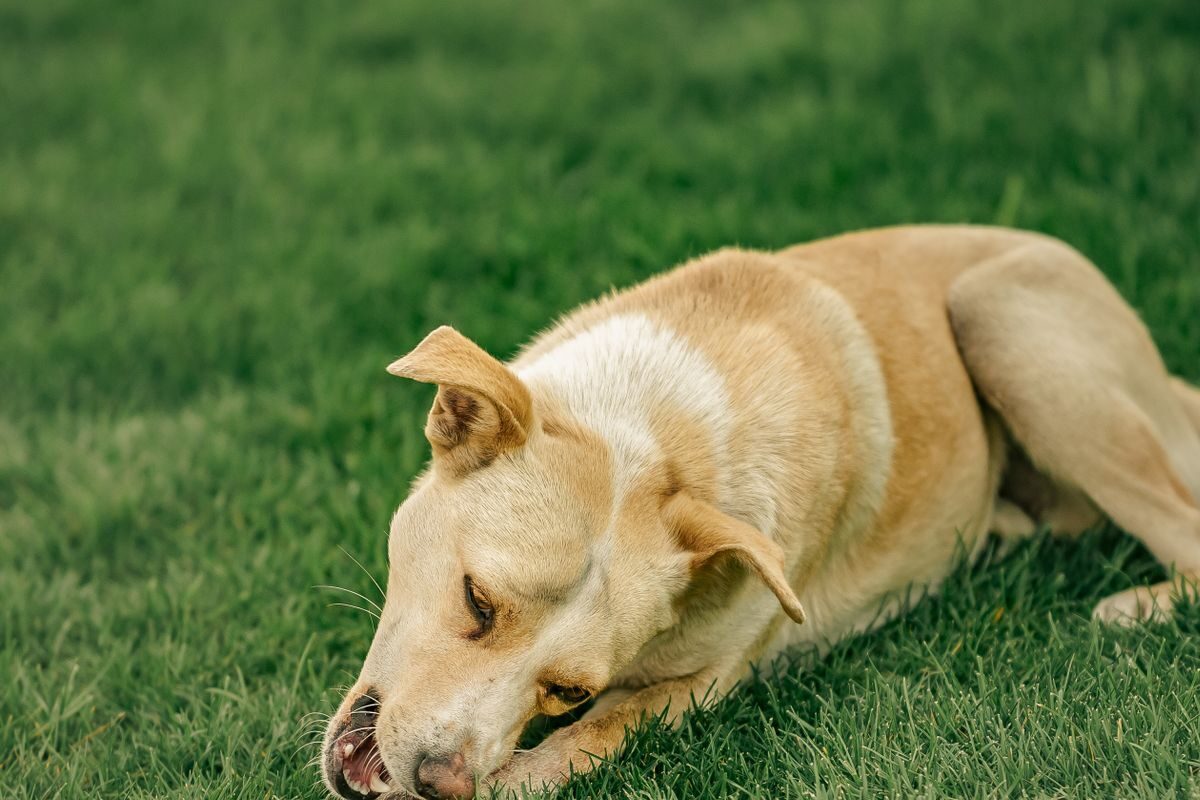
Most dogs eat grass because it is normal grazing behaviour, not because they are ill. In the University of California, Davis surveys, about 68 percent of owners said their dogs ate plants daily or weekly, yet only about 8 percent were often ill beforehand. Worry only when grass-eating is sudden, frantic, or paired with vomiting, appetite loss or lethargy.
Your dog stops mid-walk, lowers his head and starts grazing like he has been waiting all day for that patch. If you have wondered why do dogs eat grass, the reassuring answer for most dogs is that it is normal behaviour, not a cry for help. In the largest survey of plant-eating dogs, only about 8 percent were often ill beforehand and only about 22 percent regularly vomited afterwards, so the old idea that dogs mainly eat grass to make themselves sick does not hold up. The grass itself is rarely the problem. What is on it, and how your dog behaves around the habit, is what matters.
You are out for an ordinary walk. Your dog is bright, dinner went down fine an hour ago. Then he finds a tuft of fresh grass and settles in for a good chew, in no hurry at all.
That calm, picky grazing looks nothing like illness. It looks like a choice. And for most dogs, that is exactly what it is.
This guide looks at what researchers have measured, which explanations hold up, and where the line sits between a harmless habit and a sign worth checking. For the broader picture of care and behaviour, our starting point for looking after a dog well brings the main guides together.
At a Glance
- Grass-eating is common and, for most dogs, normal — not usually a sign of illness or a poor diet.
- In the University of California, Davis surveys, about 68 percent of owners said their dogs ate plants daily or weekly, yet only about 8 percent were often ill beforehand and about 22 percent regularly vomited afterwards.
- Dogs graze for mixed reasons: instinct, taste, hunger, boredom, and sometimes an unsettled stomach.
- The main risks come from what is on the grass — pesticides, herbicides and parasite eggs from droppings — not the grass itself.
- Frantic gulping, repeated vomiting, diarrhoea, weight loss, loss of appetite or lethargy alongside grass-eating are reasons to see a vet.
Contents
- Why do dogs eat grass in the first place?
- What the UC Davis research actually found
- Upset stomach, fibre, taste or boredom?
- The real risks are not the grass itself
- Normal grazing or a reason to worry?
- Why do dogs eat grass at home, and how to reduce it
- Frequently Asked Questions
- Sources and Further Reading
Why do dogs eat grass in the first place?

No single answer explains every dog. PetMD puts it plainly: the exact reason is not fully understood, and several theories probably overlap.
Start with instinct. Dogs are descended from wild canids that ate whole prey, including the plant matter in that prey’s stomach. PetMD notes plant material has been found in 2 to 10 percent of wolf stomach contents, and the American Kennel Club (AKC) makes a similar point: grazing may be part of what dogs are built to do, not a sign something is missing.
Some dogs clearly like fresh grass, especially new spring growth. Puppies explore with their mouths, so grazing can be curiosity as much as appetite — the pattern described in our first-week guide to bringing a puppy home, where mouthing is how a young dog learns.
How a dog eats matters, too. A dog who selects blades, chews slowly and trots on is doing something very different from a dog who gulps grass down in a frantic rush. Watch the second pattern more closely.
What the UC Davis research actually found

Most of what we know comes from surveys by researchers at the University of California, Davis School of Veterinary Medicine — Dr Karen Sueda, Dr Kelly Cliff and Dr Benjamin Hart — published in Applied Animal Behaviour Science in 2008 and summarised by Dr Hart for dvm360.
Two smaller surveys came first: 25 veterinary students, whose dogs all ate grass, with none ill beforehand and only 8 percent regularly vomiting afterwards; and 47 teaching-hospital owners, 79 percent of whom had seen their dogs eat plants, with illness infrequent and vomiting only occasional.
The third survey was the large one. More than 3,000 owners responded; after unusable answers were removed, 1,571 remained:
- About 68 percent said their dogs ate plants daily or weekly.
- About 8 percent said their dogs frequently showed signs of illness before eating plants.
- About 22 percent said their dogs regularly vomited afterwards.
- Younger dogs ate plants more often, and were less likely to seem ill beforehand or to vomit afterwards.
The team also checked diet, and found no indication that dogs fed less fibre, or mostly table scraps or raw food, ate plants more than dogs on a balanced commercial diet. Their conclusion was direct: grass-eating is a common behaviour in normal dogs, and vomiting seems incidental to plant-eating rather than its purpose.
These are owner-reported surveys, not a laboratory trial, so treat the percentages as a pattern, not exact rates for your dog — but the pattern is consistent across all three surveys, which is why vets trust it.
Upset stomach, fibre, taste or boredom?

Each popular explanation explains some dogs, some of the time. None explains all of them.
The upset-stomach idea
The dog feels sick, eats grass to irritate his stomach, vomits, and feels better. The figures show why that cannot be the main story: if most dogs were doing this, far more than 8 percent would look ill beforehand and far more than 22 percent would vomit afterwards.
It is not false for every dog. Dogs who did show illness before eating plants were more likely to vomit afterwards. The AKC also describes a dog who frantically gobbles grass first thing in the morning and brings up yellow foam, or bile. Dr Jerry Klein, the AKC’s chief veterinary officer, explains that bile on an empty stomach can irritate it, and some dogs may eat grass to help release it. A small meal late in the evening sometimes helps in that case — a conversation for your vet, not a home experiment.
Frantic gulping with lip licking, drooling or restlessness points towards nausea. Calm nibbling does not. Spotting the difference is easier once you can read the small signals your dog gives with his whole body.
Fibre and diet
Grass is roughage, and the AKC notes some dogs may seek it for fibre, which helps food move through the gut. PetMD describes an often-cited case: an 11-year-old Miniature Poodle with a seven-year history of eating plants and vomiting, whose behaviour stopped within days of moving to a higher-fibre diet.
One case is not proof for all dogs, and the Davis surveys found no general link between low-fibre diets and plant-eating — so do not change food just because your dog grazes, and do not read grazing as evidence of a deficiency. Extreme, compulsive eating of non-food items is different: the AKC notes a vet may consider pica, where dogs compulsively eat rocks, dirt or fabric. That needs veterinary assessment.
Taste, hunger and boredom
Sometimes the simplest answer is right. The AKC lists boredom and taste among its main reasons, and PetMD notes grass-eating in one 2007 study was influenced by hunger and time of day: dogs ate less grass after a meal, and less later in the day. A dog left alone in a garden will find his own entertainment, and grass is right there.
The real risks are not the grass itself

Untreated grass is not toxic to dogs, and most passes through undigested. The AKC and PetMD agree the genuine risks sit in what the grass carries.
Chemicals come first. Grass treated with herbicides or pesticides can poison a dog. PetMD lists excessive salivation, nausea, vomiting, diarrhoea and reduced appetite among the signs, and advises a veterinary clinic promptly if you suspect this, ideally with the product label. A neighbour’s lawn or a park verge may have been sprayed with no sign to warn you. If you do not know whether grass has been treated, treat it as treated.
Parasites come second. The AKC notes eating grass can expose a dog to intestinal parasites such as roundworms and hookworms, left from animal droppings. PetMD makes the same point about faecal contamination, and notes regular faecal testing and parasite prevention are the sensible defences. You cannot see parasite eggs on a lawn, so routine prevention matters more than policing every blade.
PetMD also notes a very large amount of grass can, rarely, contribute to a gut obstruction, especially mixed with other non-food items. And a grazing dog may not distinguish grass from a toxic plant beside it — one more reason to know which common foods and plants can seriously harm a dog.
The Davis team suggested, as a hypothesis only, that plant-eating in wild ancestors may have helped purge intestinal nematodes by increasing gut movement. That is a theory about evolution, not a treatment: grazing is not a substitute for worming.
Normal grazing or a reason to worry?

Use the table to sort a calm graze from a worry sign — it is a guide, not a diagnosis.
| Sign | More likely normal grazing | More likely a vet visit |
| Style of eating | Calm, selective nibbling, then moves on | Frantic gulping, large amounts, urgent |
| Before eating | Bright, normal appetite and energy | Lip licking, drooling, restlessness, looking unwell |
| After eating | No change, keen to walk or play | Repeated vomiting, diarrhoea, retching without result |
| How often | Occasional, or a steady habit in a healthy dog | New, sudden increase, or becoming compulsive |
| General state | Normal weight, stool and appetite | Weight loss, loss of appetite, lethargy, bloody stool |
| Where it happens | Your own untreated grass | Grass that may have been sprayed, or unknown ground |
The AKC advises staying alert if grass-eating becomes more frequent or excessive, and watching for vomiting, diarrhoea, weight loss, decreased appetite, bloody stool, lethargy or lip licking. A pattern, or any right-hand sign that does not settle quickly, deserves a call to your vet. Frantic eating followed by collapse, repeated unproductive retching, a swollen abdomen or signs of poisoning needs urgent care.
Why do dogs eat grass at home, and how to reduce it

If your dog grazes calmly on safe grass and stays well, you do not have to stop him. If you want to reduce the habit — because the only grass available may be treated, or the habit is excessive — the AKC and PetMD suggest a similar calm approach:
- Supervise garden time; keep your dog on a lead near grass you do not control.
- Teach a solid “leave it”, and reward choosing you over the grass.
- Redirect, do not scold: offer a toy, a game or a known cue.
- Go out after a meal rather than before one, if hunger drives the habit.
- Add occupation: play, training games, sniffing walks and puzzle feeders.
- Keep up parasite prevention and faecal checks, as your vet advises.
Do not let a training fix delay a vet visit when worry signs are present. New or escalating grass-eating plus illness is a medical question first.
Frequently Asked Questions
Do dogs eat grass because they are sick?
Usually, no. Only about 8 percent of dogs in the Davis surveys frequently showed illness before eating plants. A small number do seem to graze when nauseous, and those dogs were more likely to vomit afterwards, but sickness is not the main explanation.
Is it true that dogs eat grass to make themselves vomit?
The evidence does not support it as the usual reason. Only about 22 percent of dogs in the large survey regularly vomited after eating plants. The researchers concluded vomiting is incidental for most dogs, not the goal.
Can eating grass give my dog worms?
It can contribute to exposure. Parasite eggs from other animals’ droppings can be present in soil and on grass, and the AKC and PetMD both list roundworms and hookworms among the risks. Routine prevention and faecal testing are the practical protection.
Should I stop my dog eating grass altogether?
Not if he grazes calmly, in small amounts, on untreated grass, and stays well. Do stop him on treated or unknown grass, and speak to your vet if the habit is new, frantic, excessive or paired with vomiting, diarrhoea, appetite change, weight loss or lethargy.
My dog ate grass that had been sprayed. What should I do?
Contact your vet promptly, or an animal poison service if your vet is closed. Take the product name or label if you can, note how much your dog ate and when, and watch for drooling, vomiting, diarrhoea or reduced appetite. Do not wait for signs to worsen.
Why does my dog eat grass every day?
Daily grazing is common and usually harmless. Many dogs simply like the taste and texture, and grazing is part of normal dog behaviour rather than a daily emergency. The pattern matters more than the habit: a relaxed grazer who eats, plays and toilets normally is very different from a dog who suddenly starts gulping grass urgently.
Does eating grass mean my dog needs more fibre?
Not necessarily. Low fibre is one suggested reason, but it is not proven for most dogs, and a dog on a complete, balanced diet usually gets enough fibre already. If grass-eating comes with soft stools, weight loss or a dull coat, talk to your vet about diet rather than adding fibre on your own.
Is it safe to let my dog eat grass in the garden?
On an untreated lawn, usually yes. The real risks are not the grass itself but what is on it: weedkillers, fertilisers, pesticides and toxic plants. Keep your dog off recently treated areas, check what grows in the patch, and call your vet promptly if your dog grazes where chemicals were recently used.
Sources and Further Reading
- American Kennel Club — Why Does My Dog Eat Grass?
- PetMD — Why Do Dogs Eat Grass?
- dvm360 / Veterinary Medicine — CVC 2008 Highlights: Why do dogs and cats eat grass? (Dr Benjamin L. Hart summarising Sueda, Hart and Cliff, Applied Animal Behaviour Science, 2008)
This article is educational and is not a substitute for veterinary advice. If your dog’s grass-eating is new, frantic or excessive, or comes with vomiting, diarrhoea, weight loss or lethargy, contact your vet. If you suspect poisoning from treated grass or a toxic plant, seek veterinary help immediately.
About the author
Furrology Team — pet owner and researcher behind Furrology. We read the veterinary research and draw on real owner experience, then turn it into plain-English guides about dogs, cats, birds and small pets. We are not vets — Furrology is researched information, not veterinary advice, and a poorly pet always needs a real vet. More about how we work: About Us · Editorial Policy