
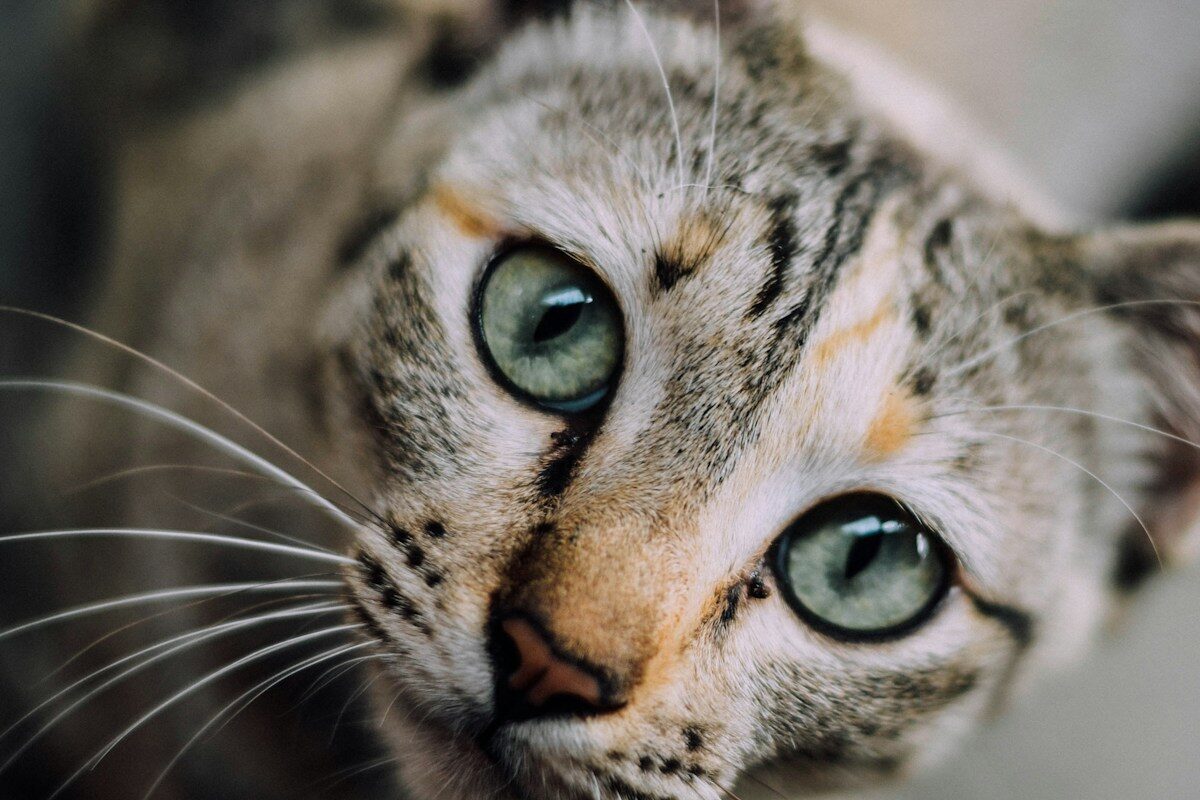
You look up from your phone and your cat is watching you, completely still, eyes fixed on your face, as if you owe an explanation. If you have wondered why does my cat stare at me like that, there is rarely one answer: a relaxed stare with slow blinks usually signals comfort and trust, a stare near feeding time is often a practised request, a wide-eyed fixed stare can mean curiosity, hunting focus or unease, and the rest of the body tells you which. Ears, pupils, tail and posture turn a mysterious stare into a readable one.
Sometimes it happens across a room. Sometimes from six inches away, at 5 a.m. And sometimes while you are eating, which tells you most of what you need to know.
This guide works through seven reasons cats stare, how to tell them apart, and when to call the vet. For the bigger picture, see our overview of cats and their everyday behaviour.
At a Glance
- A stare on its own means little. Read it with ears, pupils, whiskers, tail and posture, as RSPCA Australia advises for all cat body language.
- A soft stare with slow blinks is a positive signal. In a 2020 study in Scientific Reports, cats were more likely to slow blink back at people who slow blinked at them, and more likely to approach a person who had slow blinked.
- Staring often works as a request. If looking at you reliably produces food, play or an opened door, your cat will keep using it.
- A hard, unblinking stare with a tense body, flattened ears or a lashing tail is a warning or stress signal. Give space; do not stare back as a challenge.
- Staring into space, unresponsiveness, or a sudden change in staring in a senior cat should be discussed with a vet.
Contents
- How to read a stare: why does my cat stare at me in this moment?
- Reason 1 and 2: affection and the slow blink
- Reason 3 and 4: requests and learned behaviour
- Reason 5 and 6: curiosity, hunting focus, and watching for cues
- Reason 7: unease, overstimulation, and the hard stare
- Should you stare back? A practical guide
- When staring is a health sign
- Frequently Asked Questions
- Sources and Further Reading
How to read a stare: why does my cat stare at me in this moment?

Never read one signal alone.
RSPCA Australia advises looking at eyes, tail, mouth and posture together, noting facial expressions change fastest and give the most current signal. Add four checks: ears forward means interest or calm, flattened means uncertainty; pupils widen in dim light and with arousal, so check light first; a lashing or tucked tail points to tension; a loose body is relaxed, a crouched or stiff body wants distance.
| What you see with the stare | Most likely reading | A sensible response |
|---|---|---|
| Soft eyes, slow blinks, loose body, purring | Relaxed, comfortable, affiliative | Slow blink back; let the cat choose contact |
| Stare near food cupboard or at meal time, meowing | Practised request for food or routine | Keep routine steady; do not add extra meals |
| Head up, ears forward, following your hands or a toy | Curiosity or hunting/play focus | Offer play with a wand toy |
| Stare, then look at door, bowl or toy, then back at you | Request with a clear target | Check the target |
| Wide eyes, little blinking, tense or crouched body | Unease or feeling threatened | Stop approaching; give space and an exit |
| Hard unblinking stare, ears flat, tail lashing, hissing | Warning; wants distance now | Move away calmly; do not hold eye contact |
| Staring at nothing, unresponsive, especially if senior | Possible health or cognitive issue | Note frequency; contact your vet |
Seven common reasons sit behind those patterns. They overlap, and a single stare can carry two at once.
Reason 1 and 2: affection and the slow blink

1. Your cat feels comfortable with you
Cats are unlikely to hold relaxed eye contact with someone they distrust. A cat who settles nearby with soft eyes and drooping eyelids is sharing a room with you on purpose.
It often arrives with other quiet signals, including that rhythmic paw pressing that signals contentment. If the stare comes with that habit, our guide to why cats make biscuits on laps and blankets explains its kittenhood roots. Quiet company is the point; scooping the cat up often ends the moment.
2. The slow blink exchange
A slow blink sequence involves half-blinks followed by a prolonged eye narrow or closure. In 2020, researchers at the University of Sussex and the University of Portsmouth published the first experimental test of it in Scientific Reports, led by Dr Tasmin Humphrey and Professor Karen McComb, with Dr Leanne Proops co-supervising.
In the first experiment, with 21 cats from 14 households, cats were more likely to slow blink at owners after owners slow blinked at them, compared with no interaction. In the second, with 24 additional cats and an unfamiliar researcher, cats slow blinked more after a slow blink than a neutral expression, and preferred to approach the researcher’s hand afterwards.
The University of Portsmouth summary concludes slow blinking can provide positive communication between cats and humans, and may have begun as a way to interrupt a threatening unbroken stare. Owners call it a cat kiss. Try it as Professor McComb suggests: narrow your eyes in a relaxed smile, then close them for a couple of seconds.
The study did not prove a cat feels love in the human sense. The supported claim is positive communication and increased approach.
Reason 3 and 4: requests and learned behaviour

3. Your cat wants something specific
Cats learn routines precisely — feeding time, a particular cupboard, the chair you sit in before play — and staring is a low-cost way to start the sequence. The clue is direction: a requesting cat often looks at you, then at the bowl, door or toy, then back at you. That triangle is close to pointing.
Keep the routine steady. Feeding extra meals because a stare felt intense teaches your cat that intensity works.
4. Staring has worked before
Cats repeat behaviour that pays off. If staring has produced food, a game, stroking or an opened door, it becomes a trained tool, even though nobody formally trained it. That is ordinary learning, not scheming.
If demand staring is constant, do not punish it or give in every time. Build wanted things into predictable times: meals at set hours, play morning and evening. Our guide to building a closer bond without spoiling the routine covers that balance.
Reason 5 and 6: curiosity, hunting focus, and watching for cues

5. You are doing something interesting or unfamiliar
People are bafflingly busy to a cat. Watching you is how a cat gathers information about whether any of it matters. A curiosity stare usually has ears forwards, head up, and a body alert but not tense. Novel sounds, visitors and rearranged rooms increase watching, as the cat updates its map of what is safe.
Your cat may also look at you to check how you feel about a thing. Research on cats and unfamiliar objects found cats looking between an object and their owner, with some behaviour varying by the owner’s emotional message. A calm face and voice help.
6. Hunting and play focus has locked on
Body low or still, ears forwards, pupils wider, whiskers forwards, and sometimes a wiggling back end before a pounce: that is a hunting stare. The target may be a toy, a bird outside, or your feet under a duvet.
Redirect, do not rebuke. Slide a wand toy into the line of sight and let the sequence complete in play: stalk, chase, catch. Our guide to what your cat’s chosen sleeping spot and posture suggest covers the resting version of that watchfulness.
Reason 7: unease, overstimulation, and the hard stare

Not every stare is friendly, and this is the one to learn well, because misreading it is how people get scratched by a cat who believes it warned them clearly.
In cat-to-cat encounters, a direct, unbroken stare is confrontational. Guidance summarised from International Cat Care contrasts wide-eyed, unblinking staring in antagonistic encounters with relaxed, blinking, half-closed eyes as non-threatening signals.
Signs that move a stare into this category include a tense or crouched body, ears pinned back, pupils wide in normal light, a tail wrapped tight or flicking sharply, and hissing or growling if pressure continues. Overstimulation during stroking can look similar: fixed gaze, rippling skin, lashing tail. That is a stop signal.
The response is boring, and it works: stop, soften your gaze, turn slightly sideways, and give the cat a way out. Do not lean in or hold a staring contest. If hard stares are frequent in a previously relaxed cat, look for a cause such as pain, a new pet or a changed routine.
Should you stare back? A practical guide

For a soft stare, answer softly: narrow your eyes in a relaxed smile, close them for a couple of seconds, then look slightly away. For a requesting stare, answer the routine, not the intensity, and keep meal and play times predictable. For a curious or hunting stare, offer something better to chase.
For a hard stare, do not stare back. Unblinking eye contact from you can be read as a challenge. Blink slowly, avert your gaze, and create distance. In general, let your cat start and end eye contact: a cat free to leave will choose to look at you more, not less.
When staring is a health sign

Most staring is communication. A small set of patterns belongs in a vet conversation instead.
Prolonged blank staring with unresponsiveness should be discussed with a vet, particularly in senior cats, where cognitive changes can alter orientation and interaction. A short log of frequency and duration helps.
A stare paired with freezing, twitching, drooling, balance loss or unawareness needs prompt care, as these can accompany seizures or other neurological problems. Eye pain, a cloudy eye, pupils that stay unequal, or bumping into things needs same-day advice. A healthy young cat staring over breakfast is not a medical case: this category is for staring that is new, prolonged, unresponsive, or travelling with other changes.
Frequently Asked Questions
Why does my cat stare at me without blinking?
It usually means high focus: on you, a request, a toy, a sound, or something it is unsure about. Ears forward with a loose body points to interest; a tense body and flicking tail point to unease, and the right response is space.
Is my cat judging me when it stares?
Judgement is a human frame. Your cat is far more likely monitoring you for information: what you are doing, whether food or play might follow, and whether the room feels safe.
Why does my cat stare at me while I sleep?
Usually an early routine request: breakfast or company. Cats are most active at dawn, so your sleeping face is, to your cat, a delay in the schedule. A consistent evening play session and meal reduces dawn demands for many households.
What does it mean if my cat slow blinks at me?
A positive signal. In the 2020 Scientific Reports study, cats slow blinked more in response to a person’s slow blink and were more likely to approach after one. Owners call it a cat kiss; the careful claim is positive communication and comfort.
Why does my cat stare and then look away?
Looking away is often polite. Breaking eye contact lowers pressure and signals no conflict is intended. A cat who slow blinks then turns away is commonly comfortable and finished, not offended.
Should I be worried if my cat stares at walls or into space?
Occasional wall watching is usually tracking a sound, insect or reflection you have not noticed. Worry is for prolonged blank staring, unresponsiveness, disorientation, or a new habit in a senior cat. Log episodes and talk to your vet.
Sources and Further Reading
- Humphrey, Proops, Forman, Spooner and McComb — The role of cat eye narrowing movements in cat–human communication, Scientific Reports (2020), via University of Portsmouth summary — https://www.port.ac.uk/news-events-and-blogs/news/how-to-build-rap-paw-with-your-cat
- RSPCA Australia — Understanding cat behaviours (reading eyes, ears, whiskers, tail and posture together) — https://www.rspca.org.au/latest-news/blog/understanding-cat-behaviours/
- PetMD — Can Cats Smile? (happy body language including slow blinking, relaxed posture and kneading) — https://www.petmd.com/cat/general-health/can-cats-smile
- PetPlan UK — 10 puzzling cat behaviours explained (staring, slow blinking as trust, crouch and flicking tail before a pounce) — https://www.petplan.co.uk/cat-insurance/cat-care-and-advice/why-does-my-cat.html
This article is educational and is not a substitute for veterinary advice. If your cat’s staring changes suddenly, becomes prolonged and unresponsive, or comes with disorientation, balance problems or appetite changes, contact your vet.
About the author
Furrology Team — pet owner and researcher behind Furrology. We read the veterinary research and draw on real owner experience, then turn it into plain-English guides about dogs, cats, birds and small pets. We are not vets — Furrology is researched information, not veterinary advice, and a poorly pet always needs a real vet. More about how we work: About Us · Editorial Policy