
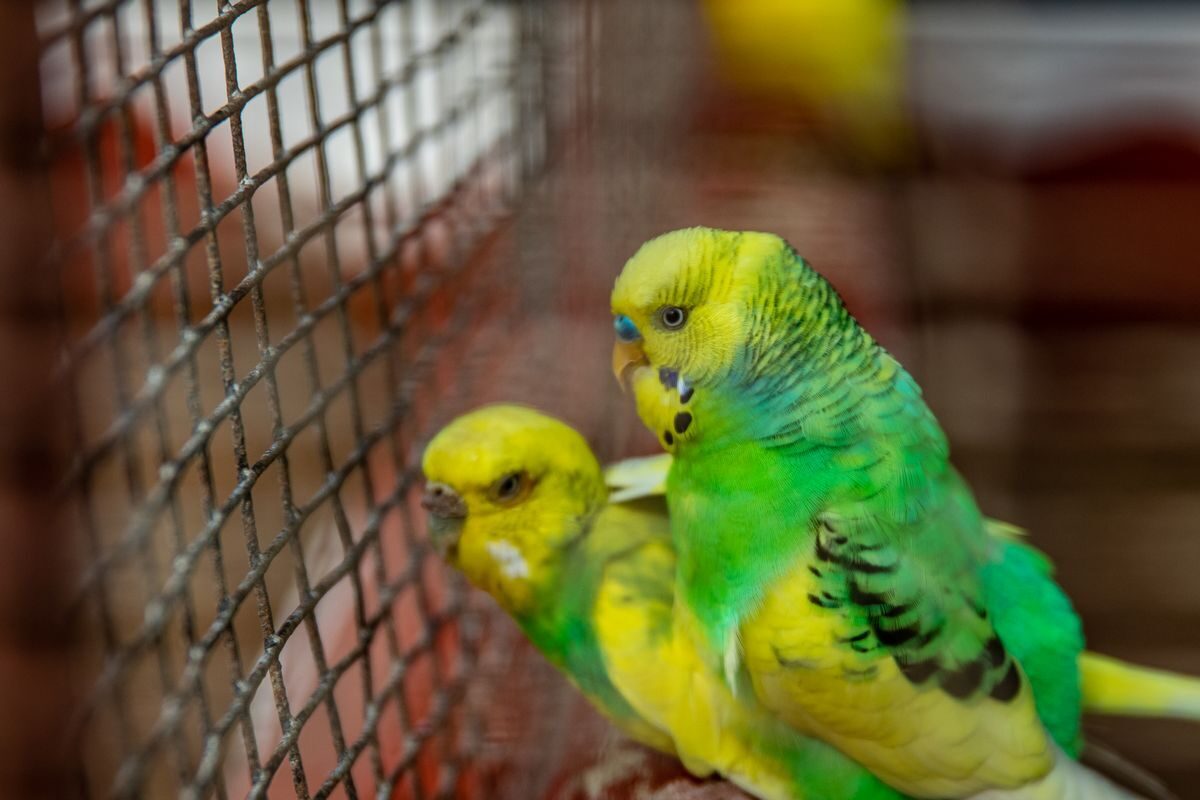
Mirror toys are not automatically bad, but they are risky for budgies, because a mirror looks like a companion who never behaves like a real flock mate. The main worries are obsession: bonding to the reflection, feeding it by regurgitating, courtship behaviour, and frustration when nothing comes back.
So, are mirror toys bad for budgies? For most pet budgies, a mirror left in the cage all the time is a poor trade: the bird reads its reflection as another budgie, tries to court, feed and talk to a companion who never answers properly, and can end up frustrated, obsessed, or less interested in you and in real birds. A brief, watched look is a different matter from living with one.
It starts sweetly: you hang a little mirror, your budgie hurries over chattering and bobbing, and the cage sounds twice as lively. The harder question is week three, when the mirror is still the centre of your bird’s day. This guide covers why mirrors pull so strongly, what sources worry about, where the other side has a point, and what to offer instead. See also our complete guide to pet birds and their care.
At a Glance
- Budgies are flock birds. A mirror looks like a companion who never behaves like a real flock mate.
- Sources worry most about obsession: bonding to the reflection, feeding it by regurgitating, courtship behaviour, and frustration when nothing comes back.
- A mirror can crowd out taming, and can come between a bird and real cage mates.
- Short, supervised mirror time, or a mirror in a busy aviary, is far less risky than a permanent mirror for a lone bird.
- Most welfare guidance leans against leaving mirrors in the cage long-term. Foraging toys, chew toys and real social time are safer.
- If your budgie guards a mirror, feeds it, or ignores other toys for it, take it out.
Contents
- Why budgies are drawn to mirrors
- Are mirror toys bad for budgies? The concerns
- The other side of the argument
- Signs a mirror has become a problem
- Better alternatives to a mirror
- What if my budgie already has a mirror?
- Are mirror toys bad for budgies in a flock?
- A simple enrichment checklist
- Frequently Asked Questions
- Sources and Further Reading
Why budgies are drawn to mirrors

In the wild, budgies live in large flocks, calling, preening, feeding and moving together. The RSPCA groups budgies with other colony-breeding species that can live in social groups, and welfare writers in New Zealand describe the typical lone pet setup, often with only a mirror for social stimulation, as a widespread welfare concern.
A mirror is not a shiny object to that social bird. It is what looks like another budgie, one who never flies off and always moves when your bird moves. Psittacology, a parrot care site with vet fact-checking, puts it plainly: budgies cannot tell that their reflection is actually them. They interpret it as another budgie, which is why solo birds can become obsessed.
Are mirror toys bad for budgies? The concerns

The trouble usually builds slowly, and it needs the same ingredients: a lone bird, long empty hours, and not much else to do in the cage.
A companion who never answers properly
A real flock mate preens back, calls back with its own timing, and sometimes starts the interaction. A reflection copies: it never initiates, never grooms, never settles a squabble. Some birds try to mate with their reflection or fight it, and because it never behaves like a real partner, they end up highly frustrated — Psittacology describes that loop as stress. Eating and sleeping can be disrupted while a bird spends hours trying to preen or feed its friend.
Feeding and courting the reflection
Regurgitation is normal in the right place: a male regurgitates to a mate and to young, as Chewy’s hormonal guide confirms through the American Budgerigar Society. Aimed at a mirror, it becomes a loop with no end. Psittacology says a budgie regurgitates on its mirror because it thinks the reflection is a flock member it is trying to woo by feeding, and the mirror should be removed. Petco’s vet Q&A gives the same advice — remove the mirror, rearrange and rotate toys — and notes constant regurgitation can affect health. Chewy adds that a mirror can trigger courting behaviour, and one of its vets recommends taking mirrors away to discourage it.
Aggression, and slower taming
Frustration does not always stay at the mirror. Psittacology notes mirror-obsessed budgies can become aggressive towards real flock mates or their carers. If biting is part of your picture, our guide to why a budgie bites and how to rebuild trust helps separate fear, hormones and guarding. Taming can stall too: a permanent mirror is a companion who asks for nothing. Older care advice puts it in one line — mirrors encourage a budgie to bond with its reflection rather than with you, especially during training.
The other side of the argument

Psittacology itself says placing a mirror in a large flock, or letting a bird play with one for a few minutes at a time, is not going to cause much harm, and that a flock bird has real friends to meet its social needs. The same source is clearest about solo birds, where the writer does not offer mirrors at all.
| Situation | How sources tend to treat it |
|---|---|
| Mirror left permanently for a lone budgie | The main concern; obsession and frustration are most likely here |
| Brief, supervised mirror play, then removed | Treated as low-risk novelty; watch for fixation |
| Mirror in a large, busy flock or aviary | Far less of an issue, because real companions meet social needs |
| Mirror used as a substitute for company | A welfare problem in itself, whatever the toy |
If a single bird clings to a mirror, the mirror may be the symptom: the real problem is a flock animal with no flock. Removing it without adding company or enrichment leaves the loneliness untouched. A mirror promises company it cannot deliver, and the longer a lonely bird relies on that promise, the poorer the outcome tends to be.
Signs a mirror has become a problem

Watch for patterns over several days, not one keen afternoon.
- Your budgie spends most of its active time at the mirror and leaves it mainly to eat or drink.
- You see repeated regurgitation onto the mirror or the perch beside it.
- Calling and head-bobbing at the mirror go on for long stretches and are hard to interrupt.
- Your bird guards the mirror, lunges at hands near it, or has become harder to step up.
- Interest in other toys, bathing, foraging or out-of-cage time drops away.
- A cage mate is ignored or chased off for most of the day.
One sign, once, is not a verdict. Several signs, most days, is a clear instruction to act. For contrast, our guide to the signs a budgie is happy and relaxed shows what loose, varied, social behaviour looks like when enrichment is working.
Better alternatives to a mirror

The goal is not a bare cage. You are replacing a false companion with real activity.
For many lone budgies, the best answer is another budgie, introduced carefully, with quarantine and space for both to move away from each other. The RSPCA notes colony species such as budgies can live in social groups in a large cage or aviary, with room to fly and retreat. A second bird doubles food, vet and cleaning needs. If one is not possible, your daily interaction has to rise — talking, training, supervised flight, every day.
For toys, Psittacology recommends foraging toys, chew toys of soft wood, bells, and training toys. PetMD lists a similar spread: shredding, foot toys, swings, noise makers and foraging toys. Rotate them every few days. Our complete parrot diet guide, from pellets to foods to avoid gives safe items to hide for foraging.
What if my budgie already has a mirror?

Do not stage a dramatic removal and leave the cage empty. Make the change part of a better day.
- Add the replacement first: a foraging toy and a chew toy, plus time interacting with your bird that day.
- Remove the mirror during a normal cage clean or rearrangement.
- Rearrange perches and remaining toys, as Petco’s vet advice suggests, so the old mirror spot is not left empty.
- Watch eating, droppings and activity for a few days. A bird who goes quiet, eats less, or calls constantly needs more enrichment, and a vet check if it persists.
- Do not reintroduce the mirror as a consolation prize for a noisy afternoon.
Some birds settle within days. Others need more out-of-cage time, a training routine, or a real companion, because the mirror was carrying more social weight than any toy can replace. A bird in a frustrated loop also misses the exercise, rest and varied feeding behind a long life — see our guide to how long budgies live and how to help them live longer.
Are mirror toys bad for budgies in a flock?

Less so. With real companions present, a mirror is one shiny item among many, and Psittacology treats that setting as unlikely to cause much harm. Watch the individual, though: a flock bird who still chooses the mirror over real mates all day is telling you something, and it should come out for that bird.
Mirrors remain a flight hazard outside the cage. PetMD lists mirrors among the dangers to check before free flight, alongside windows and ceiling fans. Cover large mirrors during out-of-cage time.
A simple enrichment checklist

- One foraging toy with a small, healthy treat hidden inside
- One chew or shredding toy your bird is allowed to destroy
- Toys rotated every few days, perches rearranged weekly
- A daily session of talking, training or supervised flight
- A bath dish or gentle misting offered regularly
- No permanent mirror for a lone bird; any mirror play brief and watched
- A plan for company — your time, honestly counted, or a companion bird
Frequently Asked Questions
Are mirror toys bad for budgies if my bird seems happy with one?
Seeming happy on day one is normal — the chatter is real social excitement. The concern is what it becomes over weeks for a lone bird: feeding and guarding the mirror, all day, with a companion who never responds properly. Judge it by the pattern, not the first afternoon.
Can a mirror stop my budgie learning to talk or bond with me?
It can slow both down. A permanent mirror is an always-available companion who never asks the bird to take a risk on a person, and older guidance warns it encourages bonding with the reflection rather than with you. Short, rewarding training sessions give your bird a reason to choose you.
My budgie regurgitates on its mirror. Should I worry?
Take the mirror out. Psittacology and Petco’s vet Q&A both treat this as courtship feeding of an imagined flock mate, and both advise removal and toy rotation. Constant regurgitation can affect health, so if it continues after the mirror goes, or comes with weight loss or changed droppings, see an avian vet.
Is a mirror better than nothing for a budgie alone all day?
It is better to fix the alone part. A mirror does not meet a flock bird’s social needs, and welfare commentary treats a mirror-only setup as part of the problem. More interaction, supervised flight, foraging, and, where possible, a companion budgie answer the need a mirror only imitates.
Can I let my budgie look in the bathroom mirror sometimes?
Brief, supervised mirror time outside the cage is the use sources treat as low risk. Keep sessions short, and cover large mirrors during free flight because of the collision risk PetMD flags. If your bird becomes hard to move away or starts feeding the glass, that game is over.
Do female budgies react to mirrors the same way as males?
Both sexes can bond to, court, or guard a reflection, though what you see may differ. Chewy’s hormonal guide notes courting triggers generally, and describes hens showing readiness by squatting, putting wings out and cooing.
What are the signs a mirror has become a problem?
Watch for a budgie who spends most of the day at the mirror, regurgitates on it, courts it, ignores food, toys and people, or gets agitated when the mirror is removed. Any of those signs means the mirror has stopped being enrichment and started being an an obsession, and it should come out.
What should I give my budgie instead of a mirror?
Real company first: another budgie if your home allows it. Otherwise, rotate safe toys, offer foraging challenges, give daily out-of-cage time, and spend time talking and training with your bird. A varied cage with things to chew, climb and shred beats a reflection that never answers back.
My budgie already has a mirror. Should I take it away at once?
Not necessarily all at once if your bird is calm and still eats, plays and interacts normally. Watch first: if the bird is bonded to the mirror but otherwise healthy, reduce mirror time gradually and add other enrichment. If obsession signs appear, remove it and expect a few unsettled days while the bird readjusts.
Sources and Further Reading
- Psittacology — Are Mirrors Bad For Budgies? (reflection read as another bird; frustration, regurgitation; brief and flock use lower risk) — https://www.psittacology.com/are-mirrors-bad-for-budgies/
- Chewy, vet-attributed — Hormonal Parakeet Behavior (mirror triggers courting including regurgitation) — https://www.chewy.com/education/bird/parakeet/hormonal-parakeet-behavior
- Petco, vet Q&A — Budgie/mirror regurgitation (remove the mirror, rearrange and rotate toys) — https://www.petco.com/pet-education/bird/vet-qa/budgie-talking-mirror-hormones-removal
- RSPCA — Living With Other Birds (budgies among colony species that can live in social groups) — https://www.rspca.org.uk/adviceandwelfare/pets/birds/company
- Companion Animals New Zealand — Budgerigars in New Zealand (lone budgie with only a mirror as a welfare concern) — https://www.companionanimals.nz/articles/budgerigars-in-new-zealand-are-we-underestimating-them
- PetMD — How Long Do Parakeets Live? (social birds, enrichment, mirror flight hazard) — https://www.petmd.com/bird/how-long-do-parakeets-live
This article is educational, not a substitute for veterinary advice. If mirror behaviour comes with weight loss, constant regurgitation or a sudden change in temperament, contact an avian vet.
About the author
Furrology Team — pet owner and researcher behind Furrology. We read the veterinary research and draw on real owner experience, then turn it into plain-English guides about dogs, cats, birds and small pets. We are not vets — Furrology is researched information, not veterinary advice, and a poorly pet always needs a real vet. More about how we work: About Us · Editorial Policy