
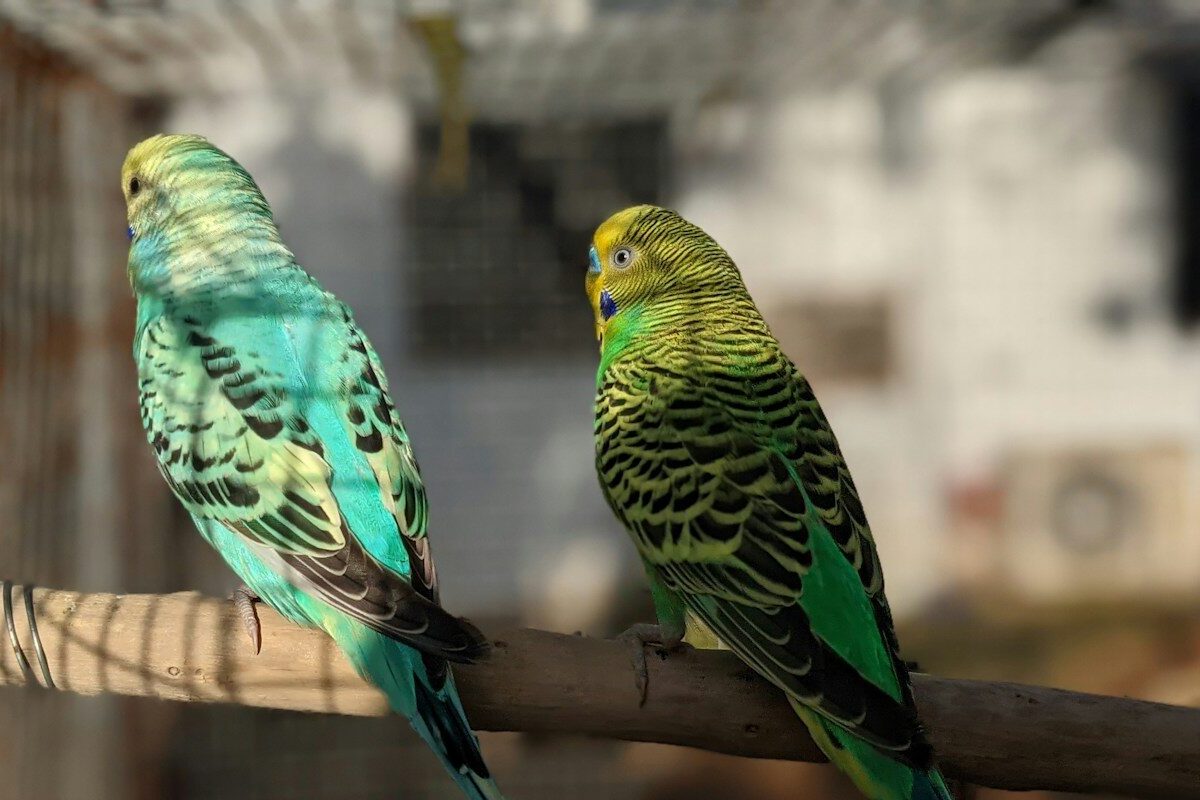
Pet budgies commonly live 5 to 10 years. PetMD puts captive budgies at 7 to 15 years, Birdfact puts the typical pet range at 6 to 12, and both agree the top end takes excellent care. Wild budgies live around 4 to 6 years, facing predators, hard seasons and no vet care.
There is no single number for how long budgies live — it is a range. Pet budgies commonly live around 5–10 years, many well-kept birds reach 10–12, and 10–15 is possible with excellent care — while wild budgies live shorter lives, at around 4–6 years. Where your bird lands depends far more on daily care than on luck.
That range surprises people both ways. Some expect a small bird to live two or three years; others have heard of a budgie in his late teens and assume that is normal. This guide gives the figures vets actually cite, and the habits that help most. For the full daily setup, our complete guide to pet birds and their care is the place to start.
At a Glance
- Pet budgies commonly live 5–10 years. PetMD puts captive budgies at 7–15 years, Birdfact puts the typical pet range at 6–12, and both agree the top end takes excellent care.
- Wild budgies live around 4–6 years, facing predators, hard seasons and no vet care.
- English, or show, budgies tend to live shorter lives than American, or pet-type, budgies: about 6–9 years against 8–12.
- The biggest preventable shorteners are an all-seed diet, no exercise, dirty air — including fumes from overheated non-stick cookware — and illness spotted too late.
- The habits that help most are a pellet-and-vegetable diet, daily flight, yearly avian vet checks, 10–12 hours of quiet sleep, and clean air.
- Older budgies slow down and sleep more. A sudden change is never just age until a vet has checked it.
Contents
- How long do budgies live as pets?
- Why wild budgies live shorter lives
- English and American budgies
- What shortens a budgie’s life
- How long do budgies live with excellent care?
- Signs your budgie is getting older
- Caring for a senior budgie
- A lifespan checklist
- Frequently Asked Questions
- Sources and Further Reading
How long do budgies live as pets?

The sources do not quote one identical figure, and pretending they do would mislead you. PetMD’s vet-written lifespan guide says budgies in captivity can live anywhere between 7 and 15 years. Its care sheet gives a tighter version: with proper care, pet budgies can live up to 10–12 years. Its facts page puts the general range at 6–12 years.
Birdfact lands in a similar place: pet budgies can live up to 15 years, but 6 to 12 is a more reasonable range, with an average probably nearer 8, and few birds reach 15.
| Life situation | Commonly cited lifespan |
|---|---|
| Wild budgie | Around 4–6 years |
| Pet budgie, ordinary care | Around 5–10 years |
| Pet budgie, excellent care | Around 10–12 years, with 10–15 possible |
| English / show budgie | Around 6–9 years |
| American / pet-type budgie | Around 8–12 years |
Exceptional birds go further. Birdfact notes pet budgies living to almost 20 in exceptional circumstances, and records the longest-lived budgie it reports, Charlie, at 29 years and 2 months. Treat those as outliers, not targets. Even the middle of the range means a decade of daily care.
Why wild budgies live shorter lives

PetMD puts wild budgies at 4–6 years and names the threat plainly: predation. Birdfact gives the same 4–6 year range. Add food that vanishes in drought, water that dries up, disease with no treatment, and the energy cost of flying long distances for the next meal.
A pet bird is spared almost all of that, which is why captivity roughly doubles the span when care is good. That doubling is not automatic. A cage removes hawks, but can add poor food, stale air, boredom and no exercise. The gap between wild and pet lifespan is a measure of how well we do our side of the bargain.
English and American budgies

Birdfact describes the traditional budgerigar, also called the American budgie, as descended more directly from wild Australian stock, with a typical lifespan of 8–12 years. The English budgie — also called the show or exhibition budgie — is larger, with fuller feathering, has been more intensively bred for the show bench, and lives more like 6–9 years on Birdfact’s figures. Other comparisons found in research point the same way, putting English budgies at roughly 7–9 years.
Choose with your eyes open, favour breeders who prioritise health over extreme looks, and give an English budgie especially attentive diet and vet care. Colour, on Birdfact’s account, has no real impact on longevity — type and breeding matter more than shade.
If you are still choosing a bird, our budgie care guide for beginners, from cage to first week walks through type and settling-in. For context only, budgies sit at the shorter-lived end of the pet parrot family — a well-kept cockatiel is usually quoted a longer span, as our guide to how long cockatiels live explains.
What shortens a budgie’s life

An all-seed diet
PetMD is blunt about seed: many seed diets do not provide adequate protein, vitamins and minerals, and parakeets can lack calcium and vitamin A on seed-heavy feeding. A pelleted, balanced diet is its recommended prevention, with seeds kept for enrichment. The full story is in our complete parrot diet guide. PetMD lists obesity, liver disease and tumours among common budgie problems, and diet feeds directly into the first two.
Too little movement, and bad air
PetMD advises the largest habitat possible, and Birdfact lists exercise and diet together as strong influences on lifespan. A sedentary bird gains weight easily and has less reserve when illness arrives.
Birds breathe far more efficiently than we do, which makes them far more vulnerable to air quality. VCA Hospitals explains that overheated non-stick coatings containing PTFE release colourless, odourless gases that are toxic when inhaled, birds can be poisoned even from another room, and smaller birds including budgies are the most sensitive. Sudden death may be the only sign. Birdfact also names cigarette smoke, air fresheners and other fumes among things that can kill a budgie suddenly.
Illness spotted too late
Budgies hide illness. PetMD says birds can be good at masking sickness, so any sense that something is off deserves a prompt vet call. By the time a small bird looks clearly ill — fluffed, quiet, tail-bobbing, off its food — the problem is often advanced, and a tiny bird has very little time in reserve.
How long do budgies live with excellent care?

No habit guarantees fifteen years. Genetics, early life and chance play a part. But birds who reach the upper end tend to share the same daily pattern.
Build the diet on formulated pellets with daily vegetables, as PetMD recommends — pellets at about 70% of the diet on its facts page, the rest from fresh vegetables, fruit, grains and small treats — and keep seed as an occasional extra. Give the largest cage you can, time out of it in a bird-safe room, and food that takes work to get. PetMD lists active foraging, enrichment and social interaction among its ways to improve a parakeet’s lifespan. Toys matter, though not every toy helps — our look at whether mirror toys are bad for budgies explains why a foraging toy beats a mirror that only pretends to be company.
PetMD advises yearly vet visits, with yearly bloodwork and parasite screening, and quarantining any new bird for at least 30 days. Regular checks establish a normal baseline that makes change easier to spot. Find that vet while your bird is well.
Budgies also need a proper night. Guidance across vet Q&A and care sources converges on 10–12 hours of darkness and quiet, with a covered cage or dark room helping in a busy home. Regular feeding, cleaning and bedtimes give a small prey animal a predictable, less stressful world.
Signs your budgie is getting older

Ageing is gradual, and its signs overlap with illness. The rule is simple: slow change over months may be age; sudden change over days is a vet visit.
Birdfact describes the pattern clearly. Older budgies sleep more and have less energy. In their last couple of years, many become quieter, less active and more withdrawn, and particularly old birds begin to lose eyesight and other senses. Plumage becomes less vibrant, and older birds become more reclusive and less talkative.
Owners also report shorter flights, stiffness when climbing, duller feathers despite a good diet, and more daytime naps in a bird who still eats normally. Sleeping more with a good appetite at nine is different from a three-year-old who has gone quiet this week: that bird is ill until proven otherwise.
Caring for a senior budgie

A senior budgie needs the same care, adjusted. Lower a favourite perch a little, add a wider perch kinder to older feet, and keep food and water within an easy hop of where your bird rests. Keep the cage layout familiar — a bird losing eyesight navigates partly from memory.
Keep the vet rhythm, and tighten it if your vet advises. Gentle weight checks catch the slow loss feathers hide. Keep diet quality high — an older body has less margin for a deficient one — and keep gentle flight going while your bird enjoys it. Keep the cage out of draughts, and let your bird set the pace of handling.
A lifespan checklist

| When | What to do |
|---|---|
| Daily | Fresh pellets, vegetables and clean water; check appetite and droppings; social time and supervised flight; 10–12 hours of dark, quiet sleep |
| Weekly | Full cage clean; weigh your bird if it tolerates it; rotate toys; offer a bath or gentle misting |
| Monthly | Check perches, toys and cage bars for wear; review how much seed and treat food is really given |
| Yearly | Avian vet examination, with bloodwork and parasite screening as advised |
| Always | No smoking, sprays or overheated non-stick cookware nearby; quarantine new birds for 30 days; act on changes quickly |
Frequently Asked Questions
How long do budgies live in a cage at home?
Most pet budgies live around 5–10 years with ordinary good care, and many reach 10–12. PetMD gives 7–15 years for captive budgies and Birdfact gives 6–12 as the typical pet range, with about 8 as a rough average. The spread reflects diet, exercise, air quality and how quickly illness is treated.
Can a budgie really live for 15 or 20 years?
Fifteen is possible but exceptional — Birdfact says not many birds reach it — and birds near 20 are rare outliers. Plan for a decade or more, celebrate anything beyond that as a bonus, and do not treat a bird who dies at nine or ten as a failure of care.
Do male or female budgies live longer?
There is no strong, consistent gap. Birdfact reports breeders and keepers sometimes say females live slightly longer, but only by a few months. Sex matters far less than diet, housing, genetics and vet care.
What is the most common preventable reason budgies die young?
Poor diet, with an all-seed diet at the centre of it. PetMD links imbalanced seed diets to nutritional disease and inadequate calcium and vitamin A, and lists obesity and liver disease among common budgie problems. Undetected illness and fume exposure are the other big preventable shorteners.
Is my budgie old at seven?
Your budgie is entering its senior stretch at seven, but is not necessarily near the end. Seven sits past the middle of the usual pet range, so it is a good age to start senior adjustments — closer weight watching, easy perches, firm yearly vet checks — while still expecting active years ahead.
How can I tell my budgie’s age if I do not know it?
Only roughly, and mainly in young birds. Birdfact notes you can only reliably age a budgie when it is young; adults are gauged loosely by plumage and behaviour, which vary between individuals. A vet can help judge from condition, eyes and feet, but an exact age for a rescued adult is usually unknowable.
What shortens a budgie’s life most often?
The preventable causes are a seed-only diet, no vet care, household hazards such as non-stick fumes and draughts, and loneliness or boredom. A budgie on pellets and vegetables, with regular vet checks, clean air and daily interaction, has a far better chance of reaching double figures than one on seed alone in a quiet room.
How can I tell if my budgie is getting old?
Look for quieter behaviour, less flying, more sleeping, duller feathers, and slower movement. Older budgies may need lower perches, easier food access and warmer rooms. Ageing itself is gradual — a sudden change in behaviour, appetite or droppings is illness, not age, and needs a vet check.
Is it worth getting a second budgie for an older bird?
Sometimes, but introduce carefully. A calm companion can enrich an older budgie’s life, but a boisterous young bird can stress a senior. Quarantine the new bird first, introduce in neutral space, and keep a spare cage ready. If your older budgie is ill or frail, ask your avian vet before adding a cage mate.
Sources and Further Reading
- PetMD — How Long Do Parakeets Live? (captive 7–15 years; wild 4–6 years) — https://www.petmd.com/bird/how-long-do-parakeets-live
- PetMD — Budgie Care Sheet (with proper care, up to 10–12 years) — https://www.petmd.com/bird/budgie-care-sheet&
- PetMD — Budgerigar Facts (lifespan 6–12 years; pellets about 70%) — http://www.petmd.com/bird/care/budgerigar-facts-what-to-know-about-budgerigar
- Birdfact — How Long Do Budgies Live? (pet 6–12 years, up to 15; English 6–9, American 8–12; ageing signs) — https://www.birdfact.com/articles/how-long-do-budgies-live
- VCA Hospitals — Teflon Poisoning in Birds (overheated PTFE gases; budgies among the most sensitive) — https://vcahospitals.com/know-your-pet/teflon-polytetrafluoroethylene-poisoning-in-birds
- Avian and Exotic Hospital — Nutrition for Psittacine Birds (seed diets high in fat, low in vitamin A, calcium, vitamin D) — https://www.avianexotichospital.com/nutrition-for-psittacine-birds.html
This article is educational, not a substitute for veterinary advice. If your budgie shows a sudden drop in activity, appetite or breathing, contact an avian vet the same day rather than putting it down to age.
About the author
Furrology Team — pet owner and researcher behind Furrology. We read the veterinary research and draw on real owner experience, then turn it into plain-English guides about dogs, cats, birds and small pets. We are not vets — Furrology is researched information, not veterinary advice, and a poorly pet always needs a real vet. More about how we work: About Us · Editorial Policy