

Research-based guide only — this guide contains no prices or affiliate links.
A new budgie sits frozen on the highest perch, eyeing your hand like it is a predator. That is not rudeness. To a budgie, you are enormous, you move fast, and your hands look exactly like the claws of something that eats birds. Taming is the slow process of proving otherwise.
There is no shortcut, and there is no day when a budgie suddenly trusts you. There are small steps, repeated daily, and one day you realise the bird that used to fly to the far corner now hops onto your finger to see what you are doing.
The first few days: do almost nothing
When a budgie arrives home, everything is new: the cage, the sounds, the smells, your face. Give it a few days to learn that the cage is safe before you ask anything of it.
Put the cage in a room where people spend time, but not in the middle of chaos. Talk near it in a normal voice. Read aloud if you like — budgies get used to voices fast, and a calm voice paired with no grabbing is the first lesson. Change food and water slowly and steadily, without chasing the bird around the cage.
If the bird eats, drinks, and starts chirping within a couple of days, it is settling. If it sits fluffed up and still for days, eats nothing, or stays on the cage floor, that is not shyness — talk to an avian vet. A healthy new budgie is wary, not shut down.
Your hand, in the cage, doing nothing
Once the bird is eating and moving normally, start putting your hand inside the cage for a few minutes a day. Do not reach for the bird. Just rest your hand on a perch or hold it still near the food dish, and wait.
The first few times, the budgie will probably move away. That is fine. You are teaching it that a hand can be present without being a threat. Keep sessions short — five minutes is plenty — and always end before the bird gets frantic. Over days, the bird will stop fleeing and start watching your hand with curiosity instead of alarm.
Hold a sprig of millet in your fingers during these sessions once the bird is calmer. Millet is the great budgie bribe. Most budgies will eventually stretch toward it, even from a nervous bird’s distance, and that first nibble from your hand is the real beginning of taming.
Teaching step-up

Step-up is the foundation of everything else. Hold your finger horizontally in front of the bird’s lower belly, just above its feet, and press very gently against it. The natural response is to step onto the finger to keep balance. The moment it does, stay still, speak softly, and offer millet.
If the bird flies off, do not chase it. Wait, let it settle, and try once more. Two or three calm attempts per session are enough. End on a success, even a small one — a single step onto your finger, rewarded and then left alone, teaches more than ten forced attempts.
Once step-up works inside the cage, practise it in different spots: from a perch, from the food dish, from the cage bars. A budgie that steps up anywhere in the cage is ready for the next step.
First time out of the cage

Do not pull a budgie out of its cage. Open the door, sit nearby, and let it come out on its own terms. The first outing might be a panicked lap around the room and straight back in. That is normal. Close the curtains, cover mirrors, turn off ceiling fans, and shut the door so the room is safe.
Let the bird land where it wants, then offer your finger for step-up. If it will not come to you, wait near the cage with millet. Most budgies return to the cage on their own when they get hungry or tired — food and familiarity pull them home.
Keep early outings short, twenty minutes or so, and always in the same bird-safe room. Over weeks, the bird will start flying to you rather than away from you, which is the moment taming turns into companionship.
Biting, setbacks, and what not to do
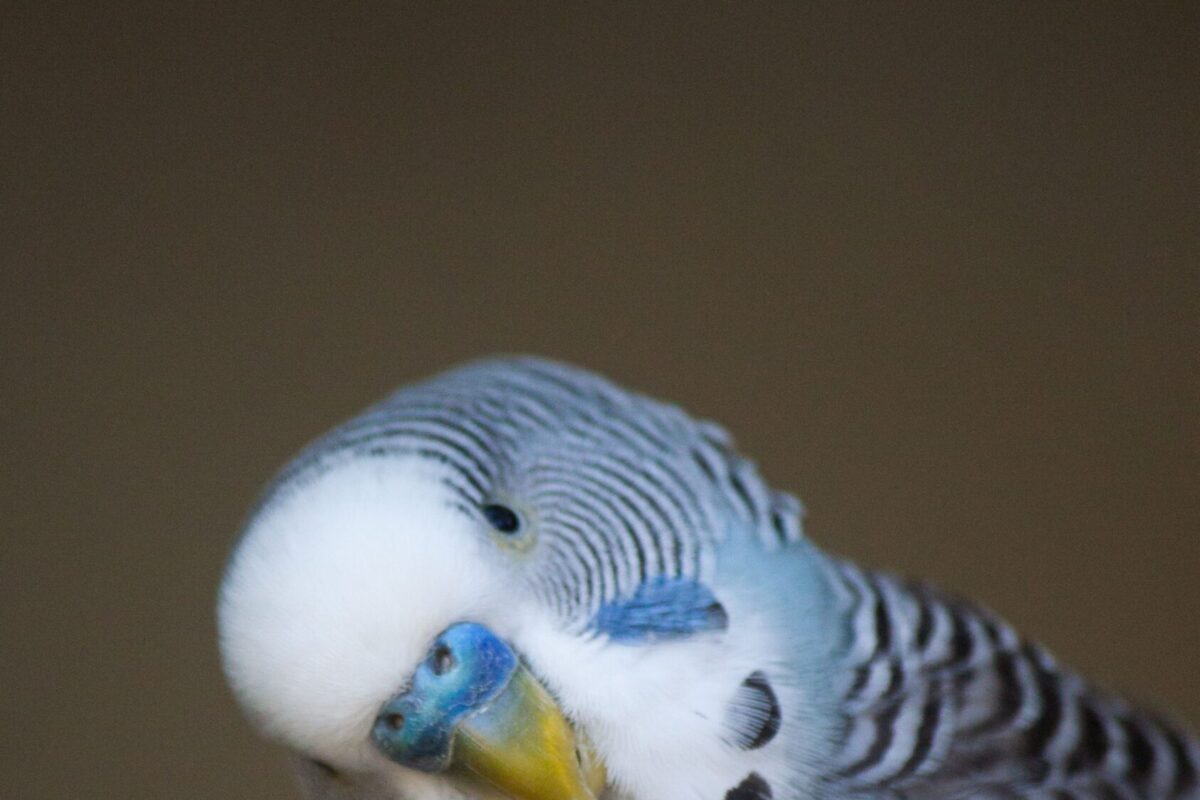
Budgies bite when they are scared, and a new bird will test your finger with its beak. A gentle exploratory nibble is not aggression. A hard bite usually means you moved too fast, cornered the bird, or ignored its warning signs — leaning away, eye pinning, a raised foot.
Never punish a bite. Do not shake your hand, shout, or flick the bird. Just go still, wait, and put the bird back on its perch calmly. Punishment teaches a budgie that hands really are dangerous, which is the opposite of taming.
Setbacks happen. A vet trip, a loud visitor, or a few days without handling can send a half-tame budgie backwards. Go back one step — hand in cage, millet, no demands — and the bird usually recovers faster than it learned the first time.
And no, you do not need to clip a budgie’s wings to tame it. Flight is how a budgie escapes fear, and a bird that can choose to come to you is a bird that actually trusts you. If anyone tells you clipping is required for taming, they are selling you a shortcut that costs the bird its confidence.
Frequently Asked Questions
How long does it take to tame a budgie?
It varies a lot. A young, hand-raised budgie may step up within days. A pet-shop adult may take weeks or a couple of months. Progress is measured in small steps — eating near your hand, then from your hand, then stepping up — not in calendar dates.
My budgie flies away every time I put my hand in. Am I doing it wrong?
Probably not — you are just early in the process. Keep your hand still, keep sessions short, and use millet. A budgie that moves away calmly is learning; a budgie that panics needs slower sessions and more distance.
Can I tame an older budgie, or only a young one?
Older budgies can absolutely be tamed. It usually takes longer, because the bird has more experience being wary of hands, but the same slow steps work. Patience matters more than the bird’s age.
Should I clip my budgie’s wings to make taming easier?
No. Clipping does not build trust, and it takes away the bird’s main way of feeling safe. A flighted budgie that chooses to come to you is genuinely tame. If you are unsure, talk to an avian vet about the pros and cons for your bird.
What do I do if my budgie bites me?
Stay calm and still, then set the bird back on its perch. Biting is nearly always fear. Look at what happened just before the bite — you probably moved too fast or cornered the bird — and slow down next time.
Related reading
- Budgie Care for Beginners: The Complete Starter Guide
- Why Does My Budgie Bite? Causes and Gentle Fixes
- 10 Signs Your Budgie Is Happy (And 5 Signs It Is Not)
- Why Does My Budgie Bob Its Head? Courtship, Excitement, and When to Watch Closer
Sources
- RSPCA — budgie care and handling advice
- Association of Avian Veterinarians — companion bird care guidance
- VCA Animal Hospitals — budgie behaviour and handling