

There is a particular kind of disappointment that every cat owner knows. You buy a toy — a nice one, with a price tag to match — and you bring it home, full of hope. Your cat sniffs it once, walks away, and spends the rest of the evening playing with the cardboard box it came in.
Cats don’t care about price tags. They care about movement, texture, and the chance to do what cats do: stalk, chase, pounce, and bat something around. And the good news is that the toys cats actually love are usually the cheap ones. Thirty dollars is a generous budget for cat toys — it buys several good toys, maybe a whole rotation of them, and the best cat toy of all is often free. This guide covers the types that are genuinely worth your money, the ones to skip, and how to keep a cat interested in toys she already owns.
The short answer: buy movement, not gadgets

The single most useful thing to understand about cat toys is that cats play by hunting. A toy works if it moves like prey — darting, hiding, rustling, twitching. A toy fails if it sits still, or if it’s too complicated for the cat to work out, or if it only entertains the human.
So the rule for a $30 budget is simple: spend it on toys that move, toys that make a sound, and toys that let your cat use her paws and teeth. Wand toys, balls, mice, crinkle toys, and puzzle feeders — these are the types that get played with. The expensive electronic toys with apps and coloured lights are usually the ones collecting dust by March.
What a $30 budget actually buys

Here’s the pleasant truth: $30 buys a lot of cat toys. A wand toy, a pack of toy mice, a crinkle ball or two, and a simple puzzle feeder will usually come in well under $30 — and that’s a full toy box, not a single toy. You don’t need to spend anywhere near $30 to give your cat a good week of play.
What the budget should do is give you room to choose. Instead of buying one $25 toy and hoping it’s the one, buy four or five different cheap ones and find out what your cat actually likes. Cats have preferences, just like people do. Some cats go mad for anything with feathers. Some only care about things that roll. Some want to wrestle with a kicker toy and nothing else. The only way to find out is to offer a few different types and watch what happens — and that’s exactly what a small budget is good for.
Wand toys: the one toy every cat should have

If you buy one thing from this guide, make it a wand toy. It’s a stick with a string and something dangly on the end — a feather, a piece of fabric, a little fish — and it’s the closest thing there is to a guaranteed good time for a cat.
A wand toy works because you control it, and because it moves like prey. You can make it dart behind the sofa, twitch under a cushion, hover in the air, or drag slowly across the floor. The cat stalks it, chases it, pounces on it, and catches it — the whole hunting sequence, in miniature, in your living room. No other toy gives your cat that full sequence.
Wand toys are also cheap — most cost only a few dollars — and ten minutes with one, once or twice a day, does more for a cat’s mood, weight, and behaviour than almost anything else you can buy. When the dangly end gets chewed through, you replace just that part, or the whole wand, for a few dollars.
One warning: never leave a wand toy out with the cat unsupervised. The string can tangle around a paw or a neck, and a determined cat can swallow string. Play with it together, then put it away. That’s the deal.
Balls, mice, and the rolling toys
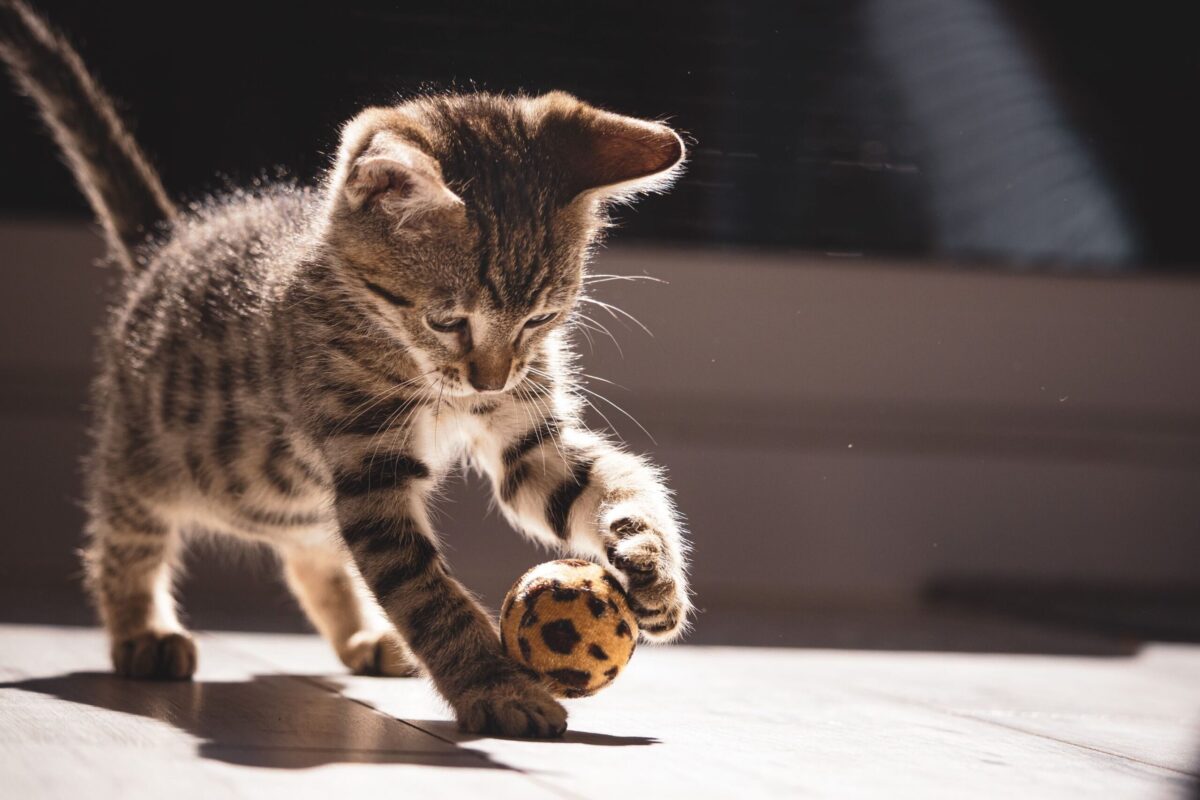
Some cats are ball cats. They want something that rolls — a ball, a toy mouse, a little jingly thing they can bat across the kitchen floor at three in the morning. Rolling toys are the simplest toys in this guide, and the most-played-with, because they let the cat play on her own terms: a quick bat, a chase, a pounce, and then she wanders off and comes back to it later.
Toy mice work especially well because they combine three things cats love: a shape they can grab, a texture they can bite, and a size they can carry. A pack of mice is cheap, and your cat will lose half of them under the fridge, which is why packs exist. Balls with bells inside are good for the same reason — the sound gives the cat something to chase, and you something to listen for when she’s playing at night.
The one thing to check with rolling toys is the size. A toy that’s too small can be swallowed, and a toy that’s too big can’t be picked up. A mouse-shaped toy about the size of a real mouse is about right. And avoid anything with glued-on eyes or whiskers that can be chewed off — a toy that sheds pieces is a toy that ends up in your cat’s stomach.
Crinkle toys and kickers

Crinkle toys. These are toys with a crinkly material inside — a ball, a pouch, a little tunnel — that makes a rustling sound when the cat touches it. Cats seem to love the sound, and they love the texture. Crinkle toys are cheap, they’re light enough to carry around, and they’re the kind of toy cats come back to again and again. They’re a good buy for a cat who likes to play alone.
Kicker toys. These are long, stuffed toys — usually a fish, or a banana shape, or a sausage — that a cat can grab with her front paws and kick with her back feet. It’s a behaviour called “bunny kicking,” and it’s a normal part of how cats play and hunt. A kicker toy gives your cat something safe to kick at, which is better than her kicking your arm. They’re cheap, they last well, and cats who like them really like them. If your cat is a wrestler, a kicker toy is the first thing to buy.
Puzzle feeders and treat toys
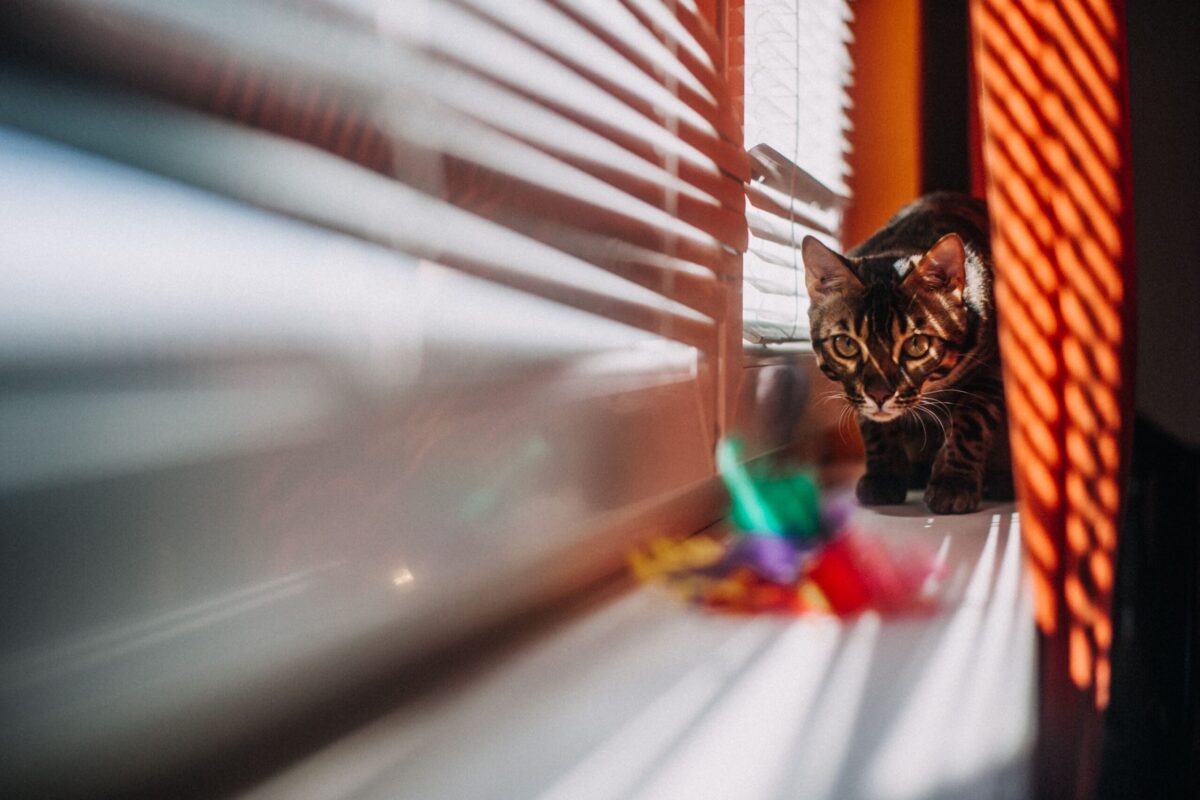
A puzzle feeder is a toy your cat has to work at to get food out of — a ball with a hole in it, a board with cups, a mat with folds to nose through. They slow down cats who eat too fast, they keep indoor cats busy, and they turn mealtimes into a game. And they’re one of the best buys in this whole guide, because they do two jobs at once: they feed your cat and they entertain her.
A simple puzzle feeder costs very little, and it doesn’t need to be complicated. In fact, the simplest ones are often the best — a ball your cat bats around to release a few pieces of dry food, or a mat with folds to hide treats in. If you had to choose between a complicated puzzle and a simple one, choose the simple one. A puzzle that’s too hard gets ignored. A puzzle that’s just hard enough gets played with every day. Our guide to cat puzzle feeders covers the different types and how to introduce one without frustrating your cat.
Treat balls work on the same principle, and they’re a good choice for a cat who needs to lose a little weight — you put some of her daily food in the ball instead of in the bowl, and she has to work for it. She eats more slowly, she moves more, and she’s busier. Just remember to count the treats as part of her daily food, not as well as it.
Catnip toys and silvervine
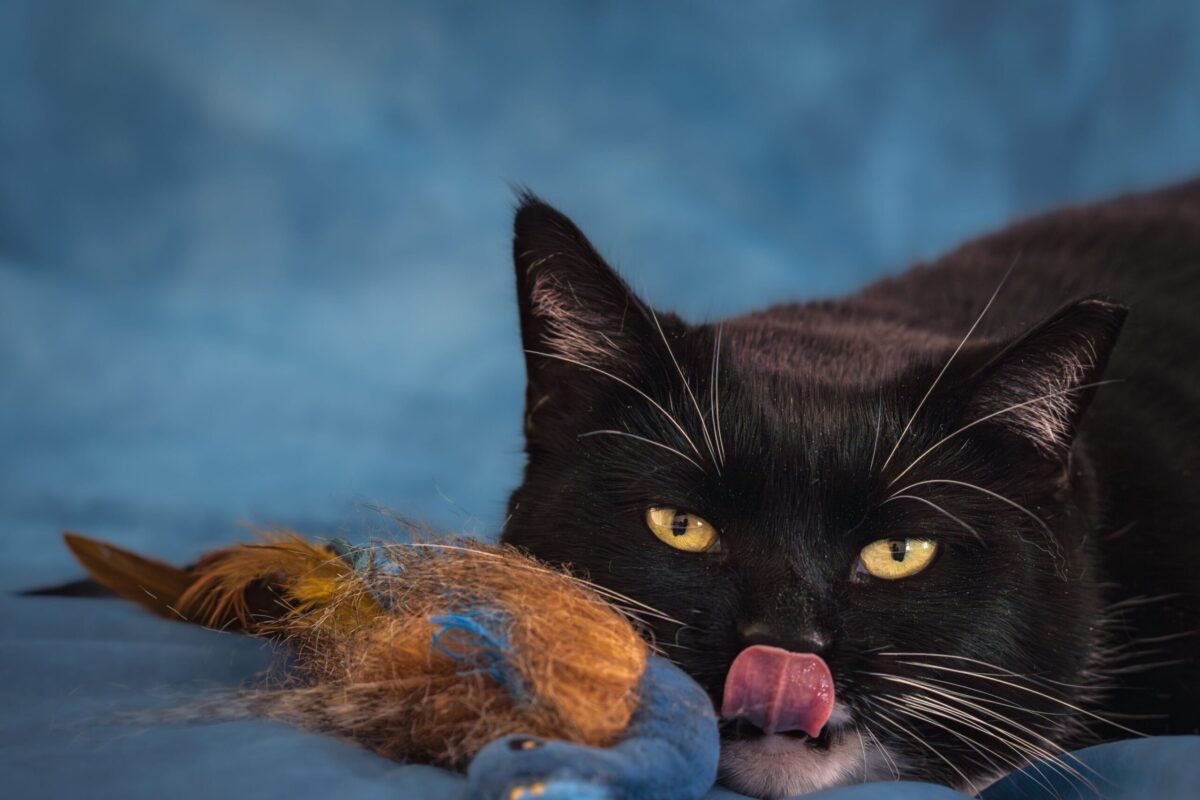
Catnip is the plant that makes many cats go slightly mad — rolling, rubbing, drooling, and then falling asleep. It’s harmless, it wears off in about ten minutes, and not every cat reacts to it — roughly a third of cats don’t respond to catnip at all. A toy stuffed with dried catnip is a cheap way to find out which kind your cat is.
Silvervine is a similar plant that’s worth knowing about, because some cats who don’t react to catnip do react to silvervine. It comes as a powder, or in toys, and it has the same short-lived, harmless effect. If your cat has never cared about catnip, silvervine is worth a try before you give up on plant-based toys entirely.
Don’t overdo it, though. A cat who has a catnip toy available all the time will stop reacting to it — the effect fades with constant exposure. Keep the catnip toys in a drawer and bring them out a few times a week. That’s when they work best.
What to skip

Electronic toys that need the cat to work them out. A toy that moves on its own sounds good, and sometimes it is — for ten minutes. But cats get bored with a toy that does the same thing every time, and a toy that needs charging or batteries is a toy that stops working when you forget. There are good electronic toys, but they’re the exception. In general, your money is better spent on toys that need you, not ones that need a charging cable.
Laser pointers as a main toy. A laser pointer is a red dot your cat can never catch, and for some cats that’s genuinely frustrating — they chase and chase and never get the satisfaction of catching anything. If you use one, end the game by pointing the laser at a real toy or a treat, so your cat gets to catch something. And never, ever use a laser pointer as your cat’s only toy. It’s a garnish, not a meal.
Toys with small glued-on parts. Eyes, bells on thin wire, feathers glued to a plastic base — anything that a cat can chew off and swallow. Read the packaging and look at the toy. If there’s something that looks like it could come off, assume your cat will get it off.
Anything that smells strongly of chemicals. A toy that smells of plastic fresh out of the packet will put off most cats. Wash new toys, or leave them out for a day before giving them to your cat. And if a toy smells strongly of perfume or chemicals even after washing, don’t give it to your cat — it’s not worth it.
Toy safety: the quick version
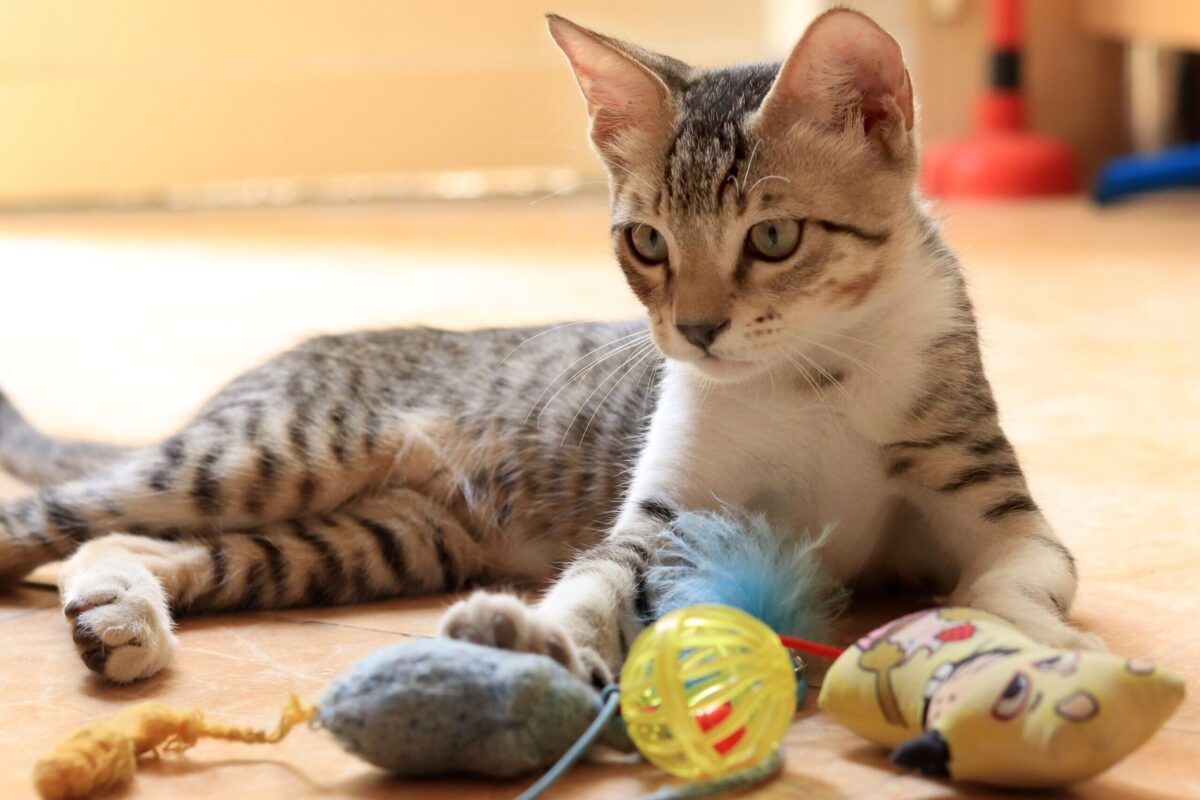
Most cat toys are safe, but a few simple checks keep them that way.
Check strings and cords. Strings longer than about fifteen centimetres are a risk if swallowed — and cats do swallow string. Wand toys should be put away after play. Toys with long dangling parts should be supervised, not left out overnight.
Check for damage. A toy that’s been chewed open, with stuffing coming out, is a toy to throw away. So is a toy with exposed wires, sharp edges, or parts coming loose. Check the toys you’re giving your cat the same way you’d check a child’s toys: if it looks like it could come apart, it will.
Supervise new toys. The first few times your cat plays with a new toy, watch what she does with it. Does she chew it apart? Does she try to eat pieces of it? Does she get tangled in it? If the answer is yes to any of those, the toy needs a different home, or a different cat.
Keeping a cat interested: rotation

A cat who has the same five toys out all the time will get bored of them — and it’s usually the owner’s fault, not the cat’s. Toys that are always available become furniture. Toys that appear and disappear stay interesting.
The fix is rotation. Keep half the toys in a drawer, and swap them every few days — a toy your cat ignored for a month will suddenly be fascinating again when it reappears. It’s the easiest trick in this guide, and it’s also how you make a $30 budget last: you don’t need new toys, you need to keep the ones you have interesting.
And play with your cat — a toy that’s been played with together is more interesting than one that’s been sitting on the floor. Ten minutes with a wand toy, once or twice a day, is the single best thing you can do with this guide. Our guide to scratching posts covers another way to keep your cat busy, and our guide to cat trees is worth a look if your cat likes height. If your cat spends a lot of time hiding, that’s a different question — our guide on why cats hide covers what’s normal and when hiding is a sign to pay attention to.
The free toys: boxes, paper, and the rest
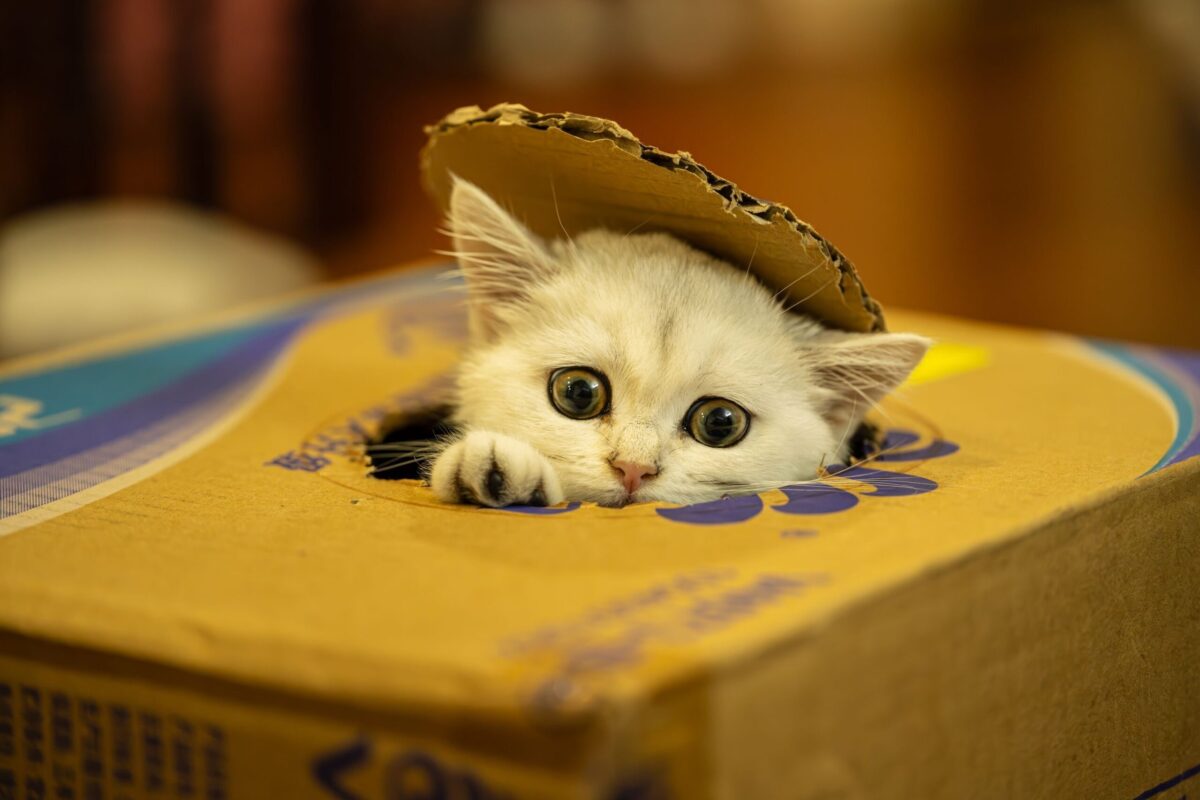
No guide to cat toys is complete without the honest truth: the best cat toys are often free. A cardboard box with a hole cut in it. A crumpled ball of paper. A paper bag — with the handles cut off first. A bottle cap to bat around. Cats love all of these, and they love them for the same reason they love the toys you buy: they move, they make a noise, and they can be stalked and pounced on.
Don’t be embarrassed about this. A cat playing with a box is a cat having a good time, and a good time is the point. The toys you buy should be the ones that add to that — the wand toy for play together, the puzzle feeder for mealtimes, the kicker for wrestling. Everything else is optional, and the box is free.
Frequently Asked Questions
How many toys does a cat need?
Not many. Four or five good toys, rotated, will keep most cats happy — and a cardboard box or a paper ball on top of that. What matters more than the number is the variety: something to chase, something to carry, something to wrestle, and something to work at for food. If your cat has one of each, she has enough.
Are cheap cat toys safe?
Yes, if you check them. The price doesn’t tell you whether a toy is safe — the construction does. Look for tight stitching, no glued-on parts, no long loose strings, and no small pieces that can be chewed off. A cheap toy that passes those checks is safer than an expensive toy that doesn’t.
Why does my cat ignore every toy I buy?
Usually one of three reasons. The toy doesn’t move like prey — it’s too still, or too complicated. The toy is always available, so it’s become boring — try rotation. Or your cat wants to play with you, not alone — try a wand toy and a ten-minute session. Some cats also just prefer free things: a box, a paper bag, a bottle cap. Let her choose.
How often should I replace cat toys?
When they’re damaged, or when your cat has stopped caring about them even after rotation. A toy with stuffing coming out, exposed wires, or parts coming loose should be thrown away immediately. Otherwise, toys last a long time — months, or years. Rotation is usually a better answer than replacement.
Is catnip safe for my cat?
Yes. Catnip is harmless and the effect wears off in about ten minutes. Not every cat reacts to it — roughly a third don’t — and kittens under about six months old usually don’t react either. If your cat doesn’t care about catnip, try silvervine, which affects some cats who ignore catnip. Use it a few times a week rather than leaving a catnip toy out all the time.
Should I leave toys out when I’m not home?
Rolling toys, balls, and mice are fine to leave out. Wand toys should be put away — the string is a risk. Puzzle feeders are good to leave out, especially if they have food in them. Check the toys for damage before you leave, the same as you would a child’s toys.
What’s the best toy for a kitten?
A wand toy and a small soft mouse are the best starting pair for a kitten. Kittens play hard, so check the toys daily for damage, and keep anything with small parts away until she’s older. A kitten who learns to play with toys — rather than with your hands — is a kitten who grows into a cat who knows what to bite and what not to. Keep your hands out of the game, and use a toy instead.