

You’re sitting on the sofa, reading a book, and you feel it. You look up, and there he is: your dog, sitting across the room, staring straight at you. Not blinking much. Not doing anything. Just watching. You go to the kitchen — he’s watching. You stand up — he’s watching. It’s a little unnerving, a little flattering, and very, very normal.
Dogs stare at their people constantly. It’s one of the most common behaviours owners ask about, and the answer is usually simple: your dog is watching you because you are the most interesting, most important thing in his world. But staring isn’t always the same thing. Sometimes it means something specific — a need, a question, a worry — and knowing the difference between a relaxed stare and a tense one is worth learning.
The short answer: he’s reading you

Dogs are better at reading human body language than almost any other animal. They watch our faces, our hands, our posture, and our movements all day, because that’s how they know what’s about to happen. Are you reaching for the lead? Are you heading to the kitchen? Are you about to sit down, or get up, or go out?
A dog who stares at you is a dog who’s paying attention. He’s watching for the small signals that tell him what comes next — the same way you’d watch a kettle if you were waiting for it to boil. You’re the source of everything good in his day, so of course he’s watching you.
It’s also worth knowing that staring at you is something dogs have learned to do because it works. A dog who stares at his owner tends to get a response — a look back, a word, a treat, a walk. Over time, the staring becomes a habit, because the habit keeps paying off. Our guide to dog body language explains how much of what dogs do is really communication, even when it looks like nothing at all.
The most common reasons dogs stare

He wants something. This is the most common reason by far. Food, a walk, a game, the door opening, a toilet break — a dog who wants something will often sit and stare at the person who can provide it. It’s not demanding in the way we think of demanding; it’s just the most direct way a dog has of asking. If your dog stares at you every evening at the same time, check the clock. There’s a good chance he’s staring because that’s when dinner usually happens.
He’s waiting for a cue. Dogs who’ve been trained — even lightly — spend a lot of time watching their owners for the next instruction. A dog who sits and stares at you during a walk may be waiting to be told which way to go. A dog who stares at you in the kitchen may be waiting to be told to sit, or to be given a job. It’s the same focus a working dog shows in the field, just applied to everyday life.
He’s showing affection. This one surprises people, but it’s real. When a dog gazes at his owner with soft eyes and a relaxed face, it can be a bonding behaviour — the same kind of eye contact that builds connection between people. Studies of dog-owner eye contact have found that mutual gazing is associated with bonding hormones in both dogs and their owners. Your dog isn’t just staring; in his own way, he’s connecting with you.
He’s bored. A dog with nothing to do will stare at you because you’re the most interesting thing in the room. If the staring comes with sighing, lying down and getting up again, or following you from room to room, boredom is a likely cause. A dog who has had a good walk, a play session, and something to chew will stare less — not because he loves you less, but because he has other things to occupy him.
He’s confused. A dog who doesn’t understand what you want from him will often stare at you, waiting for clarification. If you’ve just asked him to do something new, or if the situation has changed — a new routine, a new person in the house, a different walking route — the stare can be a dog saying, in the only way he can, “I’m not sure what you want me to do.”
He’s worried about something. A dog who is anxious will watch his owner closely, because his owner is his safe base. If the staring has increased recently — after a move, a new baby, a change in your working hours, or a loud event like fireworks — it may be a sign that your dog is feeling less secure than usual and is keeping you in sight for reassurance.
Relaxed staring vs tense staring

Not all staring is the same. The difference is in the rest of the body, and it’s worth learning to read.
A relaxed stare comes with a soft, loose body. The eyes are soft, the mouth is slightly open or relaxed, the ears are in their natural position, and the tail is still or wagging gently. The dog may blink slowly. This is the stare of a dog who is comfortable, curious, or hopeful. It’s the stare you see when your dog is waiting for dinner, or watching you read, or just enjoying being near you.
A tense stare — sometimes called a hard stare — is different. The body goes still. The eyes widen and fix on a target without blinking. The mouth closes. The ears may pin back or push forward. The tail goes stiff or still. This is not a relaxed dog. A hard stare can be a warning, a sign of fear, or a sign that the dog is about to react to something. If your dog gives a hard stare at a stranger, another dog, or a child, take it seriously and calmly move him away from whatever he’s staring at.
The same applies to staring at you. If your dog’s stare at you is relaxed, there’s nothing to worry about. If it’s tense — stiff body, fixed eyes, closed mouth — something is bothering him, and it’s worth working out what.
Staring at strangers and other dogs

Staring isn’t only something dogs do to their owners. A dog who stares fixedly at another dog or a stranger is usually communicating something more serious, and it’s worth understanding the difference.
Between dogs, a direct, fixed stare is a challenge — it’s rude in dog language, and it can escalate. If your dog locks eyes with another dog on a walk and goes stiff, that’s a signal to move him along calmly before it becomes a confrontation. A relaxed dog will glance at another dog and look away. A dog who can’t look away is a dog who’s decided this matters.
With strangers, a fixed stare can mean fear, uncertainty, or guarding. A dog who stares at a visitor and goes still is telling you he’s not sure about this person. Don’t force the interaction. Let the dog observe from a distance, and let him approach in his own time — or not at all.
Staring as part of play
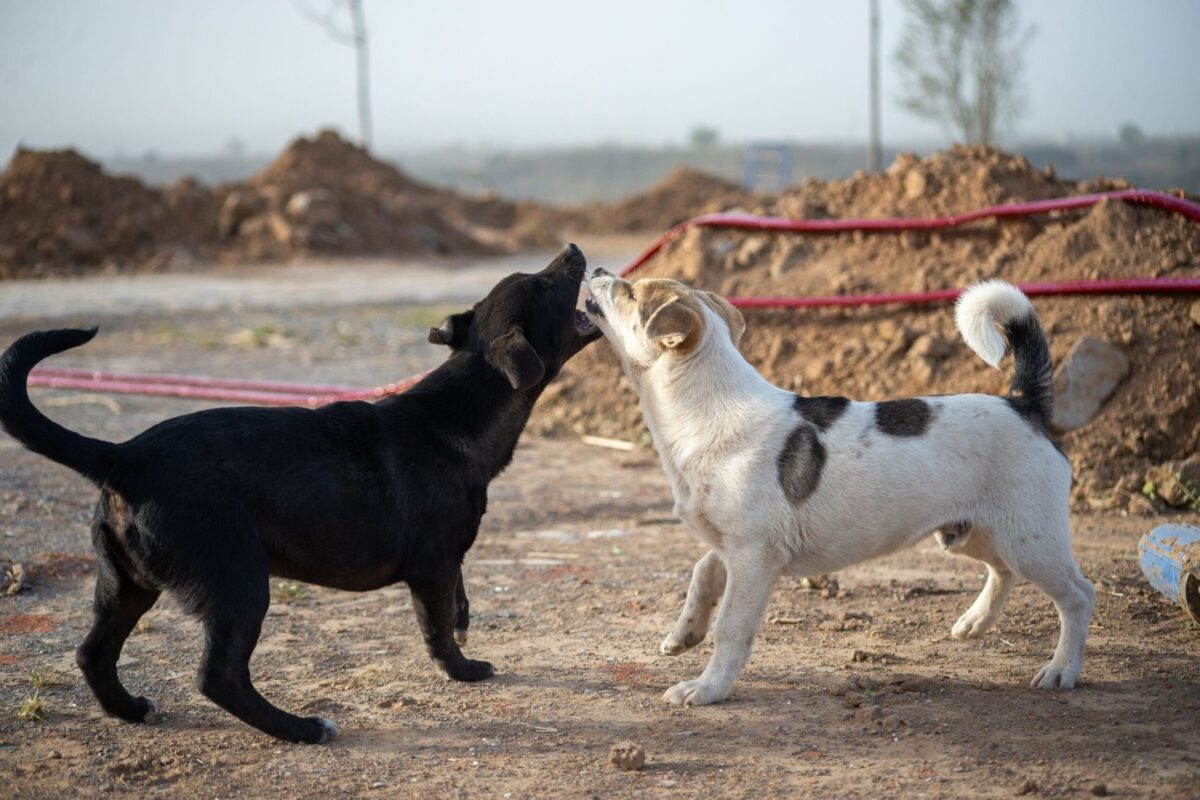
Staring shows up in play too, and it’s worth knowing what it looks like there, because play-staring is easy to mistake for something more serious.
When two dogs play, they’ll often pause and stare at each other for a moment before the next burst of chasing or wrestling. It’s part of the game — a kind of “are you ready?” check. The body language gives it away: loose, bouncy movements, play bows, wagging tails, and a stare that breaks quickly into movement. A dog who stares at you with the same loose, bouncy energy — maybe with a toy in his mouth, or with his front end down and his back end up — is inviting you to play, not challenging you.
The same applies to staring during training. A dog who is learning something new will often stare at his owner intently, waiting for the next cue. It’s focus, not defiance. If your dog stares at you during a training session with soft eyes and a wagging tail, he’s engaged and ready. That’s exactly what you want. The stare to worry about is the one with a stiff body and fixed eyes — and in play or training, that stare is rare.
When staring means something is wrong

Most staring is harmless. But there are a few situations where a change in staring behaviour is worth paying attention to.
A sudden increase. If your dog has always been a starer, that’s just who he is. But if a dog who never used to stare suddenly starts watching you constantly, something has changed. It could be a change in the household, a new routine, or a health issue — pain, vision loss, or hearing loss can all make a dog stay closer and watch more carefully. A dog whose sight is fading, for example, will watch his owner more because he’s the thing he can still track. If the change is sudden and comes with other changes — appetite, energy, mobility — a vet visit is a sensible step.
Staring at walls or into space. A dog who stares fixedly at a wall, a corner, or nothing at all — not at you, not at anything obvious — is different from a dog who stares at his owner. Occasional blank staring in an older dog can be part of ageing, but persistent staring at nothing, especially if it comes with other changes in behaviour, is worth mentioning to your vet. Our guide to why dogs tilt their heads covers another behaviour that looks cute but sometimes means something more.
Staring with other symptoms. A stare that comes with whining, pacing, panting, drooling, or restlessness is a dog who is trying to tell you something is wrong. It could be pain, nausea, anxiety, or a need to go outside urgently. If your dog is staring at you and whining at the same time, he’s almost certainly asking for something specific — and the fastest way to find out is to check the obvious things first: water, toilet, pain, fear. Our guide to why dogs whine breaks down what whining usually means.
What to do about it

For most dogs, staring needs no fixing at all. It’s normal, it’s harmless, and it’s part of living with a dog. But if the staring bothers you, or if it’s constant and intense, there are a few things that help.
Check the basics first. Is he hungry? Does he need the toilet? Is he bored? Has he had enough exercise today? Most staring has a simple cause, and the simple cause has a simple fix. A dog who has been walked, fed, and given something to do will stare less than a dog who hasn’t.
Give him something to do. A puzzle feeder, a chew, a sniffing game, or a training session gives your dog something to focus on besides you. Enrichment doesn’t just reduce staring — it makes a dog happier and more settled in general.
Teach a settle. If your dog stares at you because he wants something, teaching him to settle on his own bed is more useful than telling him to stop staring. Reward him for lying on his bed calmly, and gradually build up the time. The bed becomes a good place to be, and staring at you becomes less necessary.
Don’t stare back as a game. Some owners stare back at their dogs and laugh about it. That’s fine with a relaxed dog, but a prolonged staring contest can be uncomfortable for a dog who doesn’t understand the game. A soft look and a calm word is enough. You don’t need to out-stare your dog.
Respond to what he’s asking. If your dog stares at you at the same time every day and it’s dinner time, he’s not being strange — he’s being a dog with a good internal clock. Acknowledging the pattern and responding to it — a word, a pat, a treat — is often all he wants. Dogs stare because it works. If you respond, the staring has done its job.
Staring in puppies

Puppies stare even more than adult dogs, and for good reason. A puppy is learning everything about his world, and you’re the biggest, most important part of it. Puppies watch their owners constantly — how they move, where they go, what they do — because that’s how they learn the rules of the house.
Puppy staring is almost always relaxed and curious. The puppy is watching, learning, and bonding all at once. Most puppies grow out of the most intense staring as they mature and gain confidence, though some dogs stay watchful their whole lives. If your puppy stares at you a lot, it’s not a problem — it’s a puppy doing exactly what puppies are supposed to do.
Frequently Asked Questions
Why does my dog stare at me all the time?
Because you are the most important thing in his world. Dogs stare at their owners to read body language, to ask for things, to wait for cues, and to bond. A relaxed stare — soft eyes, loose body — is completely normal. It’s only a concern if the staring is new, sudden, or comes with a tense body and other changes in behaviour.
Is it bad if my dog stares at me?
No, not on its own. A relaxed stare is normal and harmless. It becomes something to pay attention to if the dog’s body is tense — stiff, still, eyes fixed without blinking — or if the staring is new and comes with other changes like appetite, energy, or mobility. A hard stare at a stranger or another dog is a warning signal and should be taken seriously.
What does it mean when my dog stares at me and whines?
He’s asking for something specific. The most common causes are needing the toilet, being hungry or thirsty, being in pain, or feeling anxious. Check the obvious things first — water, toilet, any sign of discomfort. If the whining and staring continue and you can’t find a cause, a vet visit is worth it.
Why does my dog stare at me when I eat?
Because eating is the most interesting thing you do, from a dog’s point of view. Food is the highest-value thing in his world, and a dog who has ever been given a scrap from the table has learned that staring at a person who is eating sometimes pays off. If you don’t want him to beg, the kindest approach is to ignore the staring completely — no eye contact, no words, no food — and reward him for settling elsewhere instead.
My dog stares at walls and into space. Should I worry?
Occasional blank staring, especially in an older dog, can be part of ageing. But persistent staring at nothing, particularly if it comes with other behaviour changes — confusion, restlessness, changes in sleep or appetite — is worth mentioning to your vet. A dog who stares at a wall and won’t respond to his name is different from a dog who stares at you.
Do dogs stare because they love you?
In a way, yes. When a dog gazes at his owner with soft eyes and a relaxed face, it’s a bonding behaviour — the same kind of eye contact that builds connection between people. It’s not the only reason dogs stare, and it’s not every stare, but the soft, relaxed gaze is genuinely a sign of attachment.