

You wake up at three in the morning. There’s a weight on your head, fur in your mouth, and a warm, purring cat curled up on your pillow – or, more precisely, on your face. You move her gently to the foot of the bed. Ten minutes later, she’s back.
If this sounds familiar, you’re not alone. Sleeping on their owner’s head is one of the most common – and most confusing – things cats do. It looks strange, it’s mildly inconvenient, and it’s also, from your cat’s point of view, completely logical. Your head is warm, it smells like you, it’s the highest point on the bed, and it’s the safest place she can find.
The short answer: warmth, scent, and safety

Cats choose sleeping spots the way you’d choose a hotel room: warmth first, safety second, comfort third. Your head ticks all three boxes, and it does it better than almost anywhere else in the house.
Warmth. Cats run warmer than humans, and they like it that way. A cat’s body temperature is higher than yours, and they seek out warm spots constantly — sunbeams, radiators, laptops, and, yes, your head. Your head gives off a lot of heat, and your hair traps it. For a cat, your pillow is one of the warmest places in the bed, and your head is the warmest part of the pillow.
Scent. Your head carries your scent more strongly than the rest of you. Cats navigate the world through smell, and your scent is the most familiar, most reassuring smell there is. Sleeping on your head is, in a sense, sleeping inside your scent. It’s the cat equivalent of pulling the blanket right up to your chin.
Safety. In the wild, cats sleep in high, sheltered places where they can see danger coming and nothing can creep up on them. Your head, on top of the bed, is the highest point available — and it’s guarded by a large, warm human who would notice if anything went wrong. From a cat’s point of view, there is no safer place in the house.
Bonding. Cats who sleep on or near their owners are showing trust. A cat who sleeps on your head is a cat who feels completely safe with you — safe enough to sleep in the most vulnerable position possible, on top of the person she trusts most. It’s a compliment, even if it doesn’t feel like one at three in the morning.
Why the head, and not the feet?

If warmth and safety are the reasons, why doesn’t your cat sleep on your feet? The feet are also warm, and they’re also on the bed. But the feet move. They twitch, they kick, they get cold under the blanket. The head, by comparison, stays mostly still, stays mostly warm, and stays mostly uncovered. It also has the advantage of being near your face, where your breathing and your scent are strongest.
There’s another factor: height. Cats prefer to sleep as high as they can. Your head is the highest point on the bed, and the bed is the highest comfortable surface in the bedroom. A cat who sleeps on your head is doing what cats have always done — finding the highest safe spot and claiming it.
Some cats rotate through the bed over the night — starting at the foot, moving to your side, and ending up on your head by morning. That’s normal too. As the night gets colder, the cat moves toward the warmest spot. Your head is the final destination.
Cats who sleep on heads — and cats who don’t

Not every cat sleeps on her owner’s head, and the ones who do tend to share a few traits. They’re usually the confident ones — the cats who are comfortable being close to people, who seek out company, and who aren’t easily startled. A nervous cat is unlikely to sleep on your head, because it’s too exposed: she’s right next to a large creature that moves, snores, and occasionally rolls over. The cats who choose your head are the cats who trust you completely.
Breed plays a part too, though it’s not a rule. The more social, people-oriented breeds — Ragdolls, Siamese, Burmese, Maine Coons — are more likely to sleep on or near their owners than the more independent breeds. But personality matters more than breed. Plenty of mixed-breed cats are devoted head-sleepers, and plenty of Ragdolls prefer the foot of the bed.
And then there are the cats who don’t sleep on you at all. A cat who sleeps in her own bed, on a chair, or in another room isn’t less affectionate — she just has different preferences. Some cats run warmer than others and don’t need the extra heat. Some cats are light sleepers who are disturbed by your movement. Some simply prefer their own space. None of that means she loves you less. Cats show affection in many ways — headbutts, slow blinks, following you around, sitting near you — and sleeping on your head is only one of them. Our guide to why cats headbutt explains another of the quiet ways cats say they trust you.
If your cat used to sleep on your head and has stopped, it’s worth noticing — not because it’s necessarily a problem, but because a change in sleeping habits is one of the ways cats tell you something has changed. It could be the weather getting warmer, a new bed she prefers, or a health issue that makes her less comfortable. If the change comes with other changes — appetite, energy, grooming — mention it to your vet.
Is it a problem?
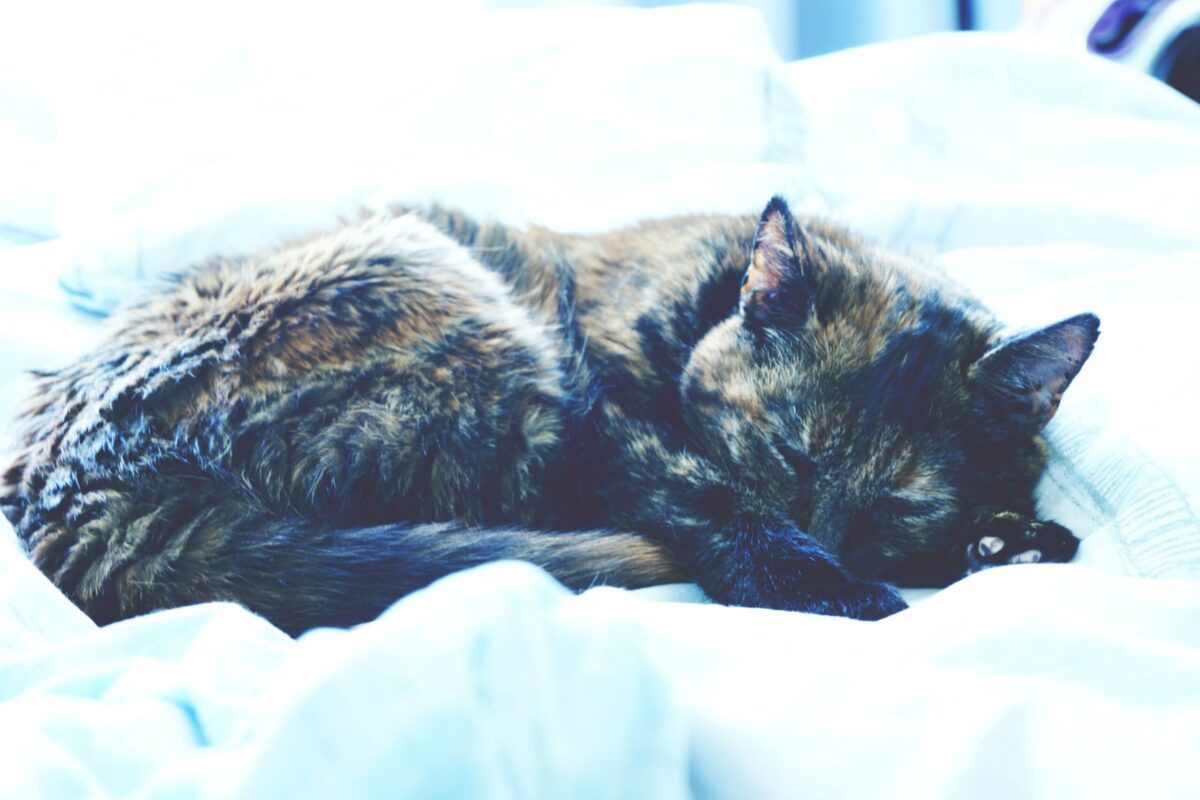
For most cats and most owners, sleeping on the head is harmless — just mildly annoying. But there are a few situations where it’s worth thinking about.
If it disturbs your sleep. A cat on your head can mean broken sleep, especially if she kneads, purrs loudly, or moves around. If you’re waking up tired, it’s worth gently redirecting her. This isn’t about punishment — it’s about giving her a better alternative.
If you have allergies or asthma. A cat sleeping on your face puts fur and dander right where you breathe. If you have allergies or asthma, this is a genuine health consideration, and it’s worth keeping the cat off your pillow — even if she disagrees.
If the cat is suddenly doing it more. A cat who has always slept on your head is just being herself. But a cat who suddenly starts sleeping on your head much more than usual — especially if it comes with other changes in appetite, energy, or behaviour — may be seeking extra warmth or reassurance because something has changed. If the change is sudden and comes with other symptoms, a vet visit is worth it.
For most people, though, the only real problem is the fur in the mouth and the weight on the head. And both of those are manageable.
How to move her without a nightly battle

If you’d rather your cat slept somewhere else, the trick is not to push her away — it’s to make somewhere else more appealing. Cats don’t respond to being told no. They respond to better options.
Give her a warm spot of her own. A heated cat bed, or a regular cat bed placed on a warm surface near your bed, gives her the warmth she’s looking for without your head being involved. Place it at the same height as your bed if you can — on a bedside table, for example. Height matters to cats, and a bed on the floor is a poor substitute for a bed at pillow height. Our guide to cat beds covers the warm spots cats actually use.
Put something that smells like you there. An old T-shirt you’ve slept in, placed in her bed, gives her your scent without your head. It sounds odd, and it works surprisingly well.
Be consistent. If you move her off your head every night, but let her stay on the nights you’re too tired to bother, she’ll keep trying — because sometimes it works. Cats are persistent precisely because inconsistent rules teach them that trying is worth it. Pick a spot, move her there gently every time, and give her a quiet stroke when she settles there.
Close the bedroom door. If nothing else works and your sleep is genuinely suffering, closing the bedroom door is a fair option. Your cat will complain about it — probably loudly, and probably for a few nights. But she’ll adjust. Cats are adaptable, and a cat who can’t get into the bedroom will find another warm spot. It’s not cruel; it’s a boundary. Just make sure she has water, a litter tray, and a comfortable place to sleep outside the bedroom.
Never punish her for it. Scolding, spraying, or pushing a cat off the bed doesn’t teach her to sleep elsewhere. It teaches her that the bed is a stressful place, which usually makes the behaviour worse — or makes her more anxious in general. Gentle redirection, every time, is the approach that works.
Sleeping positions and what they mean
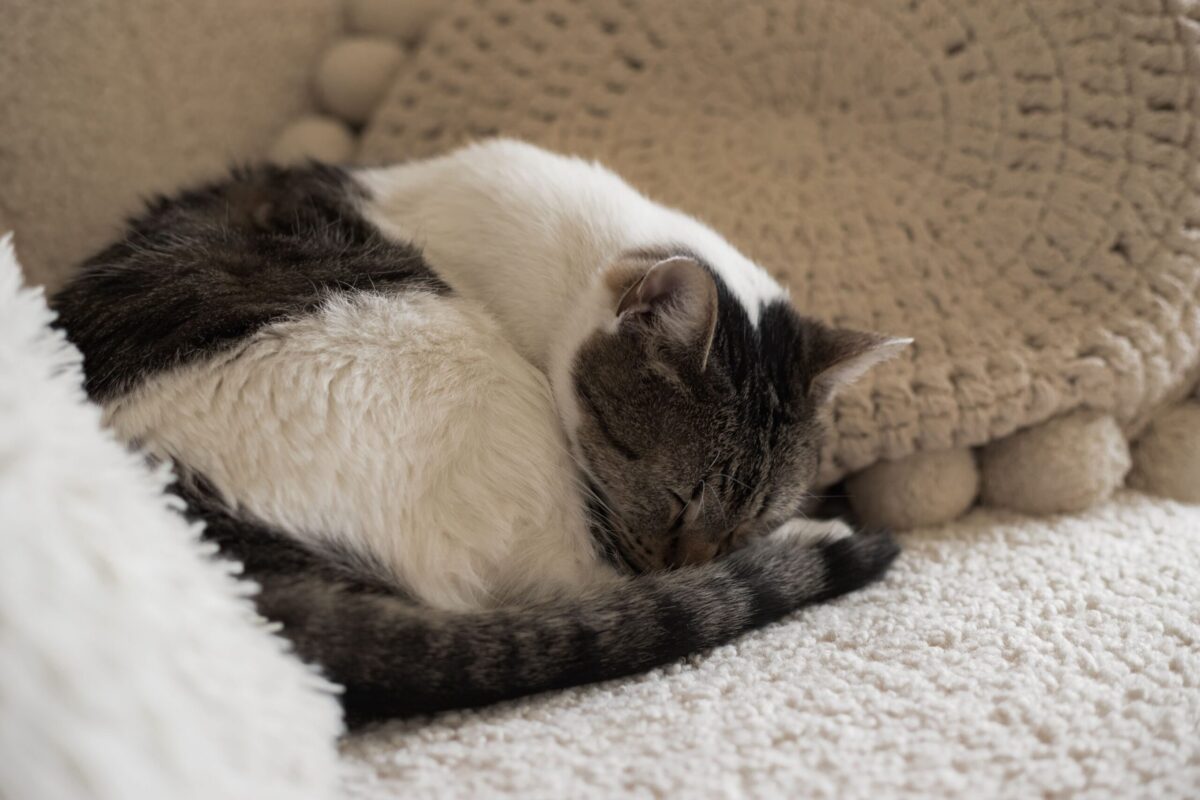
A cat who sleeps on your head is usually curled up tight, which is itself a sign of contentment — a cat who curls into a ball is conserving heat and feeling safe. But cats sleep in many positions, and each one says something about how they’re feeling.
A cat stretched out on her side is relaxed and warm. A cat on her back with her belly showing is very relaxed — though it doesn’t mean she wants a belly rub. A cat curled nose-to-tail is keeping warm. A cat who sleeps with her eyes half open is resting lightly, not deeply asleep. Our guide to cat sleeping positions explains the full range and what each one usually means.
The head-sleeping position is really just the curled-up position applied to the warmest, highest spot available. It’s not a separate behaviour — it’s the same instinct, pointed at your pillow.
Cats and sleep: the bigger picture

Cats sleep a lot — far more than dogs, and far more than us. An average adult cat sleeps twelve to sixteen hours a day, and kittens and older cats sleep even more. That’s normal, and it’s not laziness. Cats are built for short bursts of intense activity — hunting, playing, exploring — followed by long periods of rest. Our guide to why cats sleep so much explains the biology behind the naps.
That much sleep means the sleeping spot matters a lot to a cat. She’ll spend more hours in it than anywhere else in the house, so she chooses it carefully. Your head wins because it’s warm, safe, high, and smells like you. It’s not random, and it’s not spiteful. It’s a cat making a sensible decision about where to spend sixteen hours a day.
Cats are also most active at dawn and dusk — the twilight hours when their wild ancestors hunted. That’s why a cat who sleeps on your head may also wake you at five in the morning with a paw on your face. She’s not being rude. Her internal clock says it’s time to be active, and you’re the nearest warm thing to announce it to. If your cat also wakes you up at night, our guide to getting your cat to sleep with you covers the routines that help cats settle through the night.
When the head-sleeping is new

A cat who has always slept on your head is simply a cat with a habit. But a sudden change is worth noticing, because cats change their sleeping habits for reasons.
She’s cold. If the weather has turned, or if you’ve turned the heating down, your cat may be seeking extra warmth. A warmer bed, or a blanket over her usual spot, may be all it takes.
She’s anxious. A new pet, a new baby, building work, a change in your routine — anything that makes a cat feel less secure can push her toward the safest, warmest spot she knows. Your head. If she’s also hiding more, eating less, or over-grooming, the anxiety is the thing to address, not the sleeping spot.
She’s unwell. Cats who feel unwell often seek warmth and closeness more than usual. If the head-sleeping is new and comes with other changes — appetite, energy, litter box habits, grooming — a vet visit is the right next step. Our guide to warning signs in cats covers the signs that mean a prompt call to the vet, and a change in sleeping habits is one of the things on the list.
She’s getting older. Older cats sleep more, feel the cold more, and seek comfort more. A senior cat who starts sleeping on your head may just be an older cat who wants warmth and reassurance. That’s not a problem — it’s a cat telling you what she needs.
Frequently Asked Questions
Why does my cat sleep on my head and not my partner’s? Usually because of warmth, scent, or habit. Your head may be warmer, your hair may trap more heat, or your cat may simply have bonded more closely with you. Cats often choose one person as their primary attachment, and that person’s head is the prize. It’s not a rejection of your partner — it’s a preference, and preferences in cats are rarely fair.
Is it safe to let my cat sleep on my head? For most healthy adults, yes. The main concerns are disturbed sleep, fur in your face, and allergies. If you have asthma or allergies, it’s better to keep the cat off your pillow. There’s no health risk from the cat herself — she’s clean, she’s warm, and she’s not going to suffocate you. The bigger risk is to your sleep quality, and that’s a decision for you.
How do I stop my cat sleeping on my head? Give her a better alternative: a warm bed at the same height as yours, near your bed, with something that smells like you in it. Move her there gently every night, and be consistent. Don’t punish her — just redirect her. If nothing works and your sleep is suffering, closing the bedroom door is a fair option, as long as she has water, a litter tray, and a comfortable spot outside.
Why does my cat sleep on my face? Same reasons as the head: warmth, scent, and safety. Your face is the warmest, most scent-rich part of you, and a cat who sleeps on your face is a cat who wants to be as close to you as physically possible. If it’s the face specifically rather than the head, it’s usually because that’s where the warmth and the breathing are. Gently moving her to your chest or your side usually works — she still gets the warmth and the closeness, and you get to breathe.
My cat only started sleeping on my head recently. Why? Something has changed. It could be the weather getting colder, a change in the household, a new source of stress, or a health issue that makes her seek extra warmth and reassurance. Check for other changes — appetite, energy, grooming, litter box habits — and if there are any, mention them to your vet. If nothing else has changed, it’s probably just the season or a new habit.
Do all cats sleep on their owner’s head? No. Some cats prefer the foot of the bed, some prefer a chair in the corner, and some prefer not to sleep near people at all. It depends on the cat’s personality, how bonded she is with you, and how warm the rest of the house is. A cat who doesn’t sleep on your head isn’t less affectionate — she just has different preferences. Cats who do sleep on your head are usually the confident, bonded, warmth-seeking type.